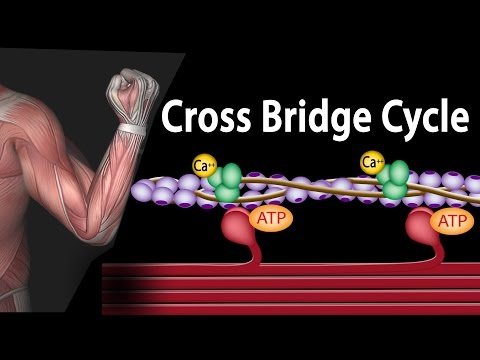
Muscle Contraction - Cross Bridge Cycle, Animation.
Muscle Contraction Mechanism
Overview of Muscle Contraction
- Muscle contraction is fundamental to all skeletal movements, involving muscle fibers made up of repetitive units called sarcomeres.
- Each sarcomere consists of overlapping thin (actin) and thick (myosin) filaments; contraction occurs as these filaments slide past each other, a process described by the sliding filament theory.
Initiation of Muscle Contraction
- The contraction begins when muscle fibers receive stimulation from a nerve impulse, leading to the release of calcium ions.
- Calcium ions bind to troponin units on actin myofilaments, displacing tropomyosin and exposing myosin binding sites for interaction with myosin heads.
Cross-Bridge Cycling
- Myosin heads initially bound to ADP and phosphate release these molecules upon binding to actin, facilitating the gliding motion between filaments.
- As myosin heads move, they release ADP; however, this motion ceases when ATP binds to the myosin heads, breaking the bond with actin.
Energy Dynamics in Muscle Contraction
- The binding of ATP leads to its decomposition into ADP and phosphate, storing energy in the myosin heads for subsequent contractions.