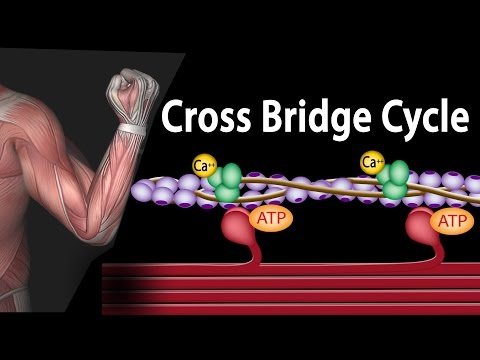
Muscle Contraction - Cross Bridge Cycle, Animation.

Muscle Contraction - Cross Bridge Cycle, Animation.

Muscle Contraction Mechanism

Overview of Muscle Contraction

  • Muscle contraction is fundamental to all skeletal movements, involving muscle fibers made up of repetitive units called sarcomeres.
  • Each sarcomere consists of overlapping thin (actin) and thick (myosin) filaments; contraction occurs as these filaments slide past each other, a process described by the sliding filament theory.

Initiation of Muscle Contraction

  • The contraction begins when muscle fibers receive stimulation from a nerve impulse, leading to the release of calcium ions.
  • Calcium ions bind to troponin units on actin myofilaments, displacing tropomyosin and exposing myosin binding sites for interaction with myosin heads.

Cross-Bridge Cycling

  • Myosin heads initially bound to ADP and phosphate release these molecules upon binding to actin, facilitating the gliding motion between filaments.
  • As myosin heads move, they release ADP; however, this motion ceases when ATP binds to the myosin heads, breaking the bond with actin.

Energy Dynamics in Muscle Contraction

  • The binding of ATP leads to its decomposition into ADP and phosphate, storing energy in the myosin heads for subsequent contractions.
Video description

(USMLE topics) Molecular basis of the sliding filament theory (skeletal muscle contraction) - the cross bridge cycle. Purchase a license to download a non-watermarked copy of this video on AlilaMedicalMedia(dot)com Voice by: Sue Stern ©Alila Medical Media. All rights reserved. Muscle contraction is at the basis of all skeletal movements. Skeletal muscles are composed of muscles fibers which in turn are made of repetitive functional units called sarcomeres. Each sarcomere contains many parallel, overlapping thin (actin) and thick (myosin) filaments. The muscle contracts when these filaments slide past each other, resulting in a shortening of the sarcomere and thus the muscle. This is known as the sliding filament theory. Cross-bridge cycling forms the molecular basis for this sliding movement. - Muscle contraction is initiated when muscle fibers are stimulated by a nerve impulse and calcium ions are released. - To trigger muscular contraction, the troponin units on the actin myofilaments are bound by calcium ions. The binding displaces tropomyosin along the myofilaments, which in turn (and) exposes the myosin binding sites. - At this stage, the head of each myosin unit is bound to an ADP and a phosphate molecule remaining from the previous muscular contraction. - Now, the myosin heads release these phosphates and bind to the actin myofilaments via the newly exposed myosin binding sites. - In this way, the actin and myosin myofilaments are cross-linked. - The two myofilaments glide past one another, propelled by a head-first movement of the myosin units powered by the chemical energy stored in their heads. As the units move, they release the ADP molecules bound to their heads. - The gliding motion is halted when ATP molecules bind to the myosin heads, thus severing the bonds between myosin and actin. - The ATP molecules bound to myosin are now decomposed into ADP and phosphate, with the energy released by this reaction stored in the myosin heads, ready to be used in the next cycle of movement. - Having been unbound from actin, the myosin heads resume their starting positions along the actin myofilament, and can now begin a new sequence of actin binding. - Thus, the presence of further calcium ions will trigger a new contraction cycle