ASD_Lecture 20
Understanding Template Method Pattern
Introduction to Template Method
- The discussion begins with an overview of the Template Method pattern, described as a method that is final and exists within an abstract class. This class may contain some implementations while others are left abstract.
Example Explanation
- An example is introduced where a superclass controls certain functionalities, indicating that modifications cannot be made directly to the existing methods in this superclass.
Class Hierarchy and Control
- The speaker explains how subclasses inherit from the superclass, emphasizing that each subclass has control over its own behavior while adhering to the structure defined by the superclass.
Design Principles
- The importance of good design principles is highlighted, particularly focusing on maximizing reuse (maximal reuse). Changes in one part of the system should not necessitate changes across multiple classes.
Modification Challenges
- It’s noted that if modifications are needed, they must occur within specific classes rather than altering shared components. This encapsulation helps maintain system integrity.
Implementing Changes in Subclasses
Object Creation and Management
- Objects created under this pattern are considered new instances; thus, any changes or additions require careful management to avoid disrupting existing functionality.
Information Distribution Across Classes
- A challenge arises when information related to operations is distributed across multiple classes, which can complicate design and implementation efforts.
Abstract Class Responsibilities
- The abstract class serves as a template for subclasses but does not allow direct modification. Instead, it delegates responsibilities to its subclasses for specific implementations.
Modifying Template Methods
Allowing Modifications through Hooks
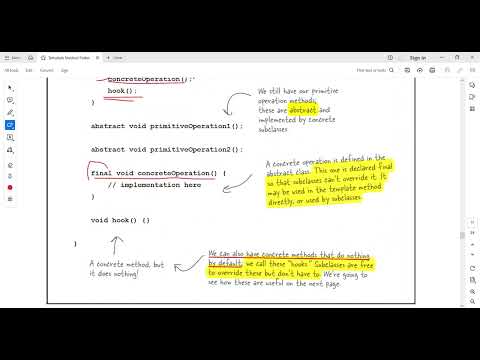
- The concept of hooks is introduced as a way for subclasses to modify behaviors without changing the template method itself. This allows flexibility while maintaining structure.
Concrete Operations Definition
- Concrete operations are defined within the abstract class but can be overridden in subclasses. This provides both guidance and freedom for subclass implementations.
Practical Application of Hooks
Overriding Behavior Restrictions
- While subclasses can override certain behaviors, there are restrictions on modifying core functionalities defined in the abstract class.
Flexibility with Empty Implementations
- Subclasses have the option to leave hook methods empty or provide their own implementation based on specific needs without enforcing mandatory behavior changes across all subclasses.
Conclusion: Benefits of Using Template Method Pattern
Enhancing Code Maintainability
- By using this pattern effectively, developers can enhance code maintainability and reduce redundancy by centralizing common logic while allowing customization at subclass levels.
This structured approach ensures clarity regarding key concepts discussed throughout the transcript while providing timestamps for easy reference back to specific points in time during playback.
User Input Handling and Design Principles
Enhancing User Input Processing
- The speaker discusses the implementation of user input handling, emphasizing the importance of reading customer responses effectively. This involves creating a system that allows for dynamic adjustments based on customer feedback.
- A key feature mentioned is the ability to either invoke or not invoke an "add command" based on the customer's input, showcasing flexibility in response handling.
- The speaker reflects on previous limitations where certain commands were mandatory, highlighting improvements that allow for optional modifications in user interactions.
Implementing Default Methods and Customer Options
- Introduction of a hook method with a default value set to true, which can be modified by customers if they choose not to use it. This demonstrates adaptability in design.
- The option provided through this hook method aligns with design principles that prioritize user customization and control over their experience.
- The speaker encourages exploration of these design principles further, suggesting they are foundational for effective user interface development.