Ecologia - Aula 01 - Introdução à ecologia
Introduction to Ecology
Overview of the Course
- Wellington introduces the first class of the Ecology discipline, emphasizing its connection with previous subjects, particularly sustainability.
- The course aims to deepen understanding of essential concepts for aspiring ecologists and ecology educators.
Life in the Universe
- A significant scientific discovery was made regarding a planet outside our solar system that may support life due to its rocky nature and suitable distance from its star.
- The existence of liquid water is highlighted as a fundamental requirement for life on Earth, linking it to Earth's position in the solar system.
Planetary Movements and Seasons
Understanding Earth's Dynamics
- The two main movements of Earth—rotation and translation—are explained, leading to day/night cycles and seasonal changes.
- Seasonal variations are attributed not to distance from the sun but rather to Earth's axial tilt of 23 degrees.
Current Seasonal Context
- Wellington notes that while it is winter in the Southern Hemisphere, it is summer in the Northern Hemisphere, affecting human activities like travel.
Ecosystems and Their Components
Definition of Ecosystems
- An ecosystem consists of communities of organisms (plants, animals, microorganisms) interacting with abiotic elements such as sunlight, atmospheric gases, and soil.
Community Dynamics
- Each biological community comprises various populations that exhibit dynamics like growth rates and mortality. For example, he mentions the population dynamics of wolves (lobo guará).
Levels of Biological Organization
Hierarchical Structure
- Life is organized into levels ranging from individual organisms through systems (organs/tissues/cells), up to entire biospheres.
Focus on Ecological Study
- The study will emphasize interactions at all levels within ecosystems while considering human impacts on these systems.
Energy Flow in Ecosystems
Importance of Energy
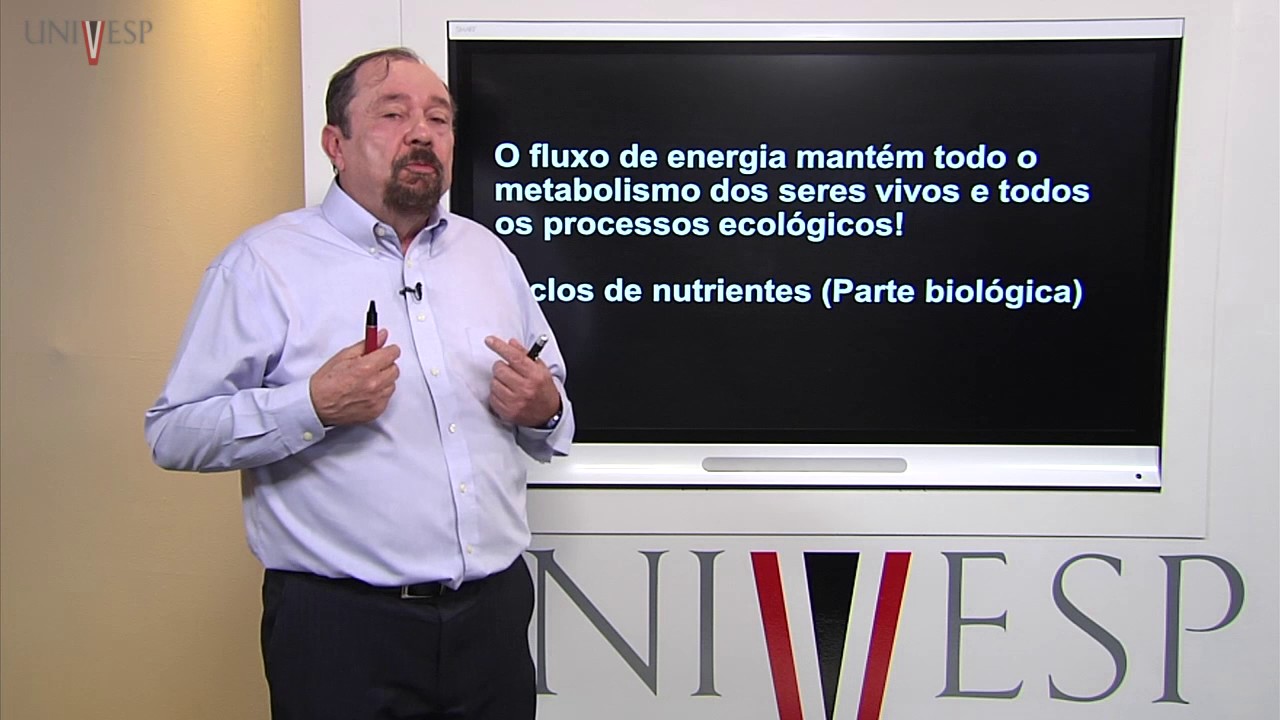
- All biological processes depend on energy; living organisms maintain complexity through energy flow primarily derived from solar energy captured by plants.
Trophic Levels Explained
- Chlorophyll plays a crucial role in converting solar energy into organic molecules (like sugars), which are then transferred through food chains.
Energy Transfer Efficiency
Understanding Energy Flow and Nutrient Cycles
The Role of Energy in Nutrient Cycles
- Energy flow is crucial for maintaining higher trophic levels, which will be explored in future lessons.
- Photosynthesis serves as the primary entry point for carbon into living organisms, where plants absorb CO2 from the atmosphere and grow.
- Carbon transitions through the food chain, moving from plants to herbivores and eventually returning to the atmosphere upon decomposition.
- Human activities significantly disrupt nutrient cycles; for instance, deforestation not only destroys forests but also releases substantial amounts of carbon into the atmosphere.
Impact of Human Activities on Carbon Cycle
- The burning of fossil fuels contributes to increased atmospheric CO2 levels, leading to global warming by trapping solar energy.
- Evidence shows that global warming is occurring, with potentially severe consequences discussed in future classes about ecosystem changes.
Biodiversity and Extinction Threats
- Numerous species are facing extinction globally; examples include well-known Brazilian species like the maned wolf and blue macaw.
- Ecological studies have cataloged threatened species, highlighting the importance of biodiversity conservation efforts.
Climate Influence on Ecosystem Distribution
- Life distribution correlates with climatic zones; equatorial regions support greater biodiversity due to abundant water and sunlight.
- Variations in climate across latitudes lead to diverse ecosystems influenced by energy availability and water resources.
Factors Limiting Population Growth
- Climate is a limiting factor affecting organism development; other local components also play significant roles in population dynamics.
- Biological history impacts species distribution; for example, antelopes from Africa cannot thrive in Brazil due to evolutionary differences.
Population Dynamics and Growth Curves
- Population growth follows a characteristic curve influenced by environmental resistance that limits exponential growth potential.
- Future lessons will delve deeper into population dynamics and factors affecting growth limitations.
Brazil's Diverse Biomes
- Brazil hosts various biomes including the Amazon rainforest, cerrado savanna, Atlantic forests, Pampas grasslands, caatinga desert regions, and rich aquatic ecosystems.
- The country's vast freshwater resources contribute significantly to its unique flora and fauna diversity.
Ecology: A Scientific Discipline
Definition and Scope of Ecology
- Ecology is defined as a science that investigates the environment of living beings, focusing on their distribution, abundance, and interactions.
- It encompasses the study of relationships among living organisms and between them and their environment, highlighting the processes resulting from these interactions.
Historical Context
- The term "ecology" derives from the Greek words "oikos" (house or environment) and "logos" (study or knowledge), coined in the 19th century by Ernst Haeckel.
- Despite being a relatively recent field—less than 200 years old—ecology has established a substantial database that informs decision-making in society.
Objectives of Ecological Science
- The primary goal of ecology is to generate knowledge that allows for hypothesis testing, predictions, and generalizations about ecological phenomena.
- Understanding biological knowledge aids in exploring life beyond Earth by identifying necessary conditions for life found on our planet.
Application of Ecological Knowledge
- Knowledge about nutrient cycles and energy flows can guide governments in making informed decisions, such as limiting carbon emissions.