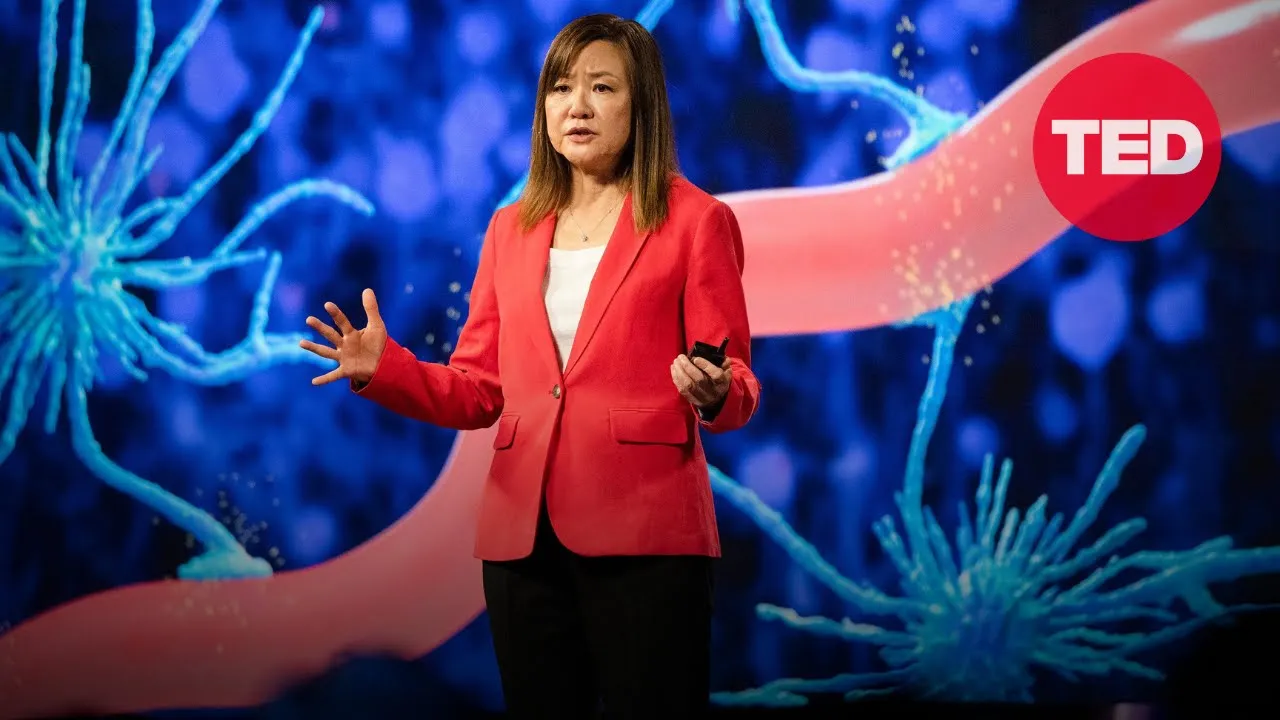
Could We Treat Alzheimer's with Light and Sound? | Li-Huei Tsai | TED
Introduction
The speaker introduces herself and the topic of her talk, which is about gamma waves and their potential to treat Alzheimer's disease.
Brainwaves
The speaker explains that the brain generates waves with different frequencies to transmit information and thoughts by coordinating the activity of nerve cells. She focuses on gamma waves, which are important for synchronizing brain activity to process new information from the senses and for learning and memory.
- Gamma waves at 40 hertz have reduced power and synchrony in people with Alzheimer's disease.
- We need to find a way to boost these gamma waves artificially to treat Alzheimer's disease.
Boosting Gamma Waves
The speaker discusses how she and her colleagues at MIT tried different approaches to entrain or stimulate increased gamma waves in mice engineered to model Alzheimer's disease.
- They found that showing mice lights blinking at 40 hertz or placing buzzing sound at 40 hertz creates a 40-hertz disco that increases the power and synchrony of these waves across the brain.
- Mice exposed to gamma light and sound stimulation had major reductions in protein build-ups, amyloid plaques, and tau tangles that are hallmarks of Alzheimer's progression.
- The stimulation preserved more connections or synapses that bind nerve cells into circuits.
- More cells survived, so the brain decayed less.
Conclusion
The speaker concludes by summarizing how light and sound stimulation can help treat Alzheimer's disease in mice engineered to model this disease.
- Light and sound stimulation produced profound benefits in mice engineered to model this disease.
- These physical differences resulted in better performance on learning and memory tests than untreated mice did.
Gamma Wave Stimulation and Alzheimer's Disease
Li-Huei Tsai discusses the potential of gamma wave stimulation in treating Alzheimer's disease. She explains how gamma waves are important for brain function and how their impairment can lead to the development of Alzheimer's disease. She also shares her team's findings on the effectiveness of gamma wave stimulation in mice and humans.
The Brain and Gamma Waves
- The brain has immune cells known as microglia that maintain health by removing waste.
- Microglia change their form and activity following gamma wave stimulation.
- Blood vessels in the brain respond to gamma wave stimulation by widening their diameters, increasing blood flow, which may play a key role in flushing out waste.
Human Testing
- Li-Huei Tsai's group has begun testing gamma light and sound stimulation in humans.
- They have developed a delivery device that volunteers can use at home, consisting of a poster-sized light box with a speaker underneath to produce synchronized 40-hertz sensory stimulation.
- Recent pilot clinical studies have shown encouraging results, including increased connectivity and synchrony in participants' brains.
Clinical Efficacy
- Li-Huei Tsai's group has found signs of preservation of brain volume and cognitive improvement with gamma wave stimulation.
- A private company co-founded by her team, Cognito Therapeutics, has seen benefits in human testing, including reduced brain atrophy and improvement in mental functioning.
- Gamma wave stimulation appears safe, with participants using their devices consistently and tolerating the stimulation well.
Future Research
- Li-Huei Tsai's team is working to launch a new study on whether gamma-wave stimulation can effectively delay the incidence of Alzheimer's disease.
- She dreams of a "gamma society" where gamma wave stimulation is integrated into daily life through lighting or video entertainment.
Implications for Alzheimer's Disease
- The impairment of gamma waves happens early in the course of Alzheimer's disease and has tremendous effects on many different cell types and functions in the brain.
- Gamma wave stimulation could give the brain an opportunity to heal by breaking the process that leads to Alzheimer's disease.
Thank You for Your Work
In this section, the speaker expresses gratitude towards someone or a group of people for their work.
Expressing Gratitude
- The speaker thanks someone or a group of people for their work.
Turn any video into a summary like this
YouTube links, meetings, lectures. With transcripts, search, and chat.