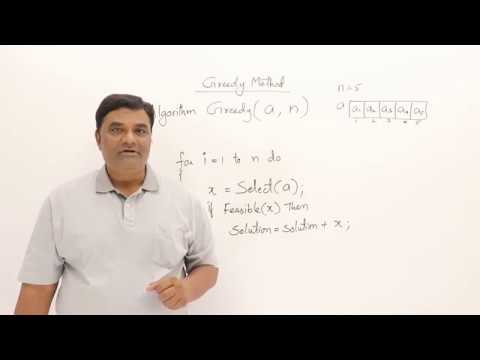
3. Greedy Method - Introduction
Greedy Method: An Overview
Introduction to Greedy Method
- The greedy method is a strategy for solving problems, similar to divide and conquer. It is an approach that can be adopted for various problem types.
- This method is specifically used for optimization problems, which require either a minimum or maximum result.
Understanding Optimization Problems
- An example of an optimization problem involves traveling from location A to B with multiple possible solutions (walking, biking, driving, etc.).
- Constraints are essential; for instance, if the journey must be completed within 12 hours, only certain modes of transport become feasible solutions.
- A feasible solution satisfies the constraints of the problem. The terms "feasible" and "not feasible" are commonly used in this context.
Types of Solutions
- If the goal is to minimize costs while traveling, it becomes a minimization problem.
- An optimal solution is both feasible and provides the best outcome (minimum cost). There can only be one optimal solution per problem.
- Optimization problems can require either minimum or maximum results; thus they are categorized as such.
Key Terms Recap
- Feasible Solution: Satisfies constraints given in the problem.
- Optimal Solution: Achieves the objective of minimizing or maximizing results.
- Optimization Problem: Requires either a minimum or maximum result.
Strategies for Solving Optimization Problems
Approaches to Optimization
- Various strategies exist for solving optimization problems; some may suit specific problems better than others.
Introduction to Greedy Method Approach
- The greedy method solves problems in stages by considering one input at a time and including it in the solution if it’s feasible.
General Algorithm of Greedy Method
- In each stage, inputs are evaluated sequentially. If an input meets feasibility criteria, it gets included in the final solution.
Example Application of Greedy Method
- For instance, when selecting a car based on features (optimality), one could evaluate all available brands/models before making a decision.
This structured overview captures key concepts related to the greedy method and its application in solving optimization problems while providing clear timestamps for reference.
Greedy Approach in Decision Making
Understanding the Greedy Method
- The process of selecting a car involves evaluating various brands and models, where cost may not be the only factor; features play a crucial role in determining the best choice.
- Initially, one narrows down options by focusing on preferred brands like Toyota or Hyundai, subsequently filtering to select top models rather than lower-tier ones.
- The selection of the latest or well-tested model from these top choices exemplifies a greedy approach, as it prioritizes immediate benefits without considering all available options.
- This method allows for efficient decision-making by avoiding exhaustive comparisons across all cars in the market while still arriving at what is deemed the best option.
Application of Greedy Approach in Hiring
- In hiring scenarios, an employer might receive thousands of applications and use a series of tests (written, technical, group discussions) to filter candidates down to one perceived as the best fit.
- The selected candidate is considered optimal based on the established selection procedures; however, this does not guarantee they are objectively superior to all applicants.
- Complaints from other candidates about fairness highlight that while one person is chosen as "best," it reflects adherence to a specific selection methodology rather than an absolute measure of quality.
- A more thorough approach would involve giving every candidate equal opportunity across all testing phases; however, this would be time-consuming and costly—hence why many opt for a greedy strategy instead.
Conclusion on Greedy Methods
- The discussion emphasizes that following known methods can lead to quick solutions but may overlook potential alternatives. Future problems will further illustrate how greedy approaches function in various contexts.
Turn any video into a summary like this
YouTube links, meetings, lectures. With transcripts, search, and chat.