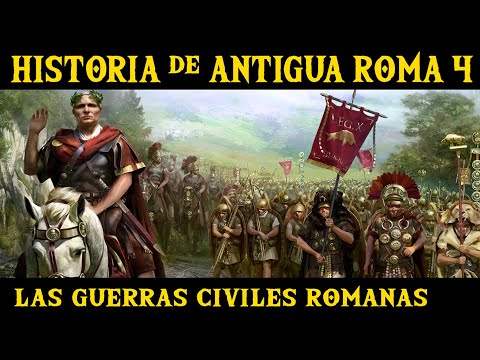
ANTIGUA ROMA 4: De la República Romana al Imperio Romano - Sila, Pompeyo, Julio César y Octaviano
Introduction and Background
This section provides an introduction to the historical context of the Roman Republic and sets the stage for the events that will be discussed.
The Italian Reforms and Social War
- After the reforms of Cayo Mario, Italians gained new rights and Roman citizenship.
- In 95 BC, Lucio Licinio Crassus and Quintus Mucius Scaevola expelled Italians from Rome, revoking their rights.
- Marco Livio Druso attempted to restore these rights but was killed, leading to the Social War between Italians and Romans.
Formation of a Federation and Conflict with Rome
- Itálicos (Italians) created a federation with its capital in Corfinium (now Italica) and fought against Rome.
- Soldiers like Lucio Cornelio Sila and Cayo Mario were called upon to fight against the Italians.
- The Senate eventually granted citizenship to resolve the conflict.
First Mithridatic War and Roman Civil War
This section discusses the events leading up to the first Mithridatic War and the Roman Civil War between Sila, Optimates, Rufo, and Mario.
Conflict with Mithridates VI
- King Mithridates VI invaded several regions controlled by Rome, resulting in 80,000 deaths.
- Sila fought against Mithridates VI in various battles.
Power Struggles in Rome
- Sulpicio Rufo persuaded the Senate to put Mario in command of the army while Sila was away fighting rebels.
- Sulla marched his troops back to Rome, defying Senate opinion for personal ambition.
Reign of Terror under Cina's Rule
This section highlights the reign of terror under Lucio Cornelio Cina's rule and the subsequent overthrow by mutinied soldiers.
Tyranny and Executions
- Cina, allied with itálicos, Roman soldiers, and freed slaves, took control of Rome.
- A reign of terror ensued with widespread executions of both Optimates and their supporters.
Overthrow of Cina
- Soldiers who refused to fight for Sila mutinied against Cina in 84 BC, resulting in his death.
Sulla's Return to Power
This section covers Sulla's return to power after defeating Cina and his subsequent reforms.
Sulla's Campaigns
- Sulla returned to Rome almost unopposed as troops defected from the consul Lucius Cornelius Scipio Asiaticus.
- Metellus Pius, Marco Licinio Craso, Lucio Licinio Lúculo, and Pompey Neo helped recover Italy and Africa for Sila.
Battle of Colline Gate and Dictatorship
- The first Roman Civil War ended in 82 BC after the Battle of Colline Gate outside Rome.
- Sulla became dictator with absolute power, initiating a period of proscriptions lasting three years.
Conclusion of Sulla's Reign
This section discusses the conclusion of Sulla's reign and the political landscape that followed.
Reforms and Retirement
- Sulla implemented reforms that increased senatorial power and reduced tribunes' authority.
- He retired in 80 BC but died shortly after.
Division among Optimates
- Former officers of Sila such as Metellus Pius, Marco Licinio Craso, Lucio Licinio Lúculo, and Pompey Neo clashed with the popular faction.
- Divisions within the Optimates began to emerge.
The transcript provided does not cover all aspects of Roman history during this period and may be missing some details.
Metellus Pius and Pompey's Intervention
This section discusses the involvement of Metellus Pius and Pompey in various conflicts.
Metellus Pius and Defeat in Hispania
- Metellus Pius was the general manager of defeat but failed to succeed.
- In 66 BC, Pompey came to help in the struggle against Sertorius' lieutenant, Perpenna.
- Perpenna killed Metellus Pius and took command of his troops.
- However, they were soon defeated by Pompey, leading to the end of the war in Hispania.
- Pompey took the opportunity to found the city of Pompaelo (Pamplona).
The Third Mithridatic War
- Shortly after, Pontus broke out into the Third Mithridatic War.
- Mithridates VI rearmed and allied with Tigranes the Great of Armenia to try to destroy Rome.
- Nicomedes III, king of Bithynia, bequeathed his kingdom to Rome as a casus belli.
Lucullus and Pompey's Campaigns
- The Senate sent Lucullus as consul to deal with King Mithridates VI while Pompey remained in Hispania.
- After the battle of Cyzicus, Lucullus managed to force Mithridates VI to take refuge in Tigranocerta, capital of Armenia.
- However, Lucullus faced challenges with aging soldiers being constantly attacked by tribes in distant lands.
Spartacus' Rebellion
- In 73 BC, Spartacus led a rebellion known as the War of Spartacus.
- Spartacus was a Thracian former soldier who escaped from a gladiatorial school in Capua along with other warriors and slaves seeking freedom.
Crassus and the War against Spartacus
This section focuses on Crassus' role in defeating Spartacus and his followers.
Crassus Takes Charge
- Marco Licinio Crassus took charge of dealing with Spartacus, with the help of Pompey and Lucullus' brother Terencio Varrón.
- After finishing their campaigns in Hispania and Macedonia respectively, Crassus managed to encircle the rebels in Apulia and defeat them.
- Many of the captured rebels were crucified along the Appian Way.
Pompey, Crassus, and Political Alliances
This section discusses the political alliances formed by Pompey and Crassus.
Pompey and Crassus as Consuls
- In 70 BC, Pompey and Crassus became consuls despite their differences.
- Crassus was accused of always seeking glory at the end of a war.
- They supported Sulla but gradually became more popular, leading to the return of power rights to tribunes of plebs and poorer classes.
Pompey's Actions
- Pompey befriended Gaius Julius Caesar, nephew of Cayo Mario.
- He also dealt with Cilician pirates who had disrupted wheat imports to Rome.
- In 66 BC, he replaced Lucinius Lucullus in the war against Mithridates VI.
Pompey's Victories in the East
This section highlights Pompey's victories in the East.
Defeat of Mithridates VI
- Around 64 BC, Pompey cornered King Mithridates VI in Bosporus.
- Mithridates attempted suicide but failed due to his immunity to poison. He asked a slave to kill him instead.
- Pompey's territories in the East expanded, increasing his popularity.
Conquest of Seleucid Kingdom and Judea
- Pompey dethroned the last Seleucid king, Antiochus XIII.
- He also arrived in Judea and managed to subdue it after making an agreement with Hircano from the Maccabean family.
Catiline's Conspiracy and Caesar's Rise
This section covers Catiline's conspiracy and Julius Caesar's rise to power.
Catiline's Conspiracy
- In 63 BC, Catiline presented himself as a candidate for elections but faced distrust due to his alleged conspiracy.
- Marco Tulio Cicero and Cayo Antonio won the elections against Catiline.
- Catiline assembled an army to stage a coup and kill Cicero but was defeated by Cicero and his army in the Battle of Pistoia. The Senate condemned them to death without trial.
Pompey Returns to Rome
This section discusses Pompey's return to Rome and the conspiracies against him.
Conspiracies Against Pompey
- In 63 BC, when Pompey returned from war in the East, some senators conspired against him.
- They disliked politicians gaining fame among people or the army, fearing monarchy or dictatorship.
- To avoid this perception, upon arrival at Brindisi, Pompey disbanded his army and entered Rome as a normal citizen.
The First Triumvirate
This section focuses on the formation of the First Triumvirate between Pompey, Crassus, and Julius Caesar.
Formation of the First Triumvirate
- Pompey sought support from popular classes and joined forces with Crassus, who was the richest man in Rome at the time.
- Julius Caesar, a former propretor of Hispania and pontifex maximus, also joined the alliance.
- The First Triumvirate was formed as an alliance against the optimates led by Cicero.
Caesar's Conquests in Gaul
This section highlights Julius Caesar's conquests in Gaul.
Caesar's Objectives
- After his consulate, Julius Caesar asked for control over Narbonensis Gaul, Cisalpine Gaul, and Illyria.
- He began conquering the Gauls (modern-day France) and achieved his objectives.
Caesar's Conquests and the Roman Civil War
This section provides an overview of Caesar's military campaigns and the Roman Civil War.
Caesar's Military Campaigns
- Caesar crossed the Rhine River to defend Gaul against Germanic tribes.
- He also ventured to Britain across the English Channel, but with limited success.
- Caesar formed an alliance with Cleopatra VII of Egypt during his campaign in Gaul.
The Triumvirate and Crassus' Death
- The triumvirate, consisting of Caesar, Pompey, and Crassus, renewed their alliance in 55 BC.
- Crassus met his death while battling the Parthian Empire in Syria.
Vercingetorix and Rome's Internal Conflicts
- Vercingetorix led a Celtic rebellion against Rome but was eventually defeated by Caesar at Alesia.
- Rome faced internal conflicts between Clodius Pulcher and Tito Annio Milón, resulting in gang wars and burning of the Senate building.
The Roman Civil War
- The second Roman Civil War began when Caesar's troops crossed the Rubicon River into Roman territory.
- Pompey fled to Greece while Lépido became the highest magistrate in Rome under Caesar's command.
- After defeating various opponents, including Pompey's son Sextus Pompey, Caesar returned to Rome as dictator.
Caesar's Reign as Dictator
This section focuses on Caesar's reign as dictator and his political reforms.
Cleopatra and Mithridates VI
- Caesar established Cleopatra as the queen of Egypt and had a son with her.
- Caesar intervened in Pontus to defeat Farnaces, the son of Mithridates VI.
Battles and Reforms
- Caesar achieved victory at the Battle of Zela, where he famously said "Veni Vidi Vici."
- He faced Scipio Metellus and King Juba I in North Africa at the Battle of Thapsus.
- In Spain, Caesar defeated Sextus Pompey in the Battle of Munda.
- Caesar implemented constitutional reforms, including changes to judicial appointments and term limits for propraetors and proconsuls.
Conclusion
This section concludes the summary by highlighting Caesar's return to Rome as dictator and his implementation of political reforms.
Please note that this is a brief summary based on the provided transcript. For a more comprehensive understanding, it is recommended to refer to the original video.
The Life and Legacy of Julius Caesar
This section discusses the accomplishments of Julius Caesar, including his creation of colonies, temples, and monuments in Rome. It also mentions his political enemies and his desire for harmony.
Julius Caesar's Accomplishments
- Julius Caesar created many colonies, temples, and monuments in Rome.
- He raised the new Senate building called Culia Julia or the Temple of Venus Genetrix.
- He was considered the ancestress of his family.
- Despite having political enemies, Caesar did not retaliate against them as he wanted harmony.
The Assassination of Julius Caesar
This section describes the assassination of Julius Caesar by a group of senators led by Marcus Junius Brutus and Cassius. It also mentions Cleopatra's reaction to his death.
Assassination of Julius Caesar
- In March 44 BC, a group of senators including Marcus Junius Brutus and Cassius murdered Julius Caesar during a senatorial session.
- Cleopatra was scared upon learning about his death and took their child to Egypt.
- The assassination was motivated by the Senate's upset over Caesar's flirtations with monarchy.
The 3rd Civil War and the 2nd Triumvirate
This section discusses the aftermath of Julius Caesar's death, including the election of Marco Antonio as consul and Gaius Octavius as his successor. It also mentions Cicero's attempt to gain control over Gaul.
Aftermath of Julius Caesar's Death
- Marco Antonio was elected consul after Julius Caesar's death.
- Gaius Octavius was chosen as Julius Caesar's successor.
- Cicero saw an opportunity to take control of Gaul by aligning with Marco Antonio.
- Decimus Junius Brutus, one of the conspirators, refused to give up power.
The Second Triumvirate
This section discusses the formation of the second triumvirate between Marco Antonio, Gaius Octavius (later known as Gaius Julius Caesar Octavianus), and Lepidus. It also mentions their actions to dismantle the power of the Senate and persecute their opponents.
Formation of the Second Triumvirate
- The second triumvirate was formed between Marco Antonio, Gaius Octavius, and Lepidus.
- They began dismantling the power of the Senate and persecuting their opponents.
- Cicero lost his hands and head in retaliation for his opposition to them.
- The conspirators Brutus and Cassius fled to eastern provinces and assembled an army.
Marco Antonio's Alliance with Cleopatra
This section discusses Marco Antonio's alliance with Cleopatra after meeting her in Tarsus. It also mentions their victory over the murderers of Julius Caesar at Philippi.
Alliance with Cleopatra
- Marco Antonio sought help and love from Cleopatra after meeting her in Tarsus.
- After defeating the murderers of Julius Caesar at Philippi, they divided Roman territories among themselves.
- Marco Antonio controlled provinces in East, Gaius Octavius controlled Western provinces, and Lepidus controlled North Africa.
The 4th Roman Civil War
This section discusses tensions between Gaius Octavius (Octavian) and Marco Antonio leading to the 4th Roman Civil War. It also mentions Octavian's marriage to Marco Antonio's sister, Octavia.
Tensions and the 4th Roman Civil War
- Tensions between Gaius Octavius and Marco Antonio escalated.
- Octavian took unpopular measures such as land confiscation to cope with the economic crisis.
- Supporters of Marco Antonio, including his brother Lucio Antonio and wife Fulvia, turned against him.
- Octavian besieged Perusia, a stronghold of Marco Antonio's supporters, leading to peace negotiations.
The Battle of Nauloco and Marco Antonio's Death
This section discusses the Battle of Nauloco between Sextus Pompey and Marcus Agrippa. It also mentions Marco Antonio's marriage to Cleopatra and his eventual suicide.
Battle of Nauloco and Marco Antonio's Death
- In 36 BC, Sextus Pompey was defeated by Marcus Agrippa in the Battle of Nauloco.
- Marco Antonio married Octavian's sister, Octavia, but had a relationship with Cleopatra.
- After deserting troops and falsely believing Cleopatra was dead, Marco Antonio committed suicide.
- Cleopatra later died by snake bite.
The End of the Republic and the Beginning of the Roman Empire
This section discusses the end of the Republic and the rise of Augusto (Octavian) as a unique and strong power. It also mentions Egypt becoming part of Roman provinces.
Transition from Republic to Empire
- In 30 BC, peace returned to Rome after the war ended.
- With Egypt as part of Roman provinces, Rome could receive wheat to alleviate hunger.
- The debate arose about the failure of the republic system leading to civil wars.
- People looked towards Augusto (Octavian) as a unique and strong power to avoid further conflicts.
The summary has been provided in English, as requested.