Biosíntesis de ácidos grasos
Biosynthesis of Fatty Acids
Introduction to Fatty Acid Synthesis
- Dr. Victoria Aguirre introduces the topic of fatty acid biosynthesis, questioning why carbohydrate consumption can lead to weight gain despite low fat intake.
- She highlights the role of physical activity in preventing fat accumulation and its overall health benefits.
Objectives of the Class
- The class aims to cover stages of fatty acid synthesis, components of fatty acid synthase complex, and mechanisms for elongating and desaturating fatty acids.
- Students will learn about regulatory mechanisms in fatty acid synthesis and the relationship between carbohydrate and lipid metabolism.
Metabolic Pathways Overview
- Excess caloric intake leads to acetyl-CoA from carbohydrates and ketogenic amino acids being used for fatty acid synthesis, which are later converted into triglycerides.
- A review of lipid metabolic pathways indicates that dietary triacylglycerols undergo beta-oxidation to produce acetyl-CoA units.
Energy Production from Fatty Acids
- Each acetyl-CoA unit yields significant ATP due to their carbon structure, typically containing more than 12 carbons.
- Acetyl-CoA enters the Krebs cycle for complete oxidation, generating NADH, FADH2, and GTP through substrate-level phosphorylation.
Interconversion Between Metabolites
- High levels of acetyl-CoA can convert into ketone bodies or cholesterol; it can also revert back for new fatty acid synthesis when needed.
- The process is anabolic, utilizing reduced NADPH as a coenzyme for growing carbon skeletons during lipid transformation.
Requirements for Fatty Acid Synthesis
Components Needed for Synthesis
- To synthesize a fatty acid, carbon units enter as acetyl-CoA initially before transforming into malonyl-CoA in the cytosol.
- Reduced equivalents in the form of NADPH come from pentose phosphate pathway or malic enzyme activity; key enzymes include acetyl-CoA carboxylase and fatty acid synthase complex.
Location and Process of Synthesis
- Fatty acid synthesis occurs primarily in liver tissue, adipose tissue, and mammary glands during lactation within the cytosol.
- Citrate exits mitochondria converting into malonyl-CoA via citrate lyase with energy expenditure involved.
Mechanisms Involved in Lipid Metabolism
Role of Citrate Lyase
- Citrate lyase generates acetyl-CoA outside mitochondria while regenerating oxaloacetate that reduces further to malate through malate dehydrogenase action.
Importance of Malate Conversion
- Malate converts back to pyruvate via malic enzyme producing additional NADPH; these carbon skeleton intermediates return to mitochondrial matrix for further use.
Regulation Mechanisms
Insulin's Role
- Glucose uptake is facilitated by insulin leading to increased availability of substrates necessary for lipogenesis post-meal rich in nutrients.
Reciprocal Relationship with Beta-Oxidation
- Biosynthesis is reciprocal to beta oxidation occurring in cytosol; simultaneous citrate export inhibits beta oxidation due to opposing pathways regulated allosterically.
Key Enzymatic Processes
Acetyl-CoA Carboxylase Functionality
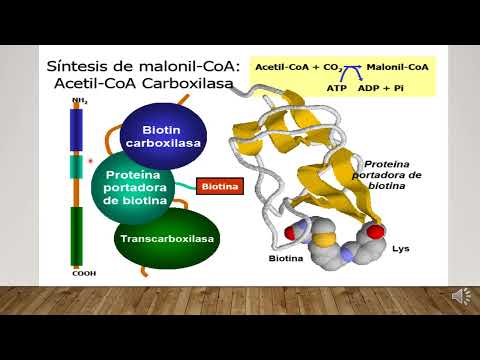
- Acetyl-CoA carboxylase catalyzes conversion from acetyl-CoA to malonyl Co-A using bicarbonate, ATP & biotin; this irreversible step is crucial in biosynthesis.
Structure & Regulation Insights
- Eukaryotic enzyme consists of three functional domains: biotin carrier protein, biotin carboxilase & transcarboxilasa highlighting its complexity.
Overview of Fatty Acid Synthase Structure and Function
Domains of Fatty Acid Synthase
- The fatty acid synthase (FAS) complex consists of identifiable domains that work in pairs, with the first domain containing binding sites for acetyl-CoA and malonyl-CoA.
- Acetyl-CoA acts as a primer for the synthesis process, while malonyl-CoA units are added to elongate the fatty acid chain.
- Domain 1 includes acetyltransferase, malonyltransferase, and beta-ketoacyl synthase (also known as condensing enzyme), illustrated in mauve color.
Enzymatic Functions in Domain 2
- Domain 2 is depicted in turquoise and contains enzymes such as enoyl ACP reductase, beta-ketoacyl reductase, and a dehydrating enzyme; ACP stands for acyl carrier protein.
- ACP is not an enzyme but a transport protein that facilitates the exchange of growing carbon skeletons between subunits.
Mechanism of Fatty Acid Synthesis
- The final enzyme involved is thioesterase, which releases palmitic acid after synthesizing a maximum chain length of 16 carbons.
- The synthesis begins with acetyl-CoA entering FAS, followed by malonyl-CoA addition; coenzyme A is released during this process.
Steps Involved in Chain Elongation
- The condensing enzyme catalyzes the joining of carbon skeletons with CO₂ release, resulting in a structure fixed to ACP.
- A keto group undergoes reduction using reduced NADP⁺ to form a hydroxyl group that subsequently gets dehydrated to create a double bond.
Final Stages of Synthesis
- Each cycle generates longer carbon chains through reductions and dehydration steps until reaching palmitate after seven cycles.
- Thioesterase cleaves palmitoyl ACP at 16 carbons via hydrolysis to liberate palmitate or palm oil.
Further Modifications Beyond Palmitic Acid
Elongation and Desaturation Processes
- After achieving 16 carbons, elongation processes occur outside the cytosol within smooth endoplasmic reticulum or mitochondria.
- Essential fatty acids like linoleic (omega 6) and linolenic (omega 3), which cannot be synthesized by humans, must be ingested from dietary sources.
Dietary Sources of Essential Fatty Acids
- Omega 6 can be sourced from oils like sunflower or avocado; omega 3 comes from walnuts or fish. These are precursors for important compounds like arachidonic acid.
Biological Importance of Omega Fatty Acids
- Omega fatty acids serve as precursors for prostaglandins and leukotrienes which have roles in vasodilation and inflammation regulation.
Mechanisms Involved in Desaturation
Role of Enzymes in Desaturation
- Desaturases introduce double bonds into fatty acids at specific positions but cannot exceed position twelve due to human enzymatic limitations.
Conversion Processes
- Stearoyl CoA desaturases convert saturated fats into unsaturated forms by incorporating oxygen into their structures through electron transport mechanisms involving cytochrome systems.
Regulation of Fatty Acid Synthesis
Overview of Mixed Oxidative Reactions
- The process involves a cytochrome acceptor with ferrous cation that exchanges with ferric cation, indicating a mixed oxidative reaction requiring specific cytochromes and electron acceptors.
Role of Endoplasmic Reticulum
- These reactions occur independently in the smooth endoplasmic reticulum, which plays a crucial role in regulating fatty acid synthesis.
Allosteric Regulation Mechanisms
- The regulation is allosteric and covalent modification occurs at acetyl-CoA carboxylase, influenced by hormones like glucagon and insulin.
Hormonal Influence on Enzyme Activity
- Hormones induce phosphorylation of acetyl-CoA carboxylase, affecting enzyme expression and activity during metabolic changes.
Special Mention: Leptin's Role
- Leptin, derived from adipocytes, significantly influences allosteric regulation in lipogenesis alongside insulin and glucagon.
Mechanisms of Lipogenesis
Activation through Citrate Presence
- Acetyl-CoA carboxylase is inactive as a protomer but becomes active when polymerized in the presence of citrate, indicating high energy availability from carbohydrates.
Conditions Favoring Fatty Acid Synthesis
- High levels of glucose lead to reduced NADPH production via pentose pathways in liver and adipose tissue under favorable conditions for triglyceride formation.
Inhibition by Palmitoyl-CoA Levels
- Excess palmitoyl-CoA inhibits polymerization of acetyl-CoA carboxylase allosterically, preventing unnecessary fatty acid synthesis when not needed.
Reciprocal Regulation with Beta-Oxidation
Interaction Between Malonyl CoA and Carnitine Transferase
- Malonyl CoA inhibits acyl-CoA carnitine transferase, preventing activated fatty acids from entering mitochondria for beta-oxidation while promoting fatty acid synthesis simultaneously.
Impact of Fasting and Exercise on Metabolism
Hormonal Responses During Fasting or Exercise
- Situations like fasting or exercise trigger glucagon and adrenaline release to signal fuel needs for ATP production or muscle contraction during physical activity.
Activation of Protein Kinase A
- Glucagon and adrenaline activate cyclic AMP-mediated signaling pathways leading to protein kinase A activation which phosphorylates acetyl-CoA carboxylase to inhibit its activity during fasting states.
Insulin's Role in Fat Storage
Insulin's Effect on Acetyl-CoA Carboxylase
- High carbohydrate intake activates insulin which dephosphorylates acetyl-CoA carboxylase allowing for increased fatty acid synthesis while promoting fat storage as triglycerides.
Long-term Genetic Regulations
Transcriptional Regulation by Insulin
- Insulin enhances expression of fatty acid synthase genes through transcription factors such as USF (Upstream Stimulatory Factors), influencing long-term lipid metabolism.
Leptin's Regulatory Functions
Leptin’s Inhibitory Effects on Lipogenesis
- Leptin regulates appetite and lipid metabolism; it inhibits expression of SREBP (Sterol Regulatory Element Binding Protein), reducing fatty acid synthesis in response to lipid deposits.
Triglyceride Formation Process
Glycerol 3-phosphate Production Pathway
- Glycerol 3-phosphate required for triglyceride formation originates from glycolysis; it combines with acyloxy groups forming triaclyglycerols after multiple enzymatic steps involving ATP expenditure.
Conclusion on Caloric Intake Impact
Relationship Between Caloric Surplus and Fat Accumulation
- Excess caloric intake leads to increased fat deposition due to enhanced biosynthesis pathways occurring primarily under anabolic conditions within liver and adipose tissues.
Turn any video into a summary like this
YouTube links, meetings, lectures. With transcripts, search, and chat.