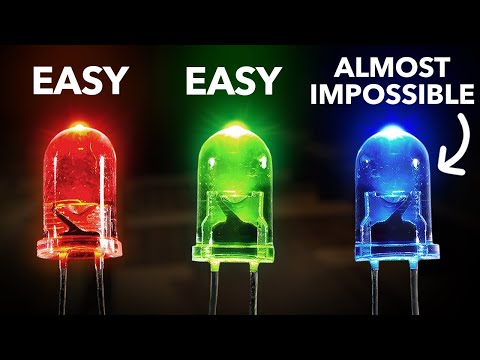
Why It Was Almost Impossible to Make the Blue LED
LEDs: The Technology That Changed the World
This section delves into the origins of LEDs, highlighting how their color is determined by electronics rather than plastic covers. It also discusses the initial limitations of LEDs to red and green colors and the quest for creating blue LEDs.
LED Color Determination
- The color of LEDs is not derived from their plastic covers but from the electronics themselves. A transparent LED emits the same red color as an opaque one.
Quest for Blue LEDs
- Initially, only red and green LEDs existed, limiting their applications to indicators, calculators, and watches. The desire for blue LEDs was crucial as it could enable the creation of white light by combining red, green, and blue.
- Despite significant efforts by major electronics companies like IBM and GE in the 1960s to develop blue LEDs, no breakthrough occurred for decades.
The Breakthrough: Creating Blue LED
This section focuses on Shūji Nakamura's groundbreaking work in developing the world's first blue LED despite facing skepticism and challenges within his company.
Shūji Nakamura's Struggle
- Shūji Nakamura faced resistance within his company due to financial constraints and skepticism about his research on new products. His lab lacked resources, leading to explosions from phosphorus leaks.
- Despite being urged to quit by supervisors at Nichia, Nakamura persisted with a radical proposal to create a blue LED after witnessing failures by prominent companies like Sony and Toshiba in this endeavor.
Nobuo Ogawa's Gamble
- Nobuo Ogawa took a risk by allocating a substantial amount of money towards Nakamura's project after years of losses in semiconductor production at Nichia. This investment aimed at potentially revolutionizing lighting technology through LEDs' efficiency compared to traditional light bulbs.
Understanding Semiconductor Physics
This section delves into semiconductor physics, explaining how they differ from conductors and insulators based on energy bands.
Semiconductor Functionality
- Light bulbs are inefficient as they primarily emit heat rather than visible light due to tungsten filament glow when current passes through them. In contrast, LEDs are more efficient as they primarily emit light owing to their structure as light-emitting diodes (LED).
Energy Bands in Semiconductors
- Semiconductors have energy bands that allow controlled electron movement between valence and conduction bands due to a smaller band gap compared to insulators where electrons cannot move under an electric field due to a large band gap.
Semiconductor Types and Functionality
This section explains the two main types of semiconductors, n-type and p-type, their composition, and how they function in creating an electric field.
N-Type Semiconductor
- Semiconductors with predominantly mobile negative charge carriers (electrons) are termed n-type.
- Electrons moving from n-type to p-type semiconductors create a slight negative charge in the former and a slight positive charge in the latter, establishing an electric field.
P-Type Semiconductor
- In p-type semiconductors, positive holes carry current as electrons move out of the valence band due to thermal energy.
- When connected, a battery can alter the depletion region's size by changing the electric field, allowing electron flow from n to p regions.
Light Emitting Diodes (LEDs)
This part delves into how LEDs work based on semiconductor properties and band gaps, leading to light emission.
LED Operation
- Connecting a battery alters the depletion region size in LEDs, enabling electron flow between semiconductor types.
- The band gap determines LED color; blue LEDs require larger band gaps due to higher energy photons emitted.
Challenges in Blue LED Development
The challenges faced by researchers in developing blue LEDs due to material requirements for efficient crystal structures are discussed.
Material Challenges
- Blue LED development required materials with near-perfect crystal structures to prevent energy dissipation as heat instead of visible light emission.
- High-quality crystal structure was crucial for blue LED efficiency; defects disrupted electron flow leading to heat dissipation.
Nakamura's Journey Towards Blue LED Invention
Nakamura's perseverance and challenges faced during his quest for inventing blue LEDs are highlighted.
Nakamura's Struggles
- Facing adversity without access to resources or recognition fueled Nakamura's determination towards achieving his goals despite initial setbacks.
The Journey of Gallium Nitride LED Development
The transcript delves into the challenges faced by scientists in creating n-type and p-type gallium nitride LEDs, the pursuit of a commercially viable blue LED, and Nakamura's innovative approach to overcome obstacles in crystal growth and LED development.
Challenges in LED Development
- Scientists struggled with creating p-type gallium nitride LEDs, crucial for commercial viability.
- Competition was fierce for zinc selenide while gallium nitride had limited interest due to past inefficiencies.
- Akasaki and Amano pioneered high-quality crystal growth using an aluminum nitride buffer layer.
Nakamura's Breakthrough
- Nakamura faced difficulties growing gallium nitride but innovatively modified the reactor for improved crystal quality.
- Through relentless dedication, Nakamura achieved significantly higher electron mobility in his gallium nitride samples.
Innovation and Obstacles
- Nakamura's two-flow reactor design revolutionized crystal growth, surpassing existing methods.
- His unique approach eliminated the need for an aluminum buffer layer, enhancing crystal quality.
Challenges in P-Type Gallium Nitride Creation
The segment explores the hurdles encountered in developing p-type gallium nitride LEDs, highlighting Akazaki and Amano's initial success and Nakamura's innovative solution through annealing.
Initial Hurdles
- Akazaki and Amano achieved the first p-type gallium nitride but faced slow production rates with electron beam irradiation.
Nakamura's Approach
The Journey to Creating the Blue LED
This section delves into the challenges faced by Nakamura in creating gallium nitride with MOCVD, leading to the development of a prototype blue LED.
Challenges in Creating Gallium Nitride
- Ammonia used for gallium nitride production contained hydrogen, hindering hole formation.
- Initial prototype was inefficient and emitted a blue-violet color.
- Pressure from Nichia's CEO to turn prototype into a product led Nakamura to innovate independently.
- Introduction of an active layer using indium gallium nitride improved LED efficiency.
Innovative Techniques in LED Development
This section highlights Nakamura's innovative approach in growing indium gallium nitride and refining the LED structure.
Customizing MOCVD Reactor
- Nakamura customized his reactor to force indium onto gallium nitride, overcoming mixing challenges.
- Incorporating an active layer initially caused electron leakage, resolved by creating an aluminum gallium nitride barrier.
Success with the Blue LED Creation
The completion of the complex blue LED structure and its groundbreaking impact on the industry are discussed here.
Achievement of True Blue LED
- Nakamura successfully created a bright blue LED emitting at 450 nanometers, revolutionizing lighting technology.
- Nichia's announcement of the world's first true blue LED garnered significant attention and sales growth.
Impact and Legal Battles
This part explores Nakamura's compensation struggles despite his pivotal role in advancing LED technology.
Compensation Dispute
- Despite immense success, Nakamura received minimal compensation from Nichia for his invention.
LED Lighting Revolution
The section discusses the benefits of LED lighting, particularly focusing on energy efficiency and cost-effectiveness compared to traditional bulbs.
Benefits of LED Lighting
- LEDs are highly efficient, lasting longer and offering customization options. They are more cost-effective in the long run.
- LED prices have decreased, making them only slightly more expensive than other bulb types. Energy savings allow for cost recovery within two months.
- Transition to LEDs can significantly reduce carbon emissions, with estimates suggesting a potential saving of 1.4 billion tons of CO2.
Next Generation LEDs: Micro LEDs and UV LEDs
This part delves into the advancements in LED technology, exploring micro LEDs and UV LEDs' applications and potential impact.
Advancements in LED Technology
- Research focuses on micro LEDs and UV LEDs for various applications such as near-eye displays for AR/VR and surface sterilization in hospitals or kitchens.
- Micro LEDs are incredibly small (as tiny as five microns) with diverse applications like retina displays. UV LEDs could revolutionize pathogen sterilization processes efficiently.
Challenges and Future Prospects of UV LEDs
The discussion revolves around the challenges faced by UV LEDs, primarily related to efficiency and cost, along with future prospects for improvement.
Challenges and Prospects
- UV LED companies experienced a surge due to COVID-19 demands for sterilization solutions using UV light technology.
- Efficiency improvements are crucial for reducing costs; if efficiency surpasses 50%, costs become comparable to mercury lamps, indicating a promising future trajectory for UV LED technology.
Nakamura's Contributions & Personal Insights
This segment highlights Nakamura's journey from his groundbreaking work on blue LED to personal anecdotes reflecting his determination and problem-solving skills.
Nakamura's Journey
- Nakamura's pivotal role in developing blue LED led to significant recognition, including a Nobel Prize in Physics alongside Akasaki and Amano.