4 de 17. El derecho romano
New Section
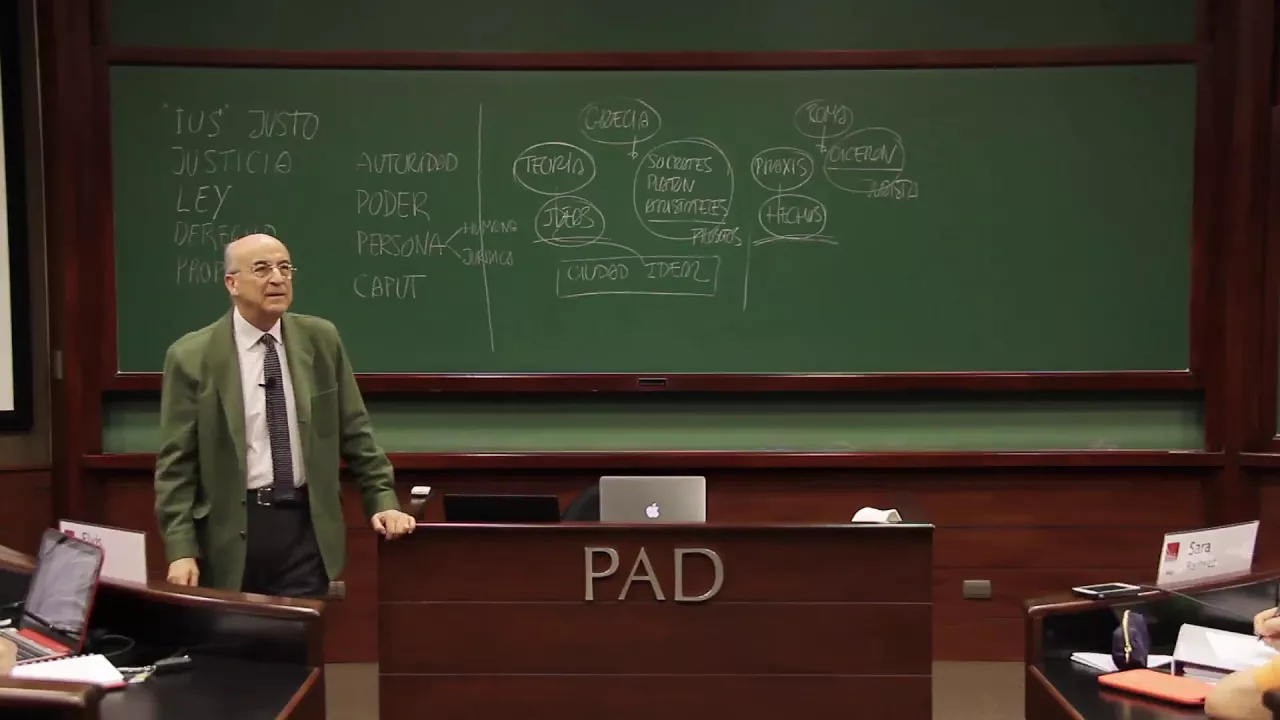
In this section, the speaker introduces the importance of Roman law in understanding economics and business. Key terms discussed include "Use" as justice, property rights, and concepts like autoritas, potestas, persona, and caput.
Understanding Roman Law
- The term "Use" in Roman law signifies justice and prompts a discussion on what is just and fair.
- Justice is defined as giving each their due, raising questions about what constitutes one's due.
- Concepts such as autoritas (authority), potestas (power), persona (individual), and caput (head) are highlighted as crucial elements in Roman law.
Exploring Greek Influence on Rome
This part delves into the influence of Greek philosophy on Rome through figures like Cicero. Contrasts between Greek philosophy focusing on ideas and Roman emphasis on practicality are discussed.
Greek Philosophy vs. Roman Law
- Cicero's deep knowledge of Greek philosophy influences Roman thought significantly.
- While Greece emphasizes philosophy with figures like Socrates and Plato, Rome focuses more on legal matters.
Divergence Between Greece and Rome
The divergence between Greek philosophical ideals and Roman legal pragmatism is explored. Romans prioritize action over abstract ideas.
Philosophical Contrasts
- Greeks lean towards philosophy while Romans focus on practicality; Grecian thinkers are philosophers while Romans are known for their legal expertise.
- Romans prioritize facts over ideas; they engage with reality rather than theoretical concepts.
Ideal City Concept in Ancient Thought
The discussion shifts to contrasting idealistic views of cities between Greeks' utopian ideals and Romans' realistic approach to governance.
Ideal City Perspectives
- Greeks ponder the ideal city concept while Romans emphasize real-world governance challenges.
New Section
In this section, the speaker discusses the importance of resolving conflicts through a combination of art and science, particularly focusing on the art of conflict resolution.
Resolving Conflicts Through Art and Science
- The process of resolving conflicts involves blending art and science, with an emphasis on the art of conflict resolution.
- Understanding conflict resolution is crucial in various fields, such as law.
- Conflict resolution requires a deep understanding of both theoretical knowledge (wisdom) and practical knowledge (prudence).
New Section
This part delves into the fundamental role of law in business and society, emphasizing wisdom and philosophy as essential components.
Role of Law in Business
- Law plays a vital role in business by facilitating interactions between different parties.
- Wisdom is highlighted as a key element in legal matters, reflecting a deeper understanding beyond mere knowledge.
- Philosophy, defined as love for wisdom, underscores the importance of comprehensive understanding in legal contexts.
New Section
The discussion shifts to Roman law's focus on prudence as a practical form of knowledge essential for resolving specific issues.
Prudence in Roman Law
- In Roman law, prudence is valued for its practical application in resolving concrete issues.
- Prudence differs from wisdom by focusing on case-by-case solutions rather than overarching theoretical knowledge.
- The ability to navigate specific cases effectively distinguishes prudence from broader wisdom.
New Section
Exploring the significance of using real-life cases to teach business students about legal principles and conflict resolution strategies.
Teaching Legal Principles Through Cases
- Business schools often use real-life cases to educate students about legal concepts and conflict resolution techniques.
- Case studies help students understand how legal principles apply to practical situations.
- Analyzing cases enhances students' ability to address complex business challenges effectively.
New Section
Contrasting wisdom with prudence in decision-making processes within legal contexts, emphasizing their distinct approaches to problem-solving.
Wisdom vs. Prudence
- Wisdom focuses on theoretical knowledge encompassing all aspects comprehensively.
- Prudence emphasizes practical knowledge tailored for individual cases or scenarios.
New Section
In this section, the speaker discusses the Napoleonic law and its importance in Latin America. The focus is on the distinction between imposing solutions and discovering them through inquiry.
Understanding the Napoleonic Law
- The Napoleonic law system in Latin America emphasizes the importance of discerning solutions rather than imposing them.
- The concept of "derecho" or law in Spanish involves understanding and applying legal principles based on human judgment and experience.
- In modern times, legal systems apply laws created by parliaments or dictators, contrasting with the Roman approach of deriving laws from human judgment.
New Section
This segment delves into the structure of Roman governance, highlighting the roles of the Senate and people in decision-making processes.
Roman Governance Structure
- The Roman Senate held authority but derived power from the people, emphasizing youth as a source of influence.
- Consultation with the Senate was crucial for decision-making, reflecting a respect for experienced individuals' judgments.
New Section
Exploring the role of judges in ancient Rome and their significance in delivering fair and authoritative decisions within society.
Role of Judges in Ancient Rome
- Judges were respected for their authority, experience, and ability to provide sound resolutions to legal matters.
- The symbol of a sword represented judicial power wielded by citizens entrusted with upholding justice within communities.
New Section
Discussing how judges executed sentences based on their authority and societal recognition as wise individuals capable of resolving disputes effectively.
Execution of Sentences by Judges
- Judges executed sentences wielding both judicial power symbolized by a sword and societal trust earned through wisdom and experience.
- Judicial errors were rectified by involving other judges to ensure fair outcomes, maintaining integrity within legal proceedings.
New Section
Examining how Roman legal principles influenced modern-day legal systems like those found in certain states within the United States.
Influence of Roman Legal Principles
- Some U.S. states maintain elements of Roman law traditions, showcasing continuity in legal practices over time.
New Section
In this section, the speaker discusses Christianity and its relevance to problem-solving by drawing analogies with obstacles and challenges individuals face in life.
Christianity and Problem-Solving
- The speaker mentions Christianity and its connection to overcoming obstacles in life.
- Emphasizes the importance of gaining different perspectives to solve problems effectively.
- Encourages looking at issues from various angles before taking action.
- Discusses the concept of "caput" in Roman law and the right to appeal to a judge.
- Explores the meaning of "caput" as distinct from "intimidation."
New Section
This section delves into the relationship between capitalism, individualism, and societal structures, particularly focusing on Roman concepts.
Capitalism and Individualism
- Links capitalism to individualism, highlighting linguistic nuances.
- Compares capitalism to egalitarianism within Roman societal frameworks.
New Section
Here, the discussion centers on rights, citizenship, and social hierarchies within Roman society.
Rights and Citizenship in Rome
- Explores the concept of rights in Roman society based on social status.
- Differentiates between "caput" (head of household) and other social roles like patricians.
New Section
This part focuses on legal actions, justice systems, and citizen participation within Roman legal frameworks.
Legal Actions and Justice Systems
- Discusses initiating legal actions as a fundamental aspect of Roman law.
- Highlights limitations on citizen actions within legal contexts.
New Section
The conversation shifts towards personhood, familial ties, religious practices, and citizenship requirements in ancient Rome.
Personhood and Citizenship Requirements
- Explores how personhood is tied to legal actions within familial structures in Rome.
New Section
In this section, the speaker discusses the concept of community and citizenship in ancient Rome, emphasizing the importance of familial ties and representation.
The Concept of Community and Citizenship
- The speaker highlights that in ancient Rome, citizenship is transmitted through consanguinity or adaptation.
- Emperors often adopted heirs as their children to ensure succession, showcasing the significance of familial relationships in citizenship.
- The head of a family represents its members and can act on their behalf, illustrating a hierarchical structure within Roman society.
- Citizenship is closely tied to one's family and community, with individuals being defined by their relationships within these groups.
- The concept of persons is essential for societal functioning, as it establishes roles and responsibilities within families and communities.
New Section
This segment delves into the theological aspect of personhood in ancient Rome, exploring how individuals are perceived within a religious context.
Personhood in a Religious Context
- The concept of persons is linked to the idea of the Trinity in Christianity, where individuals are seen as distinct entities yet united in purpose.
- Legal recognition extends personhood beyond individuals to include entities like corporations recognized under law as juridical persons.
- Communities form around common interests or goals, leading to associations such as trade unions or merchant guilds based on shared objectives.
- Associations like collegia emerge from shared professions or beliefs, uniting individuals for mutual protection and support.
- Conflicts between groups or members within them prompt the need for legal frameworks defining personhood even for slaves or other marginalized individuals.
New Section
This part focuses on legal aspects related to slavery and ownership in ancient Rome, shedding light on how personhood was attributed based on social status.
Legal Framework Around Personhood
- Slaves were considered legal persons under Roman law but lacked autonomy as they were possessions owned by others.
- Ownership symbolized power dynamics within society, with possession signifying control over individuals' actions and identities.
- Manumission granted slaves freedom but still subjected them to societal norms regarding status and rights post-liberation.
Concept of Society and University
The speaker discusses the concept of society and university, emphasizing the importance of understanding these concepts within a community context.
Understanding Society and University
- The concept of society always involves communities.
- Historically, universities were communities of professors and students, fostering friendship and knowledge exchange.
- Knowledge transmission in universities occurs through relationships and interactions among individuals.
- The speaker contrasts the traditional view of universities as non-profit educational institutions with the modern perception that treats students as customers.
- Distinguishes between the concepts of customer satisfaction in business versus the traditional role of universities in knowledge dissemination.
Role of Universities in Society
Exploring the role and significance of universities within societal frameworks.
Significance of Universities
- Discusses how interests influence university dynamics, highlighting the balance between interest, trust, and profit.
- Compares colleges to universities, emphasizing their intertwined nature within educational systems.
- Reflects on the relationship between money, values, and education in universities.
- Emphasizes the importance of preserving academic integrity over financial gains for sustainable educational development.
Educational Systems and Capitalism
Analyzing the interplay between education systems and capitalist ideologies.
Education Systems vs. Capitalism
- Explores how different countries' approaches to education impact societal progress.
- Advocates for a robust educational system to nurture future generations effectively.
El Capitalismo y la Sociedad - Parte 1
In this section, the speaker delves into the concept of capitalism and its impact on society, highlighting the importance of individual profit motives and societal balance.
Individualism in Capitalism
- The essence of individual capitalism lies in the pursuit of profit.
- Society is described as a place where everyone pursues their own interests, leading to a balanced society according to classic communist beliefs.
Social Dynamics and Society's Stability
- The speaker emphasizes that for a society to thrive, individuals must actively participate and contribute.
- The role of the poor in society is discussed, emphasizing their resilience despite challenging circumstances.
El Capitalismo y la Sociedad - Parte 2
This section continues exploring the relationship between capitalism and society, focusing on education, societal problems, and the importance of love in addressing social issues.
Education and Social Issues
- Education is highlighted as crucial for societal progress and stability.
- The significance of forming competent professionals through education is emphasized.
Love as a Solution
- Love is presented as the ultimate solution to societal problems rather than material wealth or other factors.
La Familia y la Sociedad - Parte 1
This section delves into family dynamics within society, emphasizing care for children as fundamental to social cohesion.
Family Values
- The importance of caring for children within families is discussed as essential for societal well-being.
New Section
In this section, the speaker discusses the concept of family as a vital entity for sustaining life and the interconnectedness of individuals within a family unit.
Family as a Community
- The speaker emphasizes that family is essential for maintaining life and refers to it as the foundation of existence.
- Within a family, there is a sense of community where all possessions are shared collectively among its members.
- The term "2 milus" is introduced, symbolizing the head of the household or the owner of property within a family structure.
- The idea of communal living and shared ownership is highlighted through examples like condominiums where multiple families coexist.
Property Ownership and Commonality
This segment delves into the concept of property ownership, emphasizing communal sharing and responsibility within society.
Communal Property Ownership
- The discussion centers on the significance of communal property ownership and how it relates to societal structures.
- The notion that all possessions should be shared among individuals in a community is reiterated to promote equality and collective responsibility.
- The concept of "property primada" is introduced as an institution aimed at ensuring equitable distribution and upholding common ownership principles.
Individualism vs. Community Ownership
This part contrasts individualistic views on property with communal ownership ideals, highlighting societal implications.
Individualism Impact
- Individualistic perspectives on property are critiqued for prioritizing personal gain over communal well-being.
- The speaker argues that individualistic tendencies lead to societal disparities and hinder collective progress.
Role of Private Property in Society
This section explores differing views on private property's role in society, emphasizing its impact on individual identity and societal structures.
Private Property Dynamics
- Discussions revolve around how private property can either support or undermine communal values within society.
The Nature of Ownership and Rights
In this section, the speaker delves into the concept of ownership and rights, exploring how different objects are affected by use and the nature of possessions like money.
Objects and Use
- The speaker discusses how certain objects, like a tree or a bed, do not deteriorate with use unlike money which loses its value when used.
Rights and Ownership
- Differentiates between tangible possessions like a bed that do not change with use and intangible rights such as the right to property or pension.
Concept of Ownership
- Emphasizes that ownership is more than just possessing an object; it involves prestige, relationships, obligations, and historical context according to Roman perspectives.
Ownership in Relation to People
This section explores how ownership is intertwined with relationships among individuals according to Roman beliefs.
Ownership as a Relationship
- Romans view ownership as tied to specific cases or events rather than mere possession. It involves discussions on why something belongs to someone based on relationships and obligations.
Human Presence and Ownership
- Discusses how objects exist independently in nature until humans attribute meaning through their presence, turning them into subjects of relationships.
Rights in Historical Context
The discussion shifts towards historical contexts such as the rights associated with Spanish exploration during the 16th century.
Historical Rights
- Explores the rights granted by Spain's King related to discoveries in America, emphasizing the significance of land ownership upon human arrival.
Dignity and Respect
- Touches upon issues of dignity, respect, and disrespect within societal interactions while highlighting the importance of addressing fundamental questions underlying these concepts.
Turn any video into a summary like this
YouTube links, meetings, lectures. With transcripts, search, and chat.