When are conditional statements true? (Screencast 1.1.4)
When Are Conditional Statements True?
Introduction to Conditional Statements
- The video discusses the truth of conditional statements, building on concepts from a previous video about "honest" conditional statements.
- A simple example is presented: "If you finish your dinner, then you can play outside," illustrating the structure of a conditional statement.
Understanding Truth in Conditional Statements
- The focus shifts to determining when a promise (conditional statement) is true or false.
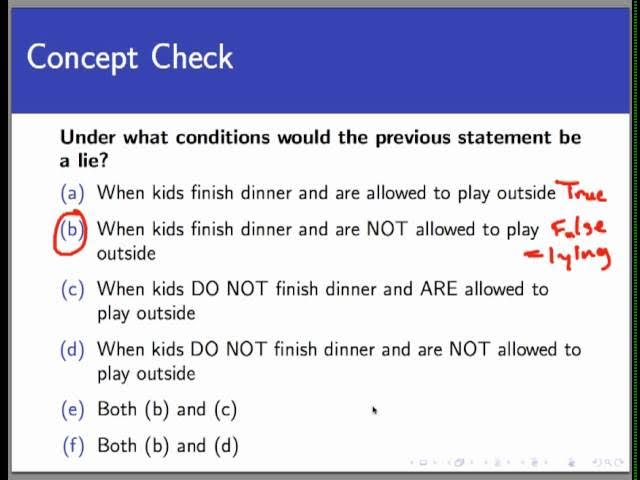
- A concept check is introduced: identifying conditions under which the speaker would be lying about their promise regarding dinner and playing outside.
Analyzing Different Scenarios
- The answer reveals that the promise is only false if children finish dinner but are not allowed to play outside (option B).
- If children finish dinner and can play outside (option A), the promise holds true; thus, it’s clear that option B indicates a lie.
Exploring Other Outcomes
- In scenario D, where kids do not finish dinner and cannot play outside, the original statement remains true as it aligns with logical consistency.
- Scenario C presents complexity: kids don’t meet the condition but still play outside. This does not invalidate the original promise since it doesn’t specify outcomes for unmet conditions.
Concept Check on Another Statement
- Another example is given: "If it is cold outside, I will put on my gloves." Viewers are asked to identify when this statement could be false.
- The correct answer emerges as when it's cold but gloves aren't worn (option A); other scenarios don't contradict the initial claim since they involve unmet conditions.
Key Takeaways
- The main takeaway emphasizes that a conditional statement is always true except in one specific case: when its hypothesis is met but its conclusion fails.