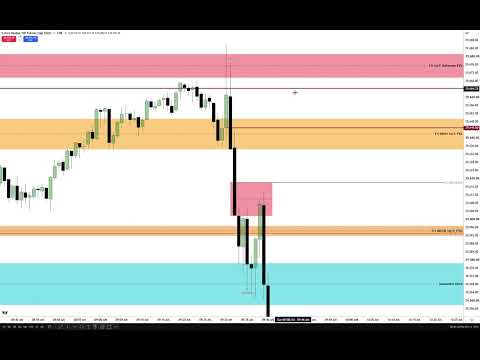
NQ Futures Review & 1st Presented Reflection FVG
Overview of Trading Concepts
Introduction to Fair Value Gaps
- The speaker introduces a review session, aiming to clarify concepts and discuss a PD array mentioned in previous discussions.
- Emphasizes the importance of focusing on trading concepts while humorously acknowledging distractions like eating snacks or browsing online.
Understanding Fair Value Gaps
- Introduces the concept of "first presented fair value gap" and distinguishes it from "first presented fair value gap with displacement."
- Explains that displacement occurs when a candlestick clears a high or low, which is not the case for the current example being discussed.
Importance of Displacement
- Discusses how buy-side imbalances relate to sell-side inefficiencies, highlighting their significance in trading strategies.
- Clarifies that the first presented fair value gap with displacement holds more weight than those without it, impacting future price action.
Analyzing Price Action
- Describes specific candlestick formations and their implications for trading decisions, emphasizing small volume bounces as indicators.
- Stresses the need to analyze price action after 9:30 AM Eastern time for identifying opposing characteristics in gaps.
Trading Strategies Post-Gap Analysis
Macro Time Considerations
- Highlights that understanding macro time frames is crucial when extending analysis into future price movements.
- Mentions managing information overload on charts and encourages traders to maintain their own data management systems.
Reflection Fair Value Gap
- Introduces the concept of reflection fair value gaps as mirror images of first presented gaps, explaining their relevance in trading contexts.
- Reiterates that distinguishing between different types of fair value gaps enhances understanding and application in trading scenarios.
Practical Application in Trading
Real-Time Trading Examples
- Shares insights from recent trades made during market hours, illustrating practical applications of discussed concepts.
- Discusses specific trades executed based on prior analysis and highlights key levels used for decision-making.
Managing Expectations After Holidays
- Advises caution when trading immediately after holidays due to potential irregularities in market behavior.
- Explains how holiday volume can skew expectations and emphasizes adapting strategies accordingly.
Advanced Trading Techniques
Entry Strategies
- Details entry points based on observed market behavior within established fair value gaps, stressing precision in execution.
- Encourages traders to focus on significant imbalances with displacement rather than merely relying on initial gaps alone.
Risk Management
- Discusses risk management techniques such as limiting contract sizes during uncertain market conditions post-holiday periods.
- Emphasizes maintaining discipline by avoiding greed and setting realistic targets based on market context.
Conclusion & Final Thoughts
Summary of Key Insights
- Recaps essential lessons learned about analyzing price action through various types of fair value gaps.
- Reinforces the idea that successful trading requires independent effort and critical thinking beyond standard indicators.
Market Analysis and Study Techniques
Understanding Market Movements
- The analysis focuses on the 7th to 9th gradient levels, indicating a significant resistance fair value gap for the day.
- Observations of market behavior show a sharp decline after reaching certain price points, highlighting the importance of pre-market session analysis.
- The speaker notes that trading conditions can be unpredictable following holidays, suggesting caution in participation during such times.
Importance of Continuous Learning
- Emphasizes the necessity of patience in teaching and learning; encourages students to keep detailed notes and questions for better understanding.
- Recommends maintaining a topical list of questions related to various trading concepts, which aids in structured learning and retention.
Commitment to Mastery
- Acknowledges that studying complex topics requires diligence and effort; highlights that this is part of the learning process.
- Expresses confidence in their unique approach to trading education compared to other methods available, reinforcing commitment to proving effectiveness over time.
Turn any video into a summary like this
YouTube links, meetings, lectures — with transcripts, search, and chat.