Estructura atómica, átomo, electrón, protón, neutrón, número atómico, de masa, ion
Understanding Atomic Structure
Introduction to Atoms
- The video introduces the concept of atomic structure, explaining that an atom is the smallest particle of an element that retains its chemical properties.
- The term "atom" derives from Greek, meaning "indivisible," but modern theory states atoms can be divided without losing their chemical identity.
Components of an Atom
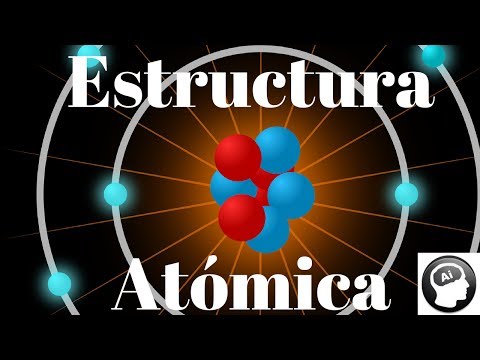
- An atom consists of two main regions: the nucleus and the extranuclear area. The nucleus contains protons (red particles) and neutrons (purple/blue particles).
- Electrons are found in a probabilistic model around the nucleus; their exact location is uncertain, but they are more likely to be found in darker shaded areas.
Size and Scale
- The size of atoms is measured in angstroms; 1 cm can contain approximately 100 million angstroms, illustrating how small atoms are.
- Key components include protons, neutrons, and electrons. Protons have a positive charge, neutrons are neutral, and electrons carry a negative charge.
Subatomic Particles Overview
- Important symbols for subatomic particles:
- Electron: e⁻ (negative charge)
- Proton: p⁺ (positive charge)
- Neutron: n° (neutral)
- Mass differences among these particles are significant; neutrons are slightly heavier than protons while electrons' mass is negligible compared to them.
Atomic Representation
- The helium atom is used as an example for representation:
- Total subatomic particles = nucleons (4), with 2 protons indicating its atomic number.
- To find neutrons in helium: total nucleons minus protons equals neutrons.
Understanding Ions
- In nature, most atoms exist as ions rather than neutral due to electron gain or loss during reactions.
- Cations form when atoms lose electrons (positively charged), while anions form when they gain electrons (negatively charged).
Calculating Ion Charges
Understanding Atomic Structure and Calculating Subatomic Particles
Basic Concepts of Atomic Structure
- The atomic number Z is crucial in identifying an atom, represented at the bottom of the notation. For sodium, Z = 11 .
- The mass number (nucleons) for sodium is 23, indicating a total of 23 particles in the nucleus, which includes both protons and neutrons.
- To find the number of neutrons, subtract the atomic number from the mass number: 23 - 11 = 12 . Thus, sodium has 12 neutrons.
Example with Carbon Atom
- For carbon, with a mass number of 12 and being neutral (no charge), both electrons and protons equal Z = 6 .
- Neutrons are calculated as A - Z = 12 - 6 = 6 , confirming that carbon has six neutrons.
Calculating Atomic Number for Oxygen
- Given oxygen's mass number A = 16 , to find its atomic number Z , we note it’s an anion with two extra electrons: Z + 2 = 10 .
- Solving gives us Z = 8 ; thus, oxygen has eight protons. Neutrons are then calculated as A - Z = 16 - 8 = 8 .
Analyzing Another Element
- For another element where nucleons are given as A =27, if it's a cation losing three electrons:
- Calculate electrons as E = Z -3.
- This leads to finding that if Z =13, then there are ten electrons.
Exam Question on Atomic Structure
- In a typical exam question regarding species containing hydrogen:
- Mass number is noted as 78; atomic number Z is 34.
- Neutrons calculated by subtracting: 44 (from A-Z) and electrons adjusted based on charge leading to 36 total.
Clarification on Subatomic Particles