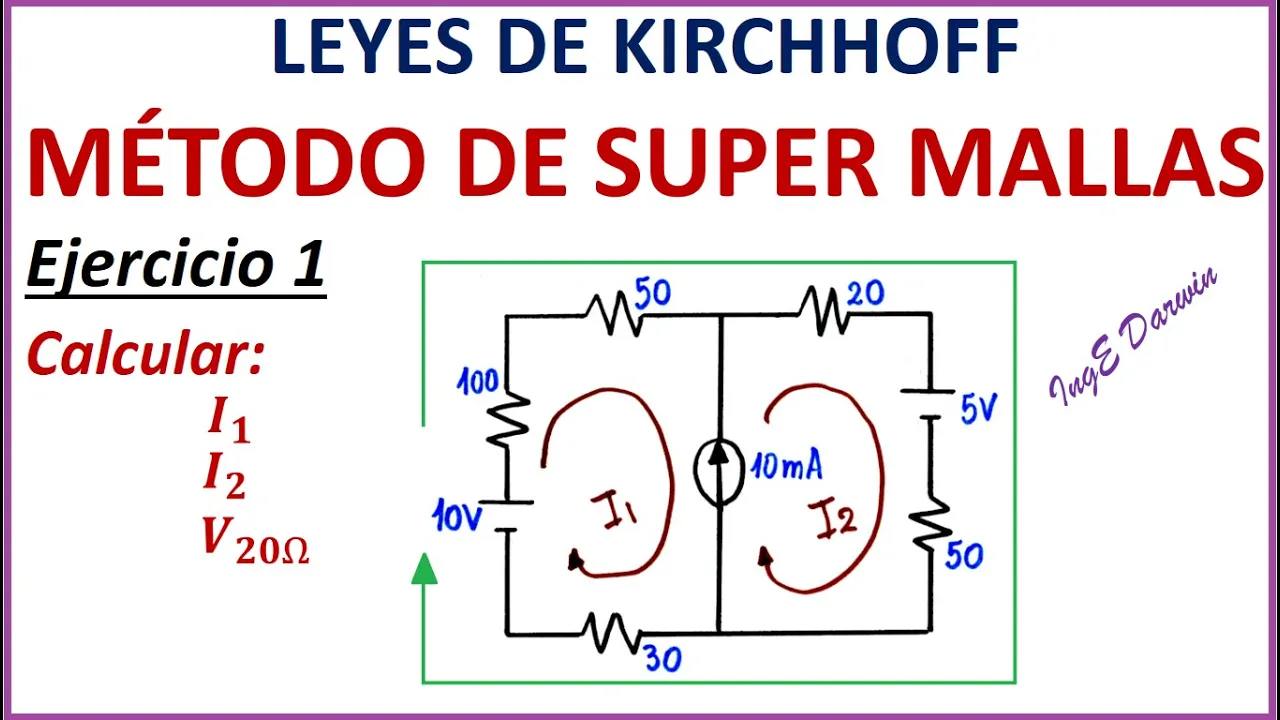
MÉTODO DE SUPER MALLAS (LEY DE KIRCHHOFF VOLTAJE) | Ejercicio 1
Laws of Hip Hop Method in Electrical Circuits
In this section, the speaker introduces the topic of solving electrical circuits using the laws of hip hop method. The focus is on calculating intensity 1, intensity 2, and voltage in a 20-ohm resistor within a circuit with two meshes.
Introduction to Solving Circuits
- The super mesh method is employed due to a current source between two meshes. Kirchhoff's voltage law states that the sum of voltages in a mesh equals zero.
- Identifying current directions involves following voltage sources' directions conventionally or using clockwise assignments for simplification.
- Current directions can be assigned clockwise for ease of resolution. Intensity 1 and intensity 2 are determined based on these assignments.
Equations and Analysis
- Steps for solving depend on the circuit type. Equations equal the number of meshes; here, two equations are formed based on current sources between meshes.
- Analyzing intensities passing through a current source involves subtracting currents with opposite directions but being cautious about which one to subtract first.
Application of Super Mesh Method
This part delves into applying the super mesh method by assuming no current source within the circuit and assigning clockwise directionality to simplify calculations.
Applying Super Mesh Method
- Identifying polarities in elements by following current flow helps determine positive and negative signs across resistors and voltage sources.
- Voltage sources have fixed polarities; larger lines denote positive terminals. Calculating total resistance times current accounts for all components' contributions.
- Formulating equations involves summing resistances multiplied by respective currents while considering polarity signs based on element orientations.
Equation Simplification
- Expressions are built step-by-step by accounting for each component's resistance and corresponding current flowing through it.
Intensities of Current and Circuit Analysis
In this section, the speaker discusses methods for determining current intensities in a circuit using techniques such as substitution and matrices. The process involves solving equations to find the values of currents flowing through different components.
Analyzing Current Intensities
- Despejar de la ecuación número 1 y 2 para utilizar el método de sustitución.
- Despejar y uno y encontrar su valor como 0.172 amperios.
- Calcular la intensidad 2 sumando 0.001 con 0.172 amperios, resultando en 0.272 amperios.
- Confirmar que las intensidades de corriente son positivas, indicando los sentidos correctos asignados inicialmente.
- Calcular el voltaje en una resistencia de 20 ohmios, obteniendo un valor de 0.544 voltios.
Simulation and Verification
This part focuses on simulating the circuit analysis results obtained earlier to verify their accuracy using software tools like Proteus. Measurements are taken using ammeters and voltmeters connected appropriately in the circuit.
Simulation Process
- Utilizar el software Proteus para simular el circuito analizado.
- Medir la corriente 1 obteniendo un valor de 17.2000 amperios y la corriente 2 con un valor de 27.2000 amperios.
- Medir el voltaje en la resistencia de 20 ohmios, registrando un valor de 0.54 voltios.