Introduction to economics | Supply, demand, and market equilibrium | Economics | Khan Academy
Introduction to Economics
Adam Smith and the Invisible Hand
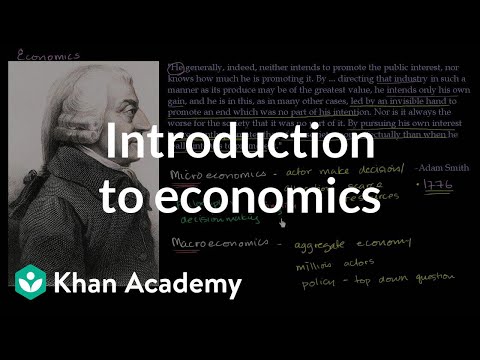
- The discussion begins with a quote from Adam Smith, regarded as the first real economist, from his work The Wealth of Nations published in 1776, coinciding with the American Declaration of Independence.
- Smith states that individual economic actors do not intend to promote public interest; they act primarily for their own gain. This self-interest is guided by an "invisible hand" that often leads to unintended societal benefits.
- The concept of the "invisible hand" suggests that when individuals pursue their self-interest, it can lead to positive outcomes for society as a whole, even if those outcomes were not intended.
- Smith argues that pursuing one's own interests can sometimes be more beneficial for society than direct attempts to promote societal well-being. This idea is foundational to capitalism.
- The speaker emphasizes how both the Declaration of Independence and Smith's ideas shaped American values regarding democracy and capitalism.
Microeconomics vs. Macroeconomics
- The speaker explains that Adam Smith's statements encompass both microeconomic (individual actions) and macroeconomic (aggregate economy) perspectives.
- Microeconomics focuses on individual actors—people, firms, households—and their decision-making processes regarding scarce resources.
- Macroeconomics examines the economy as a whole, addressing policy-related questions such as taxation and regulation impacts on productivity.
- Scarce resources are defined as limited resources like food, water, money, time, or labor. Understanding how these are allocated is crucial in economics.
- Macroeconomic analysis looks at aggregate effects from millions of individual decisions and often involves top-down policy considerations.
Mathematical Rigor in Economics
- Both microeconomics and macroeconomics strive for mathematical rigor in analyzing economic behaviors and policies.
- Philosophical foundations guide economic theories about decision-making but require simplifications for mathematical modeling purposes.
- Simplifying assumptions (e.g., rational behavior or self-interest maximization) help clarify thinking but may overlook complex human motivations.
Understanding the Limitations of Economic Models
The Role of Simplifications in Economics
- Economic conclusions can appear strong due to simplifications, but they often rely on assumptions that may be incorrect or overly simplified.
- Macro-economics is particularly prone to these issues, as it attempts to aggregate complex human behaviors across millions of individuals, leading to unpredictable interactions.
- While mathematical models in economics are valuable, they must be approached with caution and an understanding of their foundational assumptions.
Importance of Intuition Over Mathematics
- A key takeaway from studying economics is maintaining focus on true intuition rather than solely relying on mathematical models.
- Alfred Knopf's quote highlights that economists often express obvious truths in complex terms, emphasizing the need for clarity and comprehension in economic discussions.
Predictions and Their Pitfalls
- It's crucial for economists to retain a sense of intuition about the mathematics involved; this helps identify when models may lead to misleading conclusions due to oversimplifications.
- Lawrence J. Peter's quote underscores the unpredictability inherent in macro-economics, where predictions frequently fail to materialize as expected.
Turn any video into a summary like this
YouTube links, meetings, lectures. With transcripts, search, and chat.