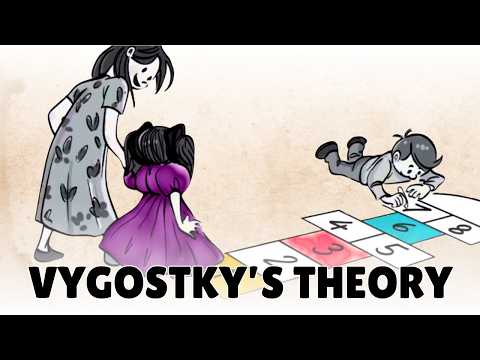
Vygotsky's Theory of Cognitive Development in Social Relationships
Vygotsky's Theory of Social Development
Overview of Vygotsky's Ideas
- Vygotsky's theory emphasizes the importance of community and language in learning, contrasting with Piaget’s stage-based cognitive development.
- He posits that children develop through social interactions rather than fixed stages, starting with four elementary mental functions: attention, sensation, perception, and memory.
Zone of Proximal Development (ZPD)
- The ZPD is defined as the space between what a child can do independently and what they can achieve with guidance from a "more knowledgeable other."
- An example illustrates this concept: a boy receives support to learn standing while a girl does not, leading to differing developmental outcomes despite similar initial abilities.
Learning vs. Development
- Vygotsky argues that within the ZPD, learning can occur before development; children can acquire skills beyond their natural maturity when supported appropriately.
- He connects speech and thought processes, stating that inner speech evolves from external dialogue through internalization.
Legacy and Educational Implications
- Despite his early death at 37 in 1934, Vygotsky became a pivotal figure in psychology. His advice for educators highlights the value of facilitating conversations among students to enhance independent thinking.
Questions for Reflection