Causalidad en epidemiología
Causality in Epidemiology
The discussion delves into the concept of causality in epidemiology, exploring the complexities of determining cause and effect relationships in health and social sciences.
Causal Relationships in Epidemiology
- In health and social sciences, many causes are insufficient to explain the observed effects, necessitating refined methods to establish causal relationships accurately.
- Evaluating causal associations involves distinguishing between mere correlations and true causation. It questions whether observed associations are genuinely causal.
- Different types of causal relationships exist, including direct relationships where a factor directly causes a disease, contrasting with indirect causes that involve multiple steps or processes.
Models of Causality
- Various models of causality are proposed to explain different types of causal relationships. Roadmap presents models with distinct steps or possibilities to illustrate potential causal links.
- Models include scenarios where a cause is neither necessary nor sufficient, highlighting complex relationships prevalent in chronic diseases with multiple contributing factors.
Understanding Causal Relationships
- Exploring relationships where factors may be necessary but not sufficient for disease manifestation provides insights into how combinations of factors interact over time to produce specific outcomes.
- Complex models depict situations where causes are neither necessary nor sufficient individually but collectively contribute to disease development, reflecting the multicausal nature of chronic illnesses.
Evidences for Causal Relationships
The conversation shifts towards discussing the historical context of establishing causality in epidemiology through evidence-based approaches like Koch's postulates.
Koch's Postulates and Causality
- Koch's postulates emerged during the discovery of microbial agents, emphasizing the need for isolating and culturing pathogens to demonstrate their role as causative agents in diseases like tuberculosis.
Detailed Discussion on Causality Models
The speaker delves into the importance of replicating experiments in host organisms, referencing historical biological and human experiments. They emphasize the need to re-culture findings in laboratories for validation.
Understanding Causality Models
- Acknowledgment of the significance and criticisms of causality models, highlighting ethical concerns regarding exact replication in humans or animals.
- Emphasis on microbiological models and infectious disease models as tools for inferring causation in scientific research.
- Introduction to the complexity of evaluating health conditions across populations, necessitating inference processes for causal determinations.
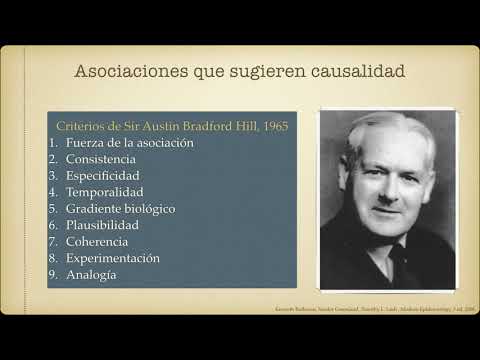
- Reference to Sir Austin Bradford Hill's 1965 postulates as pivotal for determining causal associations in scientific research.
Key Postulates for Establishing Causality
The speaker discusses Sir Austin Bradford Hill's nine postulates that remain relevant today, derived from a comprehensive review of scientific literature.
Sir Austin Bradford Hill's Postulates
- Description of the compilation process leading to nine enduring postulates by Mr. Gil based on influential thinkers' works.
- Clarification that these lists are not exhaustive but serve as guidelines for assessing potential causal relationships.
- Importance of considering these postulates during experiments to evaluate coherence, experimentation, and analogy.
Fundamental Principles in Assessing Associations
The speaker elaborates on essential principles such as strength of association, consistency, specificity, temporality, and more crucial for determining causality.
Principles for Assessing Associations
- Explanation of the concept of strength of association through statistical evidence like the increased risk observed in chimney sweepers.
- Cautionary note on high associations potentially confounded by factors like maternal age in certain syndromes.
Biological Gradient and Plausibility in Causation
The discussion delves into the biological gradient concept, emphasizing the dose-response relationship in causation and the importance of plausibility in assessing associations.
Biological Gradient
- The biological gradient asserts that a cause must always precede an effect. It refers to dose-response curves where higher exposure leads to a greater response.
Plausibility in Causation
- Plausibility focuses on whether an association is biologically possible, serving as a starting point for exploring causal relationships.
- Biases can influence biological plausibility, often rooted more in prior beliefs than empirical data due to lack of precise indicators.
Coherence and Experimentation in Causal Inference
This segment explores coherence as the cause-effect relationship based on disease history and experimentation's role in understanding causality.
Coherence
- Coherence centers on the cause-effect relationship within the natural history of diseases, illustrated through pathological changes in smokers' bronchi.
Experimentation
- Experimentation involves interrupting harmful exposures to observe if diseases regress, exemplified by reduced mortality rates in ex-smokers over time.
Analogy and Subjectivity in Causal Inference
Analogy serves as a tool for comparing historical events to current issues, while subjectivity underscores personal beliefs influencing causal inference.
Analogy
- Analogies draw parallels between past events like thalidomide causing birth defects and present scenarios to understand causal relationships.
Subjectivity