Glucogeno Parte 1
Introduction to Glycogen Metabolism
Overview of Glycogen
- Dr. Victoria Aguirre introduces glycogen as the primary carbohydrate storage form in animals, analogous to starch in plants.
- The session aims to describe glycogenolysis and glycogenesis stages, highlighting metabolic regulation differences between liver and muscle tissues.
- Discussion includes biochemical foundations of glycogen storage diseases (glycogenopathies).
Structure and Storage of Glycogen
- Glycogen appears as compact granules, about 35 nanometers in diameter, surrounded by enzymes for metabolism.
- In a 70 kg adult male, hepatic glycogen levels fluctuate significantly based on daily intake.
Postprandial Glycogen Dynamics
Glycogenesis and Degradation
- After meals (postprandial), significant peaks in glycogenesis occur, leading to gradual degradation during fasting periods.
- Muscle tissue utilizes glucose from complex carbohydrates post-meal for energy storage as glycogen.
Muscle Activity and Energy Release
- Muscle glycogen serves its own energy needs during contraction through degradation into glucose subunits.
- This process can occur via aerobic or anaerobic glycolysis depending on exercise type.
Chemical Structure of Glycogen
Structural Characteristics
- Glycogen is a highly branched homopolysaccharide with non-reducing ends facilitating further glucose incorporation.
- Linear subunits primarily feature alpha 1–4 linkages; branching points are characterized by alpha 1–6 linkages.
Biological Significance of Branching
- The branched structure allows rapid release of glucose monomers when needed, enhancing cellular storage efficiency while reducing osmotic pressure.
Stages of Glycogenolysis
General Process Overview
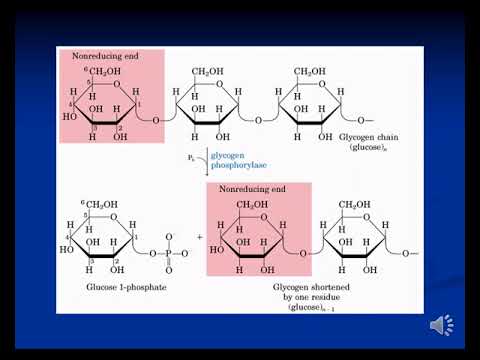
- The first step involves phosphorolysis at non-reducing ends of glycogen granules.
- When four residues remain before a branching point, glucosyl transfer occurs followed by debranching at alpha 1–6 junctions.
Enzymatic Actions in Liver vs. Muscle
- Glucose release occurs only in the liver due to the presence of glucose 6-phosphatase; muscle uses it internally for energy production.
Key Enzymes in Glycogenolysis
Role of Glycogen Phosphorylase
- The crucial enzyme for glycogenolysis is glycogen phosphorylase which catalyzes the breakdown process using inorganic phosphate.
Mechanism Details
- This enzyme facilitates the release of glucose 1-phosphate while shortening the glycan chain progressively until only four residues remain.
Debranching Enzyme Functionality
Action Steps
- Once phosphorylase cannot act due to steric hindrance, a debranching enzyme transfers three glucoses from one branch to another chain end.
Hidrólisis Process
- The remaining single residue at the branch point is released as free glucose through hydrolysis rather than phosphorolysis.
Conversion and Utilization
Transformation for Energy Use
- Released glucose 1-phosphate must convert into glucose 6-phosphate via phosphoglucomutase before entering cellular metabolism pathways.
Hepatic Functions Under Stress
- In hypoglycemic conditions or stress situations like adrenaline response, liver can release free glucose into circulation due to unique enzymatic capabilities.
Glucose Metabolism in Muscle Tissue
Glycolysis and Energy Production
- In muscle tissue, glucose must be utilized within the tissue itself, entering glycolytic pathways to transform into pyruvate, especially during intense and short-duration exercise.
- Anaerobic glycolysis occurs to generate energy for muscle contraction; a comprehensive overview of glycogen degradation is provided, highlighting the roles of phosphorylase and debranching enzymes.
Glycogenesis Process
- Glycogenesis refers to the anabolic process of synthesizing glycogen from smaller subunits, resulting in a highly branched polymer with greater molecular weight.
- This anabolic process requires an initial investment of energy; glucose will undergo phosphorylation as part of its conversion into glycogen.
Isomerization and Activation
- The transformation involves isomerizing glucose 6-phosphate to glucose 1-phosphate, preparing it energetically for incorporation into a preformed polymer.
- The addition occurs through alpha 1,4 linkages while generating branches via alpha 1,6 glycosidic bonds; this process takes place in both liver and muscle tissues under insulin's influence.
High Glucose Concentration Requirement
- A high concentration of circulating glucose is necessary for uptake by tissues using either hexokinase or glucokinase depending on the specific tissue type.
- Glucose 6-phosphate must be converted to glucose 1-phosphate and prepared energetically for subsequent reactions involving UDP-glucose formation.
UDP-glucose Formation
- UDP-glucose forms from glucose 1-phosphate through a reaction that releases pyrophosphate (PPi), which drives the energetic preparation of monomers for polymerization.
- The chemical structure shows that glucose 1-phosphate binds with uridine triphosphate (UTP), facilitating high-energy phosphate transfer upon cleavage.
Role of Pyrophosphate in Glycogenesis
Energy Dynamics in Polymerization
- Cleavage of UTP releases pyrophosphate which hydrolyzes into two orthophosphates; this reaction energizes the monomer preparation for covalent bonding within glycogen structures.
Chemical Structure Insights
- The net reaction illustrates how UDP-glucose prepares monomers energetically for attachment to pre-existing glycogen chains; this step is crucial in maintaining efficient synthesis rates.
Discovery Contributions
Historical Context
- Recognition is given to Dr. Luis Federico Leloir who discovered UDP-glucose as an important intermediate in glycogenesis during the early '70s, contributing significantly to carbohydrate biosynthesis research.
Mechanism of Glycogen Synthase Action
Enzymatic Functionality
- The chemical structure allows UDP-glucose to approach preformed residues where it adds new units at non-reducing ends via alpha 1,4 linkages facilitated by glycogen synthase.
Efficiency Factors
- Glycogen synthase releases UDP upon adding each glucose unit; initial energy investment aids covalent bond formation between growing chains.
Branching Enzyme Activity
Branching Mechanism
- Glycogen synthase can add up to seven UDP-glucoses before steric hindrance limits further activity; branching enzyme then cuts approximately seven residues off existing chains and transfers them elsewhere creating new branches via alpha 1,6 linkages.
Structural Implications
- These branch points are typically no more than four residues apart enhancing solubility and allowing faster enzymatic action during both synthesis and degradation processes.
Role of Glycogenin
Core Protein Functionality
- Each glycogen particle contains a core protein called glycogenin which initiates complex architecture through autoglucosylation using UDP-glucose on its own tyrosine residues.
Stability Considerations
- Glycogenin remains central within granules ensuring that total degradation does not occur until all other components are processed first.
Turn any video into a summary like this
YouTube links, meetings, lectures. With transcripts, search, and chat.