Summary of the AI Fluency Framework | AI Fluency
AI Fluency: Mastering the 4D Framework
Understanding AI Fluency
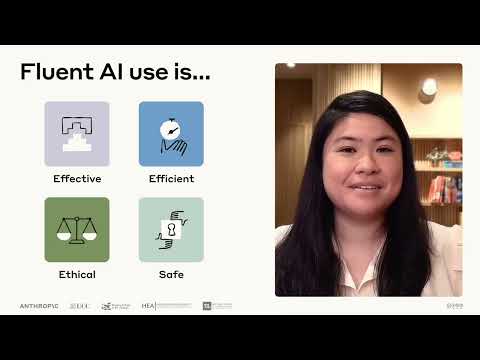
- AI fluency involves using AI effectively, efficiently, ethically, and safely, transcending mere tool usage.
- It emphasizes skills that will remain relevant regardless of future AI developments.
- The core principle is being a responsible human in the loop, enhancing existing work rather than relying solely on automation.
The 4D Framework Overview
- The framework consists of four interconnected competencies: delegation, description, discernment, and diligence. These are essential for effective collaboration with AI.
Delegation: Splitting Work Effectively
- Problem Awareness: Clearly define your goals before engaging with AI to maintain focus throughout the process. What does success look like?
- Platform Awareness: Understand different AI systems' capabilities and limitations to choose the right tool for your task. This is akin to selecting transportation based on circumstances.
- Task Delegation: Divide tasks between yourself and AI by leveraging each other's strengths—humans provide creativity while AIs offer speed and consistency.
Description: Communicating with AI
- Product Description: Specify desired outcomes in detail (e.g., email length, key messages) to guide the final result effectively.
- Process Description: Instruct how you want the task approached; think of it as teaching another person how to perform it step-by-step.
- Performance Description: Define how you want the AI to behave during interactions (e.g., critical editor vs supportive brainstorming). This shapes responses from the assistant.
Discernment: Evaluating Outputs
- Product Discernment: Assess quality by checking accuracy and whether suggestions broaden your perspective or help achieve goals effectively.
- Process Discernment: Analyze how outputs were generated; understanding reasoning helps build trust in good results while identifying issues when they arise.
- Performance Discernment: Evaluate if the interaction met your needs; did it stay within its defined role? Adjustments can be made for future interactions based on this feedback loop.
Diligence: Ethical Collaboration with AI
- Creation Diligence: Choose appropriate AI systems thoughtfully considering privacy and context suitability for specific tasks or analyses.
- Transparency Diligence: Be honest about how you've utilized AI in your work; this showcases your ability to collaborate fluently with technology as a professional skill now valued in many fields.
- Deployment Diligence: Take responsibility for what you create using AI; verify accuracy and appropriateness before sharing outputs publicly or professionally.(472)
Practicing the 4Ds
- Engaging actively with all four competencies enhances fluency over time through practice; thoughtful delegation, clear descriptions, critical evaluation of outputs, and responsible ownership lead to improved collaborations with AI tools.(491)