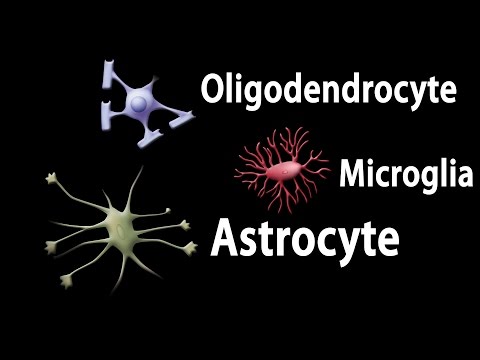
Neuroscience Basics: Neuroglia Functions, Animation.

Neuroscience Basics: Neuroglia Functions, Animation.

Introducción a las Células del Cerebro

Neuronas y Glía

  • El cerebro humano contiene miles de millones de neuronas, que son esenciales para la comunicación cerebral.
  • Existen trillones de células de soporte llamadas glía o células gliales, que son cruciales para el funcionamiento neuronal.
  • Los tipos principales de células gliales incluyen oligodendrocitos, microglía y astrocitos.

Oligodendrocitos

  • Los oligodendrocitos envuelven los axones neuronales formando la vaina de mielina, que actúa como un aislante eléctrico.
  • La mielina acelera la transmisión de señales eléctricas; sin oligodendrocitos, la propagación sería 30 veces más lenta.

Microglía

  • La microglía son macrófagos especializados en el sistema nervioso central que eliminan células muertas y patógenos.
  • Altas concentraciones de microglía indican infección, trauma o accidente cerebrovascular.

Astrocitos

  • Los astrocitos son las células gliales más abundantes y diversas funcionalmente; proporcionan soporte estructural a las neuronas.
  • Estos astrocitos dirigen el crecimiento neuronal y la formación de sinapsis mediante sus procesos llamados pies perivasculares.

Funciones Adicionales de los Astrocitos

  • Mantienen la composición química del líquido extracelular al regular neurotransmisores como glutamato y GABA.
  • Absorben iones potasio liberados por neuronas en sinapsis, regulando así su concentración en el espacio extracelular.

Comunicación entre Astrocitos y Neuronas

  • Se ha demostrado que los astrocitos pueden comunicarse eléctricamente con las neuronas y modificar señales transmitidas.
  • Pueden liberar gliotransmisores al ser estimulados, sugiriendo su papel en funciones comunicativas del cerebro.

Tumores Cerebrales

  • A diferencia de las neuronas, que tienen poca capacidad para renovarse, las células gliales pueden dividirse durante toda la vida.
  • Las células gliales son la principal fuente de tumores cerebrales.

Convierte cualquier video en un resumen como este

Videos de YouTube, reuniones, clases. Con transcripción, búsqueda y chat.

Video description

Functions of major glia (glial cells) in the brain: oligodendrocytes, microglia, and astrocytes (the other cells of the brain). Purchase a license to download a non-watermarked version of this video on AlilaMedicalMedia(dot)com Check out our new Alila Academy - AlilaAcademy(dot)com - complete video courses with quizzes, PDFs, and downloadable images. Voice by: Sue Stern ©Alila Medical Media. All rights reserved. A human brain contains billions of neurons. Neurons are probably the more important and better-known cells of the brain as they carry out the brain’s communication function. Less known are some trillions of support cells called glia, or glial cells. The glia may not be the center of attention, but without them, neuron functions would be impossible. The major types of glial cells in the brain include: oligodendrocytes, microglia, and astrocytes. Oligodendrocytes are specialized cells with long processes that wrap around axons of neurons to form the myelin sheath. The myelin sheath acts like an electrical insulator around a wire. It helps to speed up the electrical signals that travel down an axon. Without oligodendrocytes, an action potential would propagate 30 times slower! Microglia are special macrophages found only in the central nervous system. They wander through the brain tissue, phagocytizing dead, injured cells and foreign invaders. High concentrations of microglia are an indication of infection, trauma or stroke. Astrocytes are the most abundant and functionally diverse glia. These star-shaped glial cells provide supportive frameworks to hold neurons in place. They provide neurons with nutrients such as lactate. They also produce growth factors that promote neuron growth and synapse formation. It’s been suggested that astrocytes can control how a neuron is built by directing where to make synapses or dendrites. Through their processes, known as perivascular feet, astrocytes induce endothelial cells of blood vessels to form tight junctions. These tight junctions are the basis of the blood brain barrier that restricts the passage of certain substances from the bloodstream to the brain tissue. Astrocytes help to maintain the chemical composition of the extracellular fluid. They express membrane transporters for several neurotransmitters such as glutamate, ATP and GABA, and help to remove them from synaptic spaces. Astrocytes also absorb potassium ions released by neurons at synapses. This helps to regulate potassium concentrations in the extracellular space. Abnormal accumulation of extracellular potassium is known to cause epileptic neuronal activity. Recently, it has been shown that astrocytes can also communicate electrically with neurons and modify the signals they send and receive. In a manner similar to neurons, astrocytes can release transmitters, called gliotransmitters, upon stimulation. This suggests that astrocytes maybe involved DIRECTLY in the communication functions of the brain. From the clinical viewpoint, neurons have little capacity for renewal and therefore rarely form tumors. On the contrary, glial cells are capable of dividing throughout life and are the primary source of brain tumors. All images/videos by Alila Medical Media are for information purposes ONLY and are NOT intended to replace professional medical advice, diagnosis or treatment. Always seek the advice of a qualified healthcare provider with any questions you may have regarding a medical condition.