UD5: El sexenio revolucionario (1868-1874) (1ª parte): Gobierno provisional y monarquía de Amadeo I
Introduction to a Tumultuous Period in Spanish History
Overview of the Political Landscape
- The discussion begins with an introduction to a six-year period marked by significant political turmoil and instability following the fall of Isabel II.
- This era is characterized by a provisional government, the establishment of a new monarchy, and Spain's first republican experience, which is anticipated to be unsuccessful.
Crisis Leading to Revolution
- The crisis of 1868 is highlighted as both an economic and political failure, with issues such as resource scarcity and financial difficulties impacting governance.
- A coalition against Isabel II forms due to her authoritarian rule, leading to widespread discontent among various political factions.
Revolutionary Movements
- Rebels accuse Isabel II's government of corruption and authoritarianism, claiming it undermines national sovereignty by ignoring parliamentary authority.
- The revolutionary junta demands universal suffrage, freedom of press and religion, abolition of certain laws like the death penalty, and reforms in military service obligations.
Establishment of Provisional Government
Transition After Isabel II
- Following military victories over Isabel's forces in September 1868, she flees Spain; a provisional government led by General Serrano is established.
- Elections for constituent cortes are called to draft a new constitution based on universal male suffrage.
New Constitutional Framework
- The elections result in an anti-Bourbon coalition that seeks to maintain monarchy but without Isabel II or her family.
- The 1869 Constitution introduces democratic principles including rights declarations and attempts at reducing state repression seen under previous regimes.
Challenges Faced by Amadeo I
Reign Begins Amidst Opposition
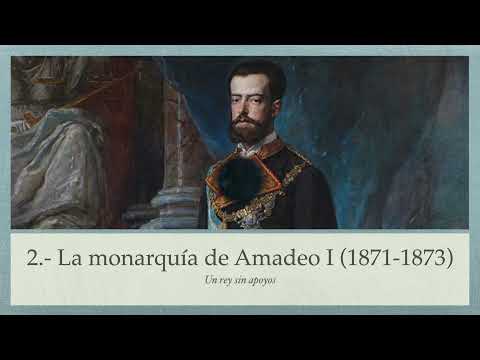
- Amadeo I ascends the throne in early 1871 but faces immediate challenges from multiple sectors including republicans and conservatives who oppose his rule.
- His reign lasts until February 1873 amidst ongoing conflicts with various groups dissatisfied with his leadership style.
Socioeconomic Struggles
- Republicans emerge as voices for social change but lack cohesion; they are divided between unitary and federal ideologies.
- Tensions arise with the Catholic Church due to reduced privileges under the new regime promoting religious freedom.
Economic Policies Under Amadeo I
Economic Reforms
- Minister Figuerola implements tax reductions on imports while introducing income taxes aimed at wealthier classes—policies that provoke backlash from conservative elites.
Ongoing Conflicts
- The Carlist Wars resurface as royalists challenge Amadeo’s legitimacy; this conflict adds further strain during his reign alongside colonial tensions in Cuba.
Conclusion: Fall of Monarchy & Rise of Republicanism
Abdication of Amadeo I
- Facing insurmountable opposition from diverse factions within Spain, Amadeo renounces his crown on February 10th, 1873.
Shift Towards Republicanism
- In response to his abdication, Spanish cortes declare a republic amid ongoing internal strife reflecting deep divisions within society.
Turn any video into a summary like this
YouTube links, meetings, lectures. With transcripts, search, and chat.