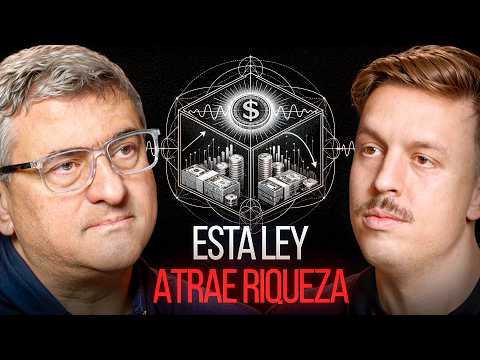
Experto En Kabbalah Revela La Ley Que Te Hace Rico Según La Ciencia | Mario Sabán
The Concept of Constant Oscillation in Business
Application for Entrepreneurs
- The concept of constant oscillation is crucial for entrepreneurs, emphasizing the importance of understanding market dynamics.
- Historical references to Levi Morteira and Josef de la Vega illustrate that economic principles reflect spiritual laws, suggesting a deeper connection between the two realms.
- Studying Kabbalah can provide entrepreneurs with insights into economic laws, particularly the principle of expansion and contraction within markets.
- Market prices are unpredictable; they fluctuate constantly, highlighting the uncertainty inherent in economics.
- Recognizing periods of expansion and contraction helps individuals avoid dangerous financial behaviors during growth phases.
Understanding Expansion vs. Growth
- Continuous investment during an expansion phase can lead to financial peril if savings and liquidity are neglected.
- Age influences risk tolerance; younger individuals may embrace higher risks while older individuals should be cautious about their expansions.
- True growth may require periods of conservation rather than relentless expansion, as unchecked growth can lead to chaos.
- Biological systems exemplify the need for balance between intake (expansion) and output (contraction), which applies to personal finance as well.
- A state of excessive contraction or expansion is detrimental; balance is essential for sustainable success.
Insights from Hebrew Alphabet
- The Hebrew alphabet's structure illustrates that true strength lies in internal energy rather than outward displays of power.
- The letter Yod represents potential energy despite its small size, symbolizing that true power does not require external validation or display.
- Individuals with strong internal resources do not need to showcase their capabilities externally; confidence comes from within.
Spiritual Guidance for Entrepreneurs
- Entrepreneurs should focus on cultivating inner strength instead of seeking external validation through visible success markers.
- An anecdote comparing profit margins between banks highlights that smaller operations can yield greater profitability without needing grand displays of success.
- This emphasizes that true value often lies beneath surface appearances; substantial gains can come from modest beginnings.
Caution Against Apathy and Appearance
- Many young people equate self-worth with material possessions, leading to a crisis where appearance overshadows genuine identity and value.
- The distinction between having versus being becomes blurred when societal pressures prioritize superficiality over authenticity.
- Historical examples like Napoleon’s downfall illustrate how unchecked ambition without strategic restraint leads to failure.
Lessons from History
- Napoleon's rapid expansion resulted in catastrophic losses due to lack of strategic contraction; this serves as a cautionary tale against aggressive growth strategies.
- In contrast, Rome's gradual approach allowed it to sustain its empire over centuries by balancing conquest with integration.
- Future entrepreneurs must heed these lessons: real growth involves understanding when to expand and when to consolidate.
Conclusion on Inner Strength vs. Outer Display
- Emphasizing inner peace over outward appearances fosters resilience against societal pressures related to success.
- The ongoing struggle between being authentic versus projecting an image reflects broader societal issues impacting self-esteem today.
- Ultimately, true strength stems from internal stability rather than external validation or material accumulation.
Turn any video into a summary like this
YouTube links, meetings, lectures. With transcripts, search, and chat.