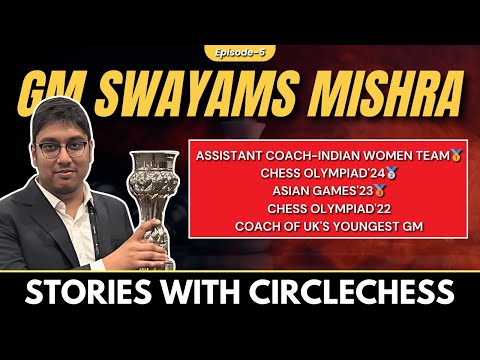
The Secret Ingredient to Chess Success ft. GM Swayams Mishra | Stories with CircleChess | Episode 5
Introduction to Grandmaster Swam Mishra
Achievements and Background
- The host congratulates Grandmaster Swam Mishra for coaching the Indian women's chess team to a gold medal, highlighting this as a remarkable achievement.
- Discussion on chess players' superstitions; the speaker suggests that talented players (1500-1600 rating) should focus less on opening preparation and more on enjoying the game.
Early Chess Journey
- Swam Mishra reflects on his first tournament experience in 1998 at age six, where he was introduced to chess by his father as a family bonding activity.
- His sister represented their state in national competitions before pursuing a medical career, while he continued to develop his skills through observation and practice.
Transitioning to Professional Chess
Decision-Making Process
- He credits his supportive parents for guiding him towards participating in tournaments and making decisions about his chess career.
- In 2007, he decided to pursue chess professionally while considering academics as an alternative career path.
Journey Towards Becoming a Grandmaster
- Describes his long journey filled with tournaments, hard work, wins, losses, and learning from mistakes as essential parts of growth in chess.
Training Experience and Coaching Career
Shift from Player to Coach
- Discusses how he began training part-time around 2012 while focusing on improving himself as a player before transitioning fully into coaching around 2018.
Impact of Coaching
Coaching Insights from a Chess Trainer
Achievements and Contributions
- The speaker expresses pride in representing their country as a trainer and contributing to the team's success, particularly in winning medals.
- Acknowledgment of coaching the Indian women's team and achieving gold is highlighted as a significant accomplishment.
Coaching Approaches: Men's vs. Women's Teams
- The speaker discusses the unique challenges of coaching women's teams compared to men's teams, emphasizing different preparation strategies.
- Preparation for national teams involves distinct approaches based on whether it’s an individual or team event, affecting game dynamics.
- In team events, strategies may include neutralizing opponents on certain boards while seeking chances on others, contrasting with individual games where players typically aim for wins.
Balancing Individual and Team Training
- The speaker explains how they balance individual training with team training during preparation camps before tournaments.
- Emphasis is placed on strategizing against strong opponents once player lists are available closer to tournament dates.
Memorable Experiences at the Olympiad
- The speaker shares humorous anecdotes about superstitions during competitions, including experiences with fellow coach Arjun Gan.
- Mention of personal superstitions among chess players; some find them helpful while others do not see value in them.
Coaching During Tournaments
- The approach to coaching students during important tournaments varies depending on whether the coach travels with them or conducts online sessions.
Approaches to Coaching Young Chess Players
Tailoring Strategies for Individual Players
- Coaches should adapt their strategies based on the specific games and styles of opponents, focusing on preparation tailored to each match.
Preparing Talented Young Players
- Different levels of players require varied preparation; for instance, lower-rated players (1500-1600) should not overly focus on openings to maintain creativity.
Importance of Enjoyment in Chess
- Coaches must ensure that young players enjoy chess to prevent loss of interest. Enjoyment leads to a stronger work ethic and resilience through wins and losses.
The Role of Educational Institutions in Development
- Universities like K University play a crucial role by providing financial support and allowing students to balance academics with chess tournaments, fostering talent development.
Qualities Essential for Young Prodigies
- Key qualities for young prodigies aspiring to become Grandmasters include fearlessness in play and consistent hard work, which distinguishes them from other players.
The Impact of Pressure on Young Chess Players
Balancing Pressure and Performance
- While pressure can be beneficial for achieving records, it largely depends on parental influence; excessive pressure may hinder performance rather than help.
Characteristics of Successful Young Players
- Successful young players often exhibit fearless gameplay without concern for ratings or losing, coupled with a strong commitment to continuous improvement.
The Coach's Role in Player Development
Guidance and Parental Involvement
- Coaches provide essential guidance but must also communicate effectively with parents who can reinforce training goals at home.
Trust Between Coach and Student
Coaching Strategies and the Role of Technology in Chess Training
Approaches to Student Engagement
- The coach emphasizes the importance of understanding student willingness to engage in chess, suggesting that if a student is reluctant, it's acceptable as they will eventually need to participate.
- Coaches are encouraged to play different formats of chess (e.g., rapid tournaments) to better understand the practical implications of their advice, which may sometimes be impractical.
Adapting Coaching Styles
- Each student is unique; while there is a general approach for most students, adaptation based on individual styles is crucial.
- Coaches should push students out of their comfort zones by addressing areas where they can improve, fostering growth beyond their existing expertise.
Influence of Technology on Chess Training
- The coach believes AI plays a significant role in chess training but acknowledges it is still in its early stages compared to other sports like cricket.
- There’s potential for AI tools to provide valuable insights about opponents and player performance, particularly benefiting coaches who can analyze data effectively.
Future Developments in AI and Chess
- The coach anticipates significant advancements in AI tools for chess over the coming years, with platforms like Circle Chess already integrating these technologies.
Personal Experience with Young Talent
- Reflecting on coaching Shus Royel, the youngest Grandmaster in the UK at age 15, the coach describes this experience as enjoyable due to her hard work and potential.
- The relationship began after a tournament where the coach made an error against Royel; subsequent collaboration was initiated by her parents seeking assistance.
Coaching Journey and Challenges
- The coach recounts working with Royel during critical moments leading up to her GM title, emphasizing flexibility despite personal commitments.
Achievements and Insights in Chess
Young Players' Journey to Success
- A young player faced challenges in a tournament, needing draws but ultimately losing, highlighting the unpredictability of competitive chess.
- Despite setbacks, this player became the UK's youngest Grandmaster (GM), showcasing potential for future achievements and the importance of perseverance.
- The speaker reflects on their contribution to students' journeys, emphasizing the joy derived from being part of significant milestones in chess history.
Motivation and Mindset
- Young players exhibit fearless play, which helps them navigate tough periods without worrying about losses or setbacks.
- The speaker contrasts their own experience at age 26 with younger players who have fewer responsibilities, allowing them to focus solely on improving their game.
- Observations reveal that young players often enjoy the game regardless of outcomes, suggesting a shift towards a more positive mindset compared to previous generations.
Recommended Chess Literature
- The speaker lists favorite chess books:
- "Instructive Modern Chess Masterpieces" as number one,
- followed by "D's Endgame Manual",
- and works by Kasparov such as "Migrate Predecessors".
Advice for Aspiring Chess Players
- Emphasizing enjoyment in playing is crucial; it fosters creativity over rigid adherence to opening theory.
- Encouragement is given to explore personal ideas rather than focusing solely on established openings.
Rapid Fire Segment Highlights
- Preference for classical chess over blitz is noted, although enjoyment in blitz has increased recently.
- The speaker discusses teaching challenges: moving students from 1500 to 2000 may seem easier but requires strong foundational skills. Transitioning from 2000 to 2500 presents unique difficulties due to tougher competition.
Chess Insights with Grandmaster Swams Mishra
Chess Preferences and Background
- The speaker expresses a preference for chess, whether online or over the board, indicating a strong connection to the game. They also mention their background as an engineer, suggesting a logical approach to problem-solving in chess.
Humor in Chess
- When asked about the funniest chess player, the speaker names Magnus Carlsen, highlighting his unique personality that may not resonate with everyone but adds humor to the game.
Enjoyment in Chess
- The discussion shifts to enjoyment derived from playing versus coaching. The speaker currently finds more joy in playing chess than coaching, indicating a personal preference for direct engagement with the game.
Atmosphere of Chess Olympics
- The atmosphere at the Chess Olympics is described as "overwhelming," reflecting both excitement and intensity associated with such prestigious events.
Key Takeaways on Mindset