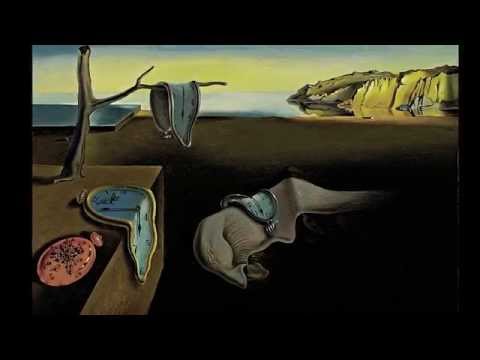
Dali, The Persistence of Memory
The Popularity of Salvador Dali's "Persistence of Memory"
Introduction to the Painting
- Steven introduces "Persistence of Memory" by Salvador Dali as a highly sought-after painting at the Museum of Modern Art, alongside Van Gogh's "Starry Night."
- Sal discusses how the painting resonates with those creating album art, highlighting its playful challenge to reality and rational thought.
Themes and Artistic Significance
- The conversation touches on Surrealism, emphasizing Dali's role in pioneering dreamscapes that defy rationality.
- Steven describes the painting’s atmosphere as deep and lonely, evoking feelings of desolation despite its surreal elements.
Visual Elements and Interpretation
- Sal notes the desert-like landscape where time seems irrelevant, suggesting a sense of abandonment within the scene.
- Steven elaborates on the stillness depicted in the painting, contrasting naturalistic rendering with absurd imagery like melting clocks.
Symbolism and Meaning
- The drooping clocks symbolize society's rigid relationship with time, challenging conventional perceptions shaped by industrial culture.
- Sal points out details such as ants consuming a timepiece, reinforcing themes around decay and time’s fluidity.
Personal Reflections on Reality
- Steven connects identifiable elements in the painting to Dali’s Catalonian roots, suggesting personal significance behind certain features.
- Sal recognizes optical illusions within Dali's work that allow for multiple interpretations simultaneously.
Philosophical Underpinnings
- The discussion shifts to Surrealism’s critique of rationality; artists aimed to reclaim dreams as valid experiences often suppressed by societal norms.
- Sal reflects on human perception of reality being subjective due to neurological wiring, questioning our judgments about what is real.
Time Perception and Philosophy
- Steven mentions attempts to link Dali’s work with concepts like time dilation but suggests deeper philosophical influences from thinkers like Bergson regarding subjective experience.
- Sal concludes that while we strive to define time logically, it remains an elusive concept fundamental yet poorly understood.
Understanding the Futility of Measurement
The Nature of Clocks and Objectivity
- The speaker suggests that clocks symbolize humanity's futile attempts to label and measure time, implying that such efforts do not equate to true understanding.
- There is a critique of the notion that labeling or measuring something leads to genuine comprehension; instead, it may create an illusion of understanding.
- Steven adds that this moment reflects a challenge to traditional ideas of objectivity, indicating a shift in how art confronts these concepts.
- The discussion highlights the tension between objective measurements and subjective experiences, suggesting that art can reveal deeper truths beyond mere quantification.
- Overall, the conversation emphasizes a philosophical exploration of perception versus reality in relation to time and measurement.