Fisiología de la Visión - Neuro
Understanding the Visual System
The instructor introduces the topic of the visual system, highlighting the importance of understanding molecular mechanisms related to signal transduction and cognitive processes in translating external stimuli into neural language.
Molecular Mechanisms and Signal Transduction
- The primary objective is to comprehend the molecular mechanisms associated with signal transduction.
- Translation of stimuli begins at sensory organs where various receptors transform physical, chemical, mechanical, and electromagnetic stimuli into a neural language understood by the nervous system through electrical activity exchange.
Visual Pathways and Brain Processing
- Exploring how auditory signals are converted into electromagnetic information or electrical activity.
- Understanding visual pathways, information transmission to the brain, varied uses of information, and brain's identification of characteristics.
Perception and Cognitive Processes
- Transitioning from sensory systems to perception to delve deeper into understanding how electrical stimulation transforms into thoughts or reasoning.
- If time permits, exploring how visual activity functions anatomically and physiologically using Superman as an example.
Recommended Reading for Deeper Understanding
The instructor suggests essential reading material for further study on eye anatomy, central visual pathways, and related topics covered in class.
Book Recommendation: "Elenas de Pur"
- Recommended chapters include Chapter 11 focusing on the eye anatomy and Chapter 12 discussing central visual pathways.
- Encourages students to refer to these chapters for comprehensive understanding as most class content is derived from them.
Anatomy of Vision: Functionality of the Eye
Delving into key aspects explaining how vision works by capturing external stimuli such as light waves for interpretation.
Vision Functionality
- Question posed regarding the function of vision - capturing visual stimuli like light waves.
Structures of the Visual System
The discussion focuses on the structures of the visual system and their functions in facilitating vision.
Structures and Functions
- Different shapes of rooms (square vs. spherical) affect visual perception.
- Each structure in the eye has a physiological function to ensure proper vision.
- Layers within the eye, like the ocular structure, play specific roles in receiving stimuli.
- The outermost layer of the visual system includes structures like cornea and conjunctiva.
- The conjunctiva and sclera protect and aid in directing light for vision.
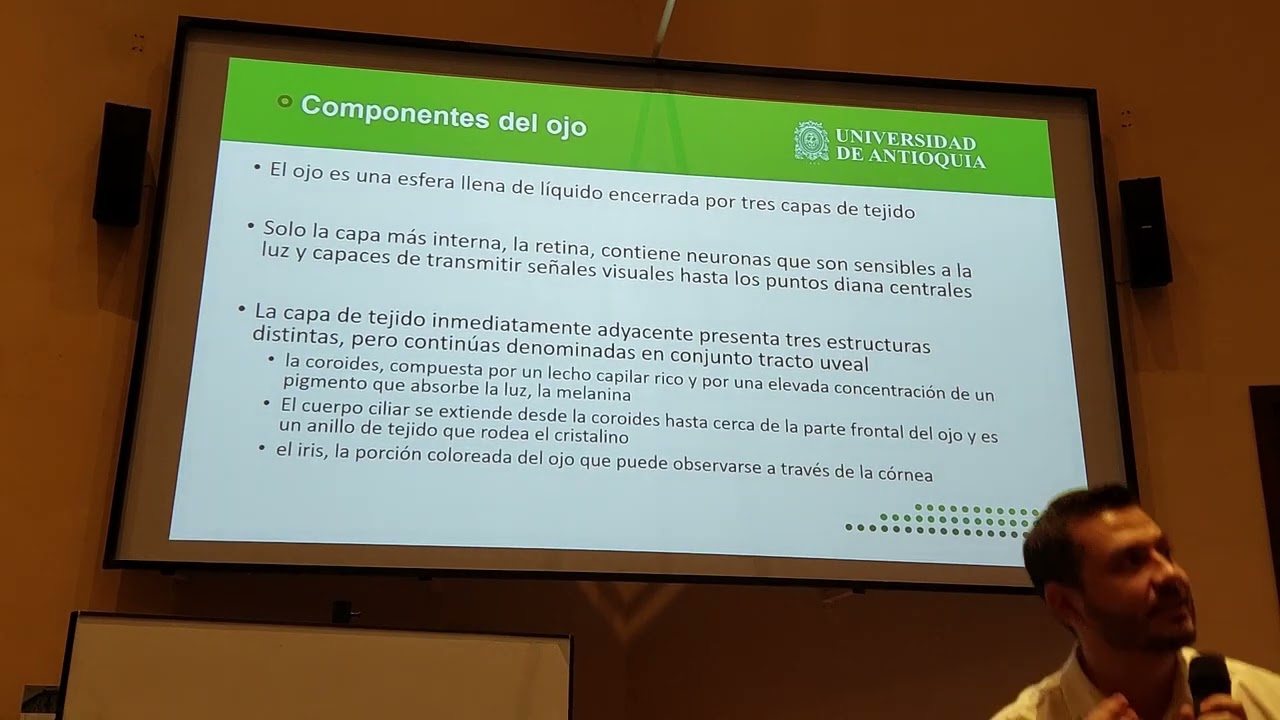
Components of the Eye
This section delves into the components that make up the eye and their respective functions in visual processing.
Eye Components
- The cornea acts as a gateway for light rays, aiding in refraction for clear vision.
- Three main structures - choroides, ciliary body, and iris - work together to capture light information.
- Choroides provide nutrients essential for eye function; ciliary body supports lens function.
- The crystalline lens projects light onto the retina for image formation.
- Iris controls light entry to regulate visual input effectively.
External Eye Structures
Exploring external eye structures such as sclera and cornea crucial for maintaining eye integrity.
External Eye Anatomy
- Sclera provides structural support while allowing transparency for light passage.
- Cornea, crystalline lens, and retina work collectively to process incoming light information effectively.
Retina Functionality
Understanding how different eye structures enable refraction towards optimal visual reception on the retina.
Retinal Processing
- Discussion on why individuals use glasses related to refractive errors like myopia or hyperopia.
Understanding Eye Alterations
In this section, the discussion revolves around how alterations in the eye's structure can impact vision and lead to blurry or distorted images.
Impact of Eye Diameter on Light Projection
- When altering the eye's diameter, it affects how light rays are projected.
- A smaller diameter causes light rays to project beyond their intended focal point, resulting in blurry vision.
- Conversely, a larger diameter ensures proper projection of light rays for clear vision.
Types of Eye Alterations
This segment delves into two main types of eye alterations caused by structural issues that hinder light convergence and clarity.
Structural Alterations Leading to Blurry Vision
- Structural issues prevent light rays from converging correctly, leading to blurred vision.
- Myopia is addressed by adjusting the object's position to realign light rays for clearer vision.
Factors Influencing Vision Clarity
Factors like eye size and corneal shape play crucial roles in determining visual acuity and may require corrective measures for optimal focus.
Addressing Hypermetropia and Presbyopia
- Hypermetropes need to move objects away for better focus due to specific eye characteristics.
- Presbyopia involves difficulty focusing up close, often requiring individuals to move objects farther away for clarity.
Corrective Measures for Visual Defects
Exploring methods such as lenses to correct refractive errors caused by structural abnormalities in the eye.
Lens Correction for Refractive Errors
- Lenses aid in refracting light appropriately, compensating for structural defects within the eye.
Impact of Corneal Changes on Vision
Discussing how alterations in corneal shape can affect light refraction and visual acuity.
Corneal Shape Influence on Light Convergence
Understanding the Structures of the Eye
In this section, the speaker discusses the structures of the eye, focusing on the retina and its components.
Retina: Vascular vs. Avascular Structures
- The retina is a vital structure in the eye that receives information and nutrients.
- : The retina is either vascular or avascular.
- : The importance of having vascular structures like the choroid to provide nutrients to the avascular parts of the retina.
Macula and Fovea: Key Regions for Visual Perception
- The macula and fovea play crucial roles in visual perception.
- : The macula contains the fovea, which houses most receptor cells responsible for contrast perception.
- : Visualization of these structures in an eye diagram to aid understanding.
Interpreting Ocular Blood Vessels
- Distinguishing between veins and arteries based on characteristics like thickness.
- : Observing vessel size aids in identifying whether it is a vein or artery.
- : Branching patterns help differentiate between veins and arteries.
Perception and Processing in Vision Systems
This part delves into how visual stimuli are processed by specialized cellular structures within the eye.
Cellular Receptors for Visual Information
- Various types of receptors are essential for capturing different aspects of visual stimuli.
- : Transformation of light stimuli into electrical signals requires specialized receptor cells.
- : Receptors not only detect color but also intensity, movement, contrast, and other perceptual features.
Efficiency through Cellular Organization
- Organizational principles optimize cellular differentiation for efficient processing.
- : Balancing differentiation with metabolic demands to avoid excessive energy consumption.
- : Importance of organized cell groups over individualized cells for stimulus identification.
Role of Photoreceptors and Bipolar Cells
- Photoreceptors, bipolar cells, and ganglion cells form fundamental processing units in vision systems.
- : Five primary cellular structures contribute to visual processing efficiency.
New Section
In this section, the speaker discusses the introduction of two types of cells, horizontal and amacrine cells, to enhance the function of capturing stimuli in the visual system.
Introduction of Horizontal and Amacrine Cells
- Horizontal and amacrine cells are introduced to distribute among regions of photoreceptor junctions and bipolar cells to improve stimulus capture.
- These cell types aim to enhance the physiological structure for better stimulus distribution and processing.
New Section
The speaker delves into the layers within the retina, highlighting key components such as pigment epithelium, receptor endings, nuclei, nerve terminations, and various cell types.
Layers Within the Retina
- The retina comprises layers including pigment epithelium, receptor endings (cones and rods), nuclei of receptors, nerve terminations, horizontal cells, and bipolar cell nuclei.
- Bipolar cells have two extensions serving as connectors between structures in the visual system.
New Section
This part focuses on the positioning of photoreceptors within the retina concerning light entry points and emphasizes understanding layer placement for optimal light interaction.
Positioning of Photoreceptors
- Discussion on where to position photoreceptors within the retina concerning light entry points.
- Emphasis on placing receptors towards light entry points for efficient light capture by passing through various retinal layers.
New Section
Exploring why photoreceptors are positioned towards the back of the eye rather than at its front for protection against damage and efficient regeneration processes.
Photoreceptor Positioning Rationale
- Placing photoreceptors towards the back protects them from direct exposure to external elements.
Understanding Neural Signaling
In this section, the discussion revolves around the process of neural signaling and how light stimuli are translated into electrical signals within the nervous system.
Importance of Receptors in Neural Signaling
- : Emphasizes the significance of conveying information to receptor structures.
- : Discusses the fundamental task of receptors in capturing light stimuli.
Translation of Light Stimuli
- : Explores the concept of translating light stimuli into electrical signals.
- : Compares translation to language conversion, highlighting how stimuli are understood by our nervous system.
Activation of Neurons
- : Reflects on Carmona's questions regarding neuron activation upon receptor-ligand binding.
- : Considers the process when a stimulus interacts with a receptor, leading to neuronal activation through action potentials.
Polarization and Signal Transmission
- : Introduces the principle that stimulation typically causes depolarization in cells but contrasts this with visual system phenomena where hyperpolarization occurs upon receptor-stimulus binding.
- : Expands on how light stimuli trigger hyperpolarization instead of depolarization, initiating signal transmission.
Hyperpolarization Mechanisms
- : Elaborates on how hyperpolarization results from changes in voltage rather than depolarization.
- : Discusses polarization shifts in nerve structures and their implications for signal processing duration based on different stimuli types.
Cellular Responses to Stimuli
This section delves into cellular responses to stimuli, focusing on mechanisms that regulate ion exchange and maintain cell polarization.
Ion Exchange for Hyperpolarization
- : Examines cellular polarization shifts concerning ion movements and thresholds for hyperpolarization induction based on stimulus characteristics.
Mechanisms Preventing Positive Ion Entry
- : Explores strategies employed by cells to prevent positive ion influx, leading to increased negativity within receptors.
Regulation via Calcium and Sodium Channels
Understanding Photoreceptor Function
In this section, the discussion revolves around the decrease in cyclic guanosine monophosphate (cGMP) and its relation to photoreceptor function.
Photoreceptor Structure and Function
- The cyclic guanosine monophosphate (cGMP) decreases due to the structure of receptors containing molecules like proteins.
- The photopigment, a protein acting as a physical stimulus receptor, leads to the reduction of cGMP.
Components of Receptors
- Receptors consist of retinal and opsins, with rhodopsins being extensively studied in rods.
- Opsins are a group of proteins that include retinal as a component, causing conformational changes upon physical stimuli impact.
Signal Transduction Pathway
- Physical stimuli trigger conformational changes in proteins within complexes like transducin activation by opsins.
- Activation of phosphodiesterase by transducin leads to hydrolysis of cGMP, resulting in decreased cGMP concentration and subsequent channel inactivation.
Cellular Response
- Decreased cGMP concentration causes reduced calcium and sodium channel activation, leading to cellular hyperpolarization.
- Hyperpolarization results from decreased sodium and calcium influx into the cell due to channel inactivation.
Regeneration Process and Vision Mechanisms
In this section, the discussion revolves around the regeneration process for functional units in vision and the mechanisms involved in responding to light stimuli.
Regeneration Process
- The regeneration process aims to restore functional unity quickly after completion, allowing for rapid responsiveness without saturation effects.
Light Stimuli Response
- Following exposure to light stimuli, there is a brief period where vision may seem impaired due to a quick phenomenon occurring at a millisecond scale.
Automatic Reaction Interpretation
- The automatic nature of reactions in vision regeneration is explained through the continuous production of proteins that seek specific transformations within the cellular environment.
Vision Degradation and Light Sensitivity
This section delves into the degradation of vision due to light exposure and explores the sensitivity levels required for visual processes.
Light Quantity Impact
- Excessive light exposure can lead to vision degradation as cells become overstimulated, highlighting the critical balance needed for optimal visual function.
Molecular Transformation
- Each molecule's immediate release triggers swift transformation processes, emphasizing the efficiency of physiological systems in responding to varying light intensities.
Polarization Concepts and Cellular Responses
Here, polarization concepts are discussed alongside cellular responses to stimuli in maintaining visual function.
Polarization Clarification
- Understanding polarization involves transitioning from negative to positive states or vice versa, with a focus on returning hyperpolarized cells back to their basal state efficiently.
Cellular Mechanisms
- To restore cellular balance post-stimulation, specific mechanisms such as hiperpolarization reversal play a crucial role in maintaining cellular stability within defined timeframes.
Transduction Pathway and Visual Restoration
This segment elucidates the transduction pathway involved in restoring visual function post-stimulus exposure.
Pathway Activation
How Vision Works
In this section, the speaker delves into the process of vision and how different cells in the eye contribute to visual perception.
Understanding Cell Activation
- The activation of cells in vision involves hyperpolarization rather than depolarization.
- Different types of photoreceptors, such as rods and cones, aid in distinguishing a wide range of information based on their sensitivity to light.
Rods vs. Cones Functionality
- Rods have poor spatial resolution but high light sensitivity, while cones offer high spatial resolution but low light sensitivity.
- Vision under varying light conditions depends on either rods (scotopic vision) or cones (photopic vision).
Photoreceptor Response to Light
- Rods are more responsive in low-light conditions, while cones dominate in bright light scenarios due to their differing response times for regeneration.
- Cones require more stimulation to activate compared to rods due to their slower regeneration rate.
Visual Resolution and Perception
This segment explores how the distribution of receptors in the retina affects visual resolution and perception under different lighting conditions.
Receptor Distribution Impact
- Rod cells have lower spatial resolution due to multiple receptors per bipolar cell, contrasting with cones' one-to-one receptor ratio.
- A practical exercise illustrates the limited spatial resolution of rod cells through a ball-tossing activity.
Spatial Resolution Comparison
- The exercise highlights the challenge of identifying specific actions when relying on rod cells for visual information.
- Under low-light conditions, visual information is present but lacks sharpness due to rod cells' limitations in spatial acuity.
Fovea and Peripheral Vision
This part discusses how foveal vision aids detailed viewing while peripheral vision serves general awareness of surroundings.
Fovea vs. Periphery Functionality
- The fovea's cone-rich structure enables detailed viewing, whereas peripheral areas with more rods facilitate general light perception.
- The distribution of rods and cones varies across the retina, influencing our ability to focus on details versus ambient light perception.
Optimal Viewing Strategies
New Section
In this section, the speaker discusses the different types of cones in the eye and how they are sensitive to various photopigments, affecting individuals' perception of reality.
Types of Cones and Photopigments
- Cones in the eye can be categorized into intermediate or medium cones and long cones, representing different chromatic ranges of layers.
- These cones contain different proteins sensitive to photopigments, which vary among individuals.
- Individuals may lack certain photopigments, leading to differences in their perception of reality.
New Section
The discussion shifts towards explaining receptor types, pigment types, and the role of specific ganglion cells in responding to light and darkness.
Receptor Types and Ganglion Cells
- Receptors have specific pigments based on regions like Centro encendido (light) and Centro apagado (darkness).
- Ganglion cells respond differently to light and darkness across the retinal field.
New Section
This part delves into how cells responding to light or darkness help differentiate contrasts in visual stimuli.
Contrast Perception
- Cells like Centro encendido respond to light objects while those like Centro apagado react to dark or absence-of-light objects.
- Activation of these cells enables differentiation between contrasting visual elements.
New Section
The speaker introduces information flow pathways from the retina for regulating circadian rhythms.
Information Flow for Circadian Rhythms
- Information serves three main purposes: one stream goes towards the hypothalamus for circadian rhythm regulation.
- Specific cells in this pathway are not intensity-dependent, aiding in regulating circadian rhythms effectively.
Detailed Analysis of Lecture on Visual Pathway
In this segment, Professor Estrada discusses the visual pathway in detail, emphasizing the role of the superior colliculus and its regulation of movement. He briefly touches upon eye movements and perception, hinting at further exploration in subsequent sessions.
Visual Pathway Discussion
- Professor Estrada highlights the significance of the superior colliculus in processing visual stimuli related to movement regulation.
- The lecture introduces aspects of perception to enhance understanding and retention, particularly focusing on the projection of the visual pathway. Histology will delve deeper into the colliculi, aiding comprehension.