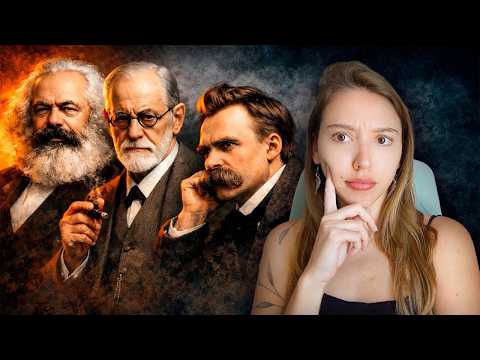
Los MAESTROS de la SOSPECHA | Nietzsche, Marx y Freud
Introduction to the Masters of Suspicion
Overview of the Three Authors
- The discussion centers on three influential figures known as the "masters of suspicion": Freud, Nietzsche, and Marx.
- The speaker hints at their identities, revealing that all three are German authors from around the same era.
- Participants in the discussion correctly identify Nietzsche and Marx as part of this group alongside Freud.
Significance of Their Ideas
- These authors are termed "masters of suspicion" because they critically examined false consciousness in society during the 1800s.
- Each author critiques different aspects: Marx focuses on economic false consciousness, Nietzsche on social values, and Freud on unconscious motivations.
Karl Marx: Critique of Economic Structures
Key Concepts in Marx's Philosophy
- Marx is recognized for his controversial views on socialism and communism but is discussed here primarily for his economic critique.
- He introduces historical materialism, arguing that material conditions shape our ideas rather than vice versa.
False Consciousness Explained
- Marx posits that class structures arise from unequal relationships within capitalism rather than being natural phenomena.
- A notable quote from Marx states that "religion is the opium of the people," suggesting it dulls awareness and distorts reality.
Friedrich Nietzsche: Rejection of Traditional Values
Understanding Nietzsche's Perspective
- Nietzsche’s background includes a study in theology before shifting focus to philosophy and philology.
- He critiques classical philosophers like Socrates and Plato for promoting values he believes lead to societal decay.
Vitalism vs. Nihilism
- Unlike nihilists, Nietzsche advocates for a vitalist approach that emphasizes life affirmation and self-overcoming through personal value creation.
The Concept of Egyptianism
Metaphor for Stagnation in Values
- Nietzsche uses Egyptianism as a metaphor for how society preserves outdated values akin to mummifying bodies—stopping them from evolving with life’s changes.
Life Affirmation Through Change
- He argues against static values; instead, he promotes adapting principles to align with life's dynamic nature.
The Transformations of Spirit According to Nietzsche
Three Transformations Explained
- The first transformation involves becoming a camel—bearing burdens imposed by society without questioning their validity.
From Camel to Lion
- The second transformation sees one become a lion who rejects these burdens but may struggle with identity post-rejection.
Achieving Childlike Freedom
- Finally, the child symbolizes creativity and autonomy—creating new values rather than merely rejecting old ones.
Sigmund Freud: Insights into Human Psychology
Freud's Contribution to Philosophy
- While primarily known as a psychoanalyst, Freud offers philosophical insights about human behavior through his concept of the unconscious mind.
Death Knells for Ego
Freud identifies three significant events (Copernican revolution being one), which he terms "deaths of ego," reshaping humanity's understanding of itself.
The Impact of Copernicus on Modern Thought
The Shift from Geocentrism to Heliocentrism
- Copernicus introduced the revolutionary idea that the Earth revolves around the Sun, challenging centuries of geocentric belief.
- This shift was significant as it contradicted intuitive perceptions; people observed the Sun rising and setting, leading them to believe in a geocentric model.
- Descartes argued against trusting our senses, suggesting they can deceive us, which further complicates our understanding of reality.
- The belief in humanity's centrality was not only scientific but also religious; humans were seen as God's creation at the universe's center.
- As science emerged as a neutral force, it began to undermine religious authority by presenting universal truths applicable regardless of one's faith.
Darwin's Contribution to Ego Reduction
- Following Copernicus, Darwin's theory of evolution presented another blow to human ego by revealing our close relationship with other species.
- Darwin emphasized that humans are not fundamentally different from animals; adaptations over time define us rather than any inherent superiority.
- This realization marked a second fall from ego—humans are just one species among many rather than the pinnacle of creation.
Freud and the Unconscious Mind
- Freud introduced a third fall from ego by asserting that individuals lack control over their thoughts and actions due to unconscious influences.
- He suggested that much of our behavior is driven by subconscious desires and patterns we do not consciously recognize or understand.
- Freud’s ideas challenge the notion of self-control and rationality, highlighting how external factors shape our beliefs and behaviors.
Philosophical Implications
- Philosophers like Nietzsche advocate for questioning established beliefs and values shaped by societal norms or unconscious biases.
- The philosophy of destruction involves critically examining what we accept as truth while recognizing limitations in personal control over destiny.
Modern Reflections on Social Media Influence
- Today’s social media creates echo chambers where algorithms reinforce existing beliefs, distorting perceptions of reality.
- Relationships formed through social media often lead to parasocial interactions, where followers feel connected to influencers without mutual recognition.
- These platforms propagate false values and ideals based on curated images rather than authentic representations of life.
The Role of Science in Understanding Mental Health
Interdisciplinary Approaches
- Mental health should be approached holistically; it's influenced by psychological, philosophical, sociological, and cultural factors beyond strict scientific validation.
- While empirical evidence is valuable in psychology (e.g., cognitive-behavioral therapy), reducing all methods to scientific proof limits understanding.
Critique of Scientism
- A rigid adherence to scientism can lead to dismissing non-scientific perspectives that contribute meaningfully to human experience.
Nietzsche’s Philosophy: God is Dead
Interpretation Beyond Literal Meaning
- Nietzsche’s declaration "God is dead" signifies a transformation in values rather than an outright denial of divinity; it reflects changing moral frameworks within society.
- His critique extends beyond religion itself towards institutionalized beliefs that hinder genuine human experience and growth.
Capitalism vs Religion
- There exists an intersection between capitalism and Christianity where both promote hard work for success but may overlook systemic barriers faced by individuals.
This structured summary captures key discussions from the transcript while adhering strictly to your formatting requirements.
The Impact of Self-Exploitation on Happiness
The Dangers of Overexertion
- Discussion on the paradox of self-exploitation, where increased personal demands lead to greater stress and burnout rather than happiness.
- Reference to Byung-Chul Han's work from 2007, highlighting its relevance in today's context regarding societal pressures.
Perspectives on God and Philosophy
- Exploration of Spinoza's conception of God, emphasizing that he rejects human-like attributes such as being a father or punisher.
- Spinoza’s God is described as substance and perfection, contrasting with traditional views in Christianity and Judaism.
Philosophical Interconnections
- Examination of how contemporary philosophers reinterpret ideas from historical figures like Foucault and Bentham regarding panopticism.
- Emphasis on the continuity in philosophical thought, where modern interpretations build upon past concepts.
Freedom vs. Illusion of Choice
Understanding Power Dynamics
- Discussion about the illusion of freedom in decision-making; individuals often believe they act freely while influenced by cultural and social factors.
- Mention of Bourdieu's concept of habitus, suggesting that actions are often conditioned by external influences rather than true autonomy.
Kantian Epistemology
- Introduction to Kant’s idea that knowledge requires spatiotemporal conditions for understanding reality.
- Distinction between phenomena (things as we perceive them) and noumena (things-in-themselves), indicating limitations in human understanding.
Critique of Truth Concepts
Post-truth Considerations
- Personal stance against the existence of an absolute truth or transcendental reality, linking it to critiques surrounding post-truth narratives.
Lacanian Complexity
- Acknowledgment of Jacques Lacan's complexity; uncertainty about fully grasping his theories reflects broader challenges within psychoanalysis.
Clarifying Spinoza’s Position
Panteísmo vs. Panenteísmo
- Clarification that Spinoza is not a pantheist but a panentheist; everything exists within God rather than equating God with everything.
Engaging with Classical Philosophy
Heraclitus vs. Parmenides Debate
- Simplified comparison between Heraclitus’ view on change versus Parmenides’ assertion that only being exists, showcasing differing ontological perspectives.
Ontological Discussions
- Reflection on the nature of deity as a creator versus Spinoza’s rejection of this notion; questioning if all conceptions align with a creator model.
Educational Insights
Importance of Pedagogical Literature
- Critique regarding educators who lack familiarity with Kant’s pedagogical works; highlights gaps in educational foundations among teachers.
Community Engagement
Building Connections Through Philosophy
- Encouragement for community interaction through live sessions discussing philosophy topics; emphasis on making complex subjects accessible to wider audiences.
Turn any video into a summary like this
YouTube links, meetings, lectures — with transcripts, search, and chat.