Understanding and building phylogenetic trees | High school biology | Khan Academy
Understanding Phylogenetic Trees
Introduction to Species Relatedness
- When examining living diversity, a natural question arises about how related different species are to each other based on their common ancestors.
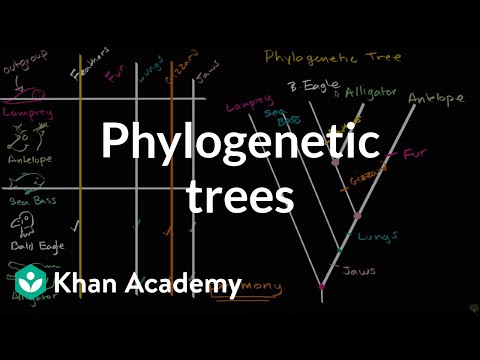
- The video aims to construct a simplified phylogenetic tree using five species and observable traits, acknowledging that this is an oversimplification of the complex reality.
Complexity in Phylogenetic Analysis
- Biologists typically analyze more than just five traits and incorporate molecular evidence (e.g., protein and DNA differences) for constructing phylogenetic trees.
- The term "phylogenetic" combines Greek roots meaning "group" or "kind" with "genesis," referring to the origins of these groups or species.
Hypothesis Formation in Tree Construction
- Creating a phylogenetic tree involves forming hypotheses that explain observed traits while seeking simplicity in explanations.
- The lamprey is identified as the outgroup due to its lack of shared traits with the other listed species, suggesting it diverged earlier from a common ancestor.
Branching Points and Derived Traits
- A branching point represents the common ancestor of the lamprey and other species, indicating evolutionary divergence over time.
- Jaws are identified as a derived trait that evolved after the divergence from the lamprey's lineage, highlighting their significance in certain environments.
Further Divergence Among Species
- After establishing jaws as a common trait among remaining species, lungs are examined next; however, not all remaining species possess them (e.g., sea bass).
- A hypothesis suggests that lungs evolved after diverging from sea bass's lineage, emphasizing parsimony—favoring simpler explanations for evolutionary changes.
Understanding Phylogenetic Trees and Species Relationships
Constructing a Phylogenetic Tree
- The discussion begins with the introduction of the bald eagle and its relationship to other species, setting the stage for constructing a phylogenetic tree.
- A branching point is established for the bald eagle, indicating its connection to both the alligator and antelope, highlighting their common traits.
- The speaker emphasizes that both the bald eagle and alligator share a gizzard as a derived trait, which is crucial for understanding their evolutionary relationships.
Derived Traits in Species
- The common ancestor of various species including sea bass, bald eagle, alligator, and antelope is identified; lungs are hypothesized to have evolved at this branching point.
- The gizzard's presence in descendants from a common ancestor is noted; it’s suggested that while they may inherit this trait, it can also be lost over time.
Unique Characteristics Among Species
- Feathers are identified as unique to the bald eagle among the discussed species; this highlights an important evolutionary adaptation.
- The fur of the antelope is mentioned as another derived trait needing further evidence for accurate placement on the phylogenetic tree.
Simplifying Complex Relationships
- A reasonable phylogenetic tree representation emerges through parsimony; simpler explanations are preferred but more complex ones may also hold truth.
- It’s concluded that based on shared ancestry, bald eagles and alligators are more closely related than either is to antelopes due to their recent common ancestor.
Genetic Evidence Considerations
- The importance of genetic evidence in supporting these hypotheses is emphasized; comparisons of DNA between species could validate or challenge these proposed relationships.