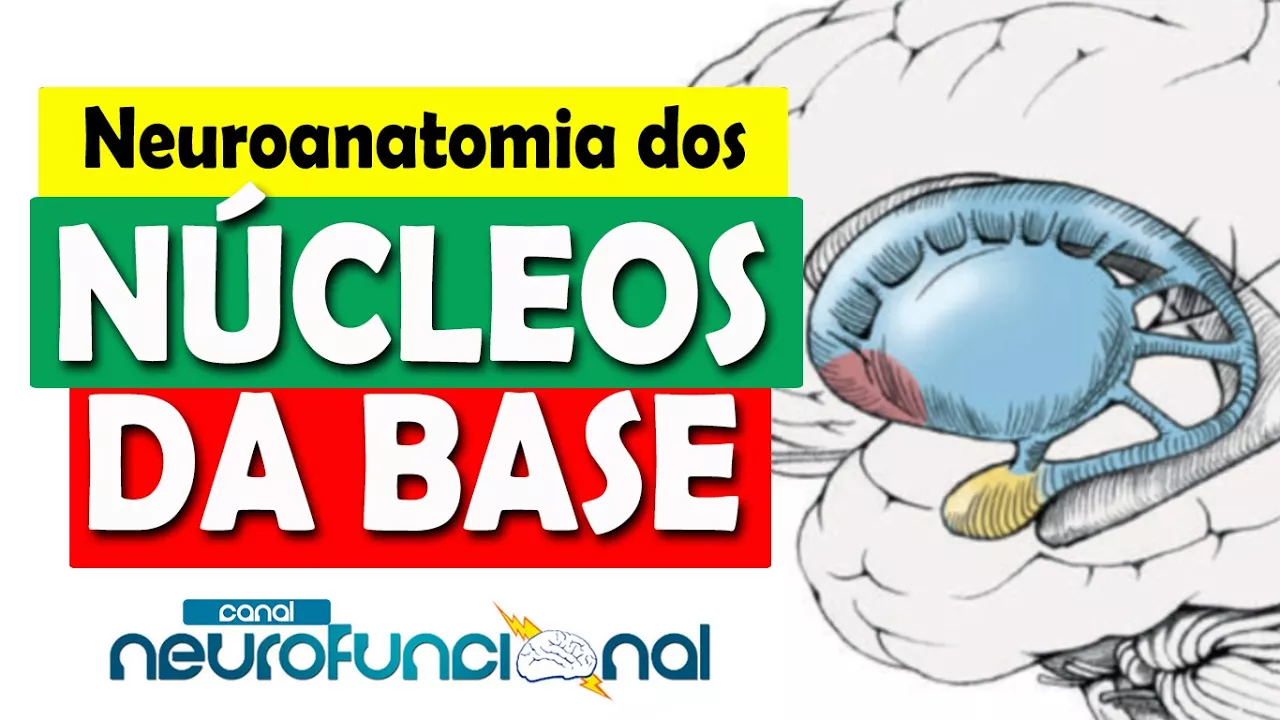
NÚCLEOS DA BASE: Neuroanatomia Funcional (Aula Completa)
Núcleos da Base: Estruturas e Funções
Introdução aos Núcleos da Base
- A aula aborda a importância dos núcleos da base no controle motor, incluindo anatomia, divisões e funções.
- O conteúdo é fundamental para entender a fisiopatologia da doença de Parkinson, que será discutida na próxima aula.
Definição e Localização
- Os núcleos da base são uma coleção de núcleos de substância cinzenta localizados profundamente na substância branca dos hemisférios cerebrais.
- É importante distinguir entre "gânglios" (localizados no sistema nervoso periférico) e "núcleos" (localizados no sistema nervoso central).
Estruturas Principais dos Núcleos da Base
- As principais estruturas incluem: núcleo caudado, putâmen, globo pálido interno e externo, claustrum, núcleo accumbens e pálido ventral.
- O núcleo subtalâmico e a substância negra também são mencionados em algumas literaturas como parte dos núcleos da base, mas isso não é consenso.
Divisão Funcional dos Núcleos
- O caudado e o putâmen formam o "striatum", enquanto o globo pálido é classificado como "paleoestriado".
- Juntos, o neoestriado (caudado + putâmen) e paleoestriado formam o corpo estriado ou estriado dorsal.
Importância do Núcleo Accumbens
- O núcleo accumbens é crucial na regulação do comportamento emocional; ele faz parte tanto dos núcleos da base quanto do sistema límbico.
Visão Anatômica Detalhada
- Em cortes transversais ou axiais, observamos as relações anatômicas entre estruturas como corpo caloso, cabeça do caudado, globo pálido interno/externo e cápsula interna.
Understanding the Substantia Nigra and Its Role in Motor Control
The Structure of the Substantia Nigra
- The substantia nigra is characterized by its dark appearance due to the presence of neurons, specifically located in the mesencephalon.
- It consists of two parts: the compact part, which is affected in Parkinson's disease, and the reticular part.
Parkinson's Disease and Neuronal Degeneration
- In Parkinson's disease, there is degeneration of dopaminergic neurons in the compact part of the substantia nigra, crucial for the nigrostriatal pathway.
- Inputs to the basal ganglia primarily come from the striatum (caudate nucleus, putamen, and nucleus accumbens), with glutamatergic neurons stimulating these areas.
Pathways and Outputs from Basal Ganglia
- Outputs from the basal ganglia exit via the internal globus pallidus, closely linked to the reticular part of substantia nigra.
- These outputs target mainly the thalamus (ventral lateral and ventral anterior nuclei), which then relay information to motor areas in the frontal lobe.
Indirect vs. Direct Pathways
- The basal ganglia control motor functions indirectly; they do not connect directly to spinal cord but send signals through thalamus first.
- Two important pathways are identified:
- Direct Pathway: Information travels from putamen to internal globus pallidus then stimulates thalamic nuclei.
- Indirect Pathway: Information goes from putamen to external globus pallidus, then to subthalamic nucleus before reaching internal globus pallidus.
Dopamine's Role in Modulating Pathways
- Dopamine produced in substantia nigra influences both pathways differently; it excites direct pathway (via D1 receptors) while inhibiting indirect pathway (via D2 receptors).
- This differential action allows dopamine to regulate motor control effectively by promoting movement through excitation while preventing unwanted movements through inhibition.
Mechanisms of Inhibition by Globus Pallidus Internus
- The internal globus pallidus exerts an inhibitory effect on thalamic activity using GABA neurotransmitters as a 'brake' for undesired movements.
Understanding Movement Disorders and the Basal Ganglia
The Role of the Internal Globus Pallidus in Movement
- To initiate movement, inhibition of the internal globus pallidus is necessary. This relates to conditions like Huntington's disease, which is an autosomal dominant hereditary disorder leading to disinhibition of the motor thalamus.
- In Huntington's disease, lesions in the subthalamic nucleus reduce its inhibitory effect on the internal globus pallidus, effectively removing a "brake" on movement and resulting in involuntary movements.
Parkinson's Disease: A Contrasting Mechanism
- Unlike Huntington's disease, Parkinson's involves loss of dopaminergic neurons that inhibit D2 pathways while failing to excite D1 pathways. This leads to predominantly inhibitory actions within motor control.
- Symptoms such as bradykinesia (slowness of movement) arise due to increased inhibition affecting both thalamic and cortical functions.
Functions of Basal Ganglia in Motor Control
- Key functions include:
- Preparation and execution of learned motor programs.
- Automation of previously acquired motor skills.
- Regulation of movement amplitude and speed.
- Sequencing logical steps for planned movements.
- Modulation of muscle tone and force; indirect pathways help smoothen movements while direct pathways facilitate them.
Pathologies Associated with Basal Ganglia
- Major pathologies can be categorized into hypokinetic disorders:
- Parkinson’s disease
- Progressive supranuclear palsy
- Lewy body dementia
- Multiple system atrophy
References and Additional Resources
- The lecture references key texts including Blumenfeld’s "Neuroanatomy through Clinical Cases," Tortora’s "Principles of Anatomy and Physiology," and Machado’s "Functional Neuroanatomy."
Engagement Encouragement