Capitulo III HPLC detectores Video 12
New Section
This section discusses the characteristics and basic operation of detectors used in HPLC, focusing on the ideal features sought for proper detector functionality.
Characteristics of Ideal Detectors
- Detectors should have a wide dynamic response range to changes in analyte concentration.
- Desired features include linearity, selectivity, appropriate sensitivity, temperature stability, good signal-to-noise ratio, and non-destructive behavior.
- The most common detector in HPLC is the UV-visible detector due to its ability to measure energy absorbed by molecules.
- Detectors should be non-destructive and provide rapid responses for complex samples.
Detector Types in HPLC
This section explores various detectors used in HPLC beyond UV-visible detectors.
Detector Varieties
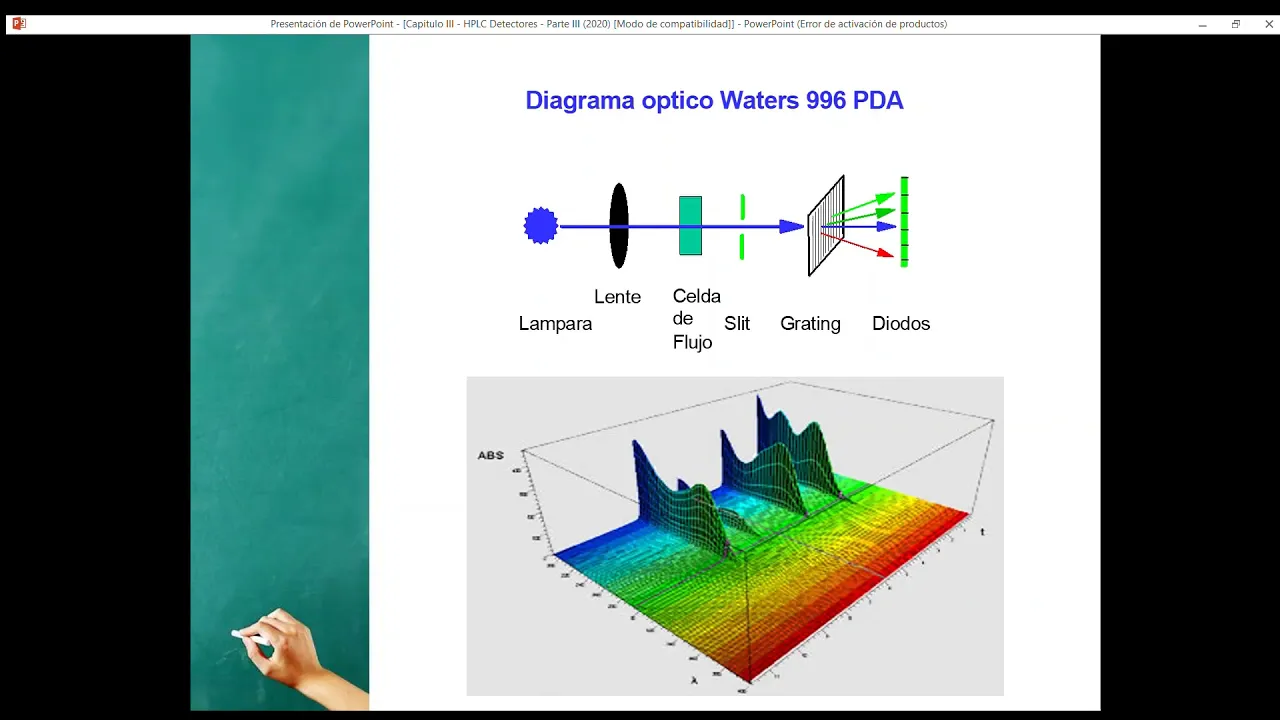
- Some detectors utilize diode arrays for comprehensive spectral analysis and qualitative identification of compounds.
- Solvent selection is crucial to minimize baseline noise caused by solvent absorbance.
- Evolving detectors like diode array offer improved sensitivity, linearity, selectivity, and real-time absorption spectrum acquisition.
Specialized Detectors and Applications
Specialized detectors cater to specific compound properties and analytical needs in HPLC applications.
Specialized Detector Types
- Fluorescence detectors are suitable for analyzing substances with natural or induced fluorescence due to their high sensitivity and selectivity.
- Refractive index detectors are universal but less sensitive; conductivity detectors are highly sensitive but require pure solvents.
fina dispersión de gotitas
The process involves the final dispersion of droplets through nebulization passing through a hot tube where the solvent evaporates, leaving a cloud of fine solid particles detected at the bottom. Detection occurs through light dispersion from a laser, responding to mass rather than molecular structure or weight.
Process Description
- The nebulized liquid passes through a hot tube for solvent evaporation, resulting in fine solid particle formation.