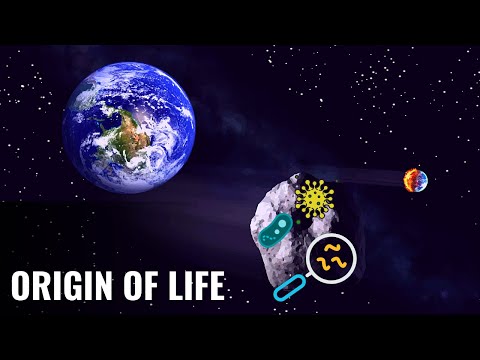
The Panspermia Hypothesis, Explained

The Panspermia Hypothesis, Explained

How Did Life Begin on Earth?

The Origins of Life

  • Life has thrived in diverse environments on Earth, from deep waters to the atmosphere, making it unique among planets in the solar system.
  • Dinosaurs are highlighted as famous extinct species, with life existing long before them; evidence suggests life began over 4 billion years ago.
  • To understand life's origins, we must look back 4.5 billion years when Earth was a hostile environment unsuitable for life.

Abiogenesis and Its Challenges

  • As Earth cooled and liquid water formed, abiogenesis occurred—life emerging from non-living matter like simple organic compounds.
  • A successful theory of abiogenesis must explain how essential elements (carbon, nitrogen, oxygen, hydrogen) interacted to form life.

Panspermia Hypothesis

  • The panspermia hypothesis posits that life exists elsewhere in the universe and may have been transported to Earth via asteroids or spacecraft.
  • Two types of panspermia are discussed: interstellar (between star systems) and interplanetary (from neighboring planets).

Mechanisms of Panspermia

  • Radiopanspermia suggests radiation pressure propelled microorganisms through space; however, DNA/RNA damage during travel limits its viability.
  • Lithopanspermia proposes microorganisms were shielded within sturdy celestial bodies like asteroids during their journey through space.

Intentional Panspermia and Its Implications

  • Intentional panspermia theorizes that an advanced extraterrestrial civilization may have intentionally or accidentally seeded life on Earth.
  • This hypothesis raises questions about the existence of intelligent civilizations since none have been found yet.

Viability of Panspermia

  • Despite challenges regarding Earth's timeline for evolution from no life to single-celled organisms, panspermia remains a plausible explanation for life's origins.
  • Discoveries of extremophiles—microorganisms thriving under extreme conditions—support the idea that life could survive space travel.

Limitations of Panspermia

Video description

The panspermia hypothesis is one of the several hypotheses in astrobiology that tries to explain the origin of life. Panspermia means "seeds everywhere." According to this hypothesis, life exists elsewhere in the universe and got transported to the Earth via asteroids, planetoids, or even spacecraft. Now Panspermia could be interstellar or interplanetary. As the name suggests, interstellar Panspermia points at the transportation of life between different star systems. In contrast, interplanetary Panspermia refers to the transport of life from the neighboring planets and stars. But, to achieve both these types of Panspermia, three mechanisms have been proposed, each having its own limitation. Let us begin with radio panspermia. It says that radiation pressure from stars propelled microorganisms through space until they reached an object to land upon. After the organisms landed on a site favorable to their existence, they developed into more extensive forms of life. But radiopanspermia ignores one critical fact. Due to the long exposure of bacteria to radiation during interplanetary travel, DNA or RNA would get extensively denatured and reduce any chances of successful Radiopanspermia to almost zero. This limitation brings us to the second mode of Panspermia, which is Lithopanspermia. To save the microorganisms from getting damaged by harmful cosmic radiations, lithospanspermia assumes that microorganisms were present on or in asteroids, comets, and other planetoids. These celestial bodies were large and sturdy enough to withstand planetary ejections, lengthy travels along with powerful atmospheric reentry, thereby carrying out safe transportation of life. The third and perhaps the most exciting mode of Panspermia is intentional Panspermia. As per this hypothesis, life was intentionally implanted on Earth by an advanced extraterrestrial civilization, or maybe it was merely an accident! It is possible that the advanced civilization was not intending to populate Earth with living organisms. Instead, it was only disposing of its organic waste that accidentally landed on planet Earth, thereby leading to life on Earth. In the 1970s, researchers discovered an exotic set of microorganisms that existed in the depths of the Galapagos Rift. They required only water and energy synthesized from the oxidation of reactive chemicals found in Earth's soil to exist. Also known as extremophiles, these microorganisms developed cysts and spores to protect and shield themselves when exposed to high stress like gamma radiations and extreme temperatures. This has again hinted at the credibility of the Panspermia hypothesis! Although Panspermia provides a satisfactory answer to the possible origin of life on Earth, it doesn't address the fundamental question of the origin of life in this universe. It only explains how life knocked on the doors of our planet. From a cosmic point of view, the origin of life is still a mystery.