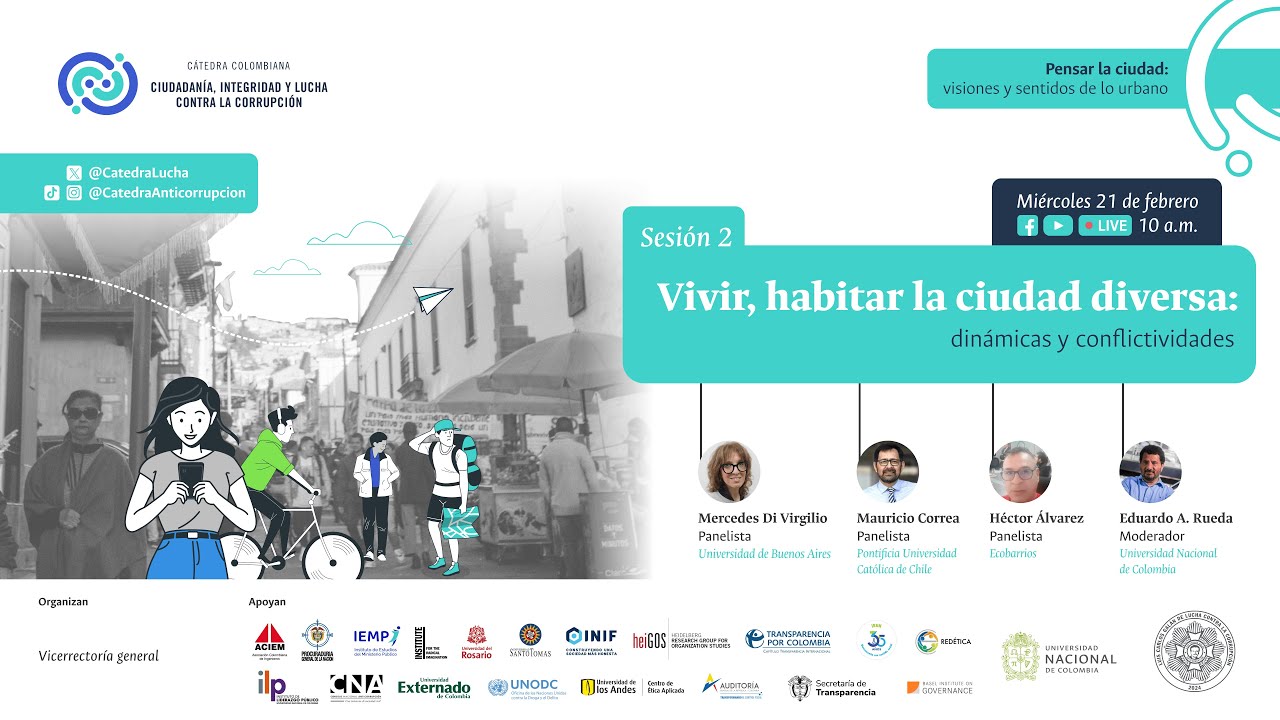
Sesión 2. Vivir, habitar la ciudad diversa: dinámicas y conflictividades
Welcome and Introduction
The session introduces the topic of good governance in cities, emphasizing the importance of integrity and combating corruption. It acknowledges the diverse audience, including public officials, social leaders, and students.
Key Points:
- Various participants from public entities in Colombia, social leaders from Central America, and students across different university campuses are welcomed.
- After the panel discussion, attendees are encouraged to join virtual rooms for interactive activities following instructions provided by the course communications and monitors.
- The upcoming discussion focuses on "Living in the City," exploring diverse dynamics and conflicts within urban spaces, particularly relevant to Latin American social, cultural, and political contexts.
Guest Speaker Introductions
The guest speakers are introduced before their presentations on urban topics related to public policies, social issues, land policies, housing policies, mobility patterns in Latin American cities.
Key Points:
- Professor María Mercedes de Virgilio from Argentina is recognized for her expertise in social sciences research focusing on urban methodologies at various universities.
- Professor de Virgilio expresses gratitude for being part of the lecture series and highlights her research experiences in Buenos Aires and other Latin American cities concerning cultural diversity's impact on daily life.
Cultural Diversity Impact
Professor de Virgilio delves into how cultural diversities shape daily life within cities like Buenos Aires through her fieldwork experiences across Latin America.
Key Points:
- Emphasizes multiple diversities rather than a singular diversity influencing culture and daily routines within urban settings.
Diversity in Latin American Cities
The discussion delves into the various forms of diversity present in Latin American societies, including ethnic, racial, and class diversities, and how these factors shape urban life.
Diversity in Latin American Societies
- Social class inequalities impact cultural diversities due to varying access to educational resources and cultural services.
- Structural issues define daily life in Latin American cities, influencing cultural diversities.
- Cultural diversities are inherent in Latin American cities due to colonization processes that enforced cultural differences.
- Migration processes play a significant role in shaping urban life, as seen in cities like Buenos Aires influenced by historical migration waves.
Impact of Migration on Urban Diversity
The conversation explores how migration processes have historically shaped the composition and dynamics of urban populations in Latin America.
Migration Dynamics
- Buenos Aires' development was significantly influenced by migration waves from the late 19th century to recent decades.
- Some Latin American cities like Bogotá did not experience intense migratory influences initially but have been impacted more recently.
- Ongoing migratory flows, such as Venezuelan and Haitian migrations, continue to structure cultural diversities within cities.
Challenges of Cultural Diversities
The challenges posed by cultural diversities within urban settings are discussed, emphasizing the complexities of coexisting with diverse populations.
Navigating Cultural Differences
- Societal inequalities based on class and ethnicity complicate the management of cultural diversities within communities.
- Creating spaces for social groups with diverse experiences is crucial for fostering peaceful coexistence and addressing conflicts.
Role of Governments in Urban Integration
The importance of governmental intervention in creating inclusive spaces for diverse populations within cities is highlighted.
Governmental Responsibilities
- Urban experiences vary based on city size, impacting how conflicts related to diversity are managed.
- Local governments play a vital role in facilitating encounters between diverse social groups through public spaces.
Meeting the Challenges of Diversity in Education
The speaker discusses how the quality of the education system impacts diversity and the importance of government policies in mediating conflicts related to educational segregation.
Quality Education and Diversity
- The quality of the education system should promote encounters, exchanges, and understanding of diversity.
- When educational quality is lacking, social groups may implement mechanisms of educational segregation to ensure access to quality education.
Government Role in Mediating Conflicts
- Governments play a crucial role in mediating conflicts by implementing policies that address violence, including campaigns against sexist expressions.
- Facilitating processes of interaction in diverse cities requires governmental intervention to navigate cultural diversities effectively.
Promoting Cohesion Through Collective Experiences
The discussion focuses on how collective experiences, such as ethnic belonging or shared challenges like housing access, can foster cohesion within communities.
Ethnic and Migrant Communities
- Ethnic and migrant communities often form cooperatives for housing access, enhancing their sense of belonging and cohesion.
- Collective experiences like struggling with housing issues can lead to the formation of cooperative initiatives among low-income families.
Empowerment Through Public Policies
Public policies play a vital role in empowering diverse collectives by providing support and resources for their development.
Collective Empowerment
- Diverse collectives' organization depends significantly on public policies that either enable or hinder their capacity for collective action.
- The potential for collectives to be spaces for survival or emancipation is influenced by public policy frameworks supporting their initiatives.
Challenges and Opportunities in Diverse Cities
Living together harmoniously in diverse urban settings requires addressing inequalities, combatting violence, and ensuring equitable access to resources.
Urban Coexistence
- Embracing diversity in cities presents both opportunities for collective organization but does not guarantee emancipatory outcomes without supportive public initiatives.
Detailed Overview of the Discussion
The discussion delves into the role of the State as a mediator, the importance of education, creating spaces for diversity, and addressing inequalities in Latin American cities.
Professor Mauricio Correa's Background
- Professor Correa holds a degree in Philosophy from the Pontifical Catholic University of Chile and a Ph.D. from the University of Valencia.
- He has been an editor for Vita, a philosophy and theology journal, and is currently an associate professor at the Institute of Philosophy and Applied Ethics.
- Prof. Correa is a co-founder of the Latin American Network of Applied Ethics (Red Laea) and has authored works on applied ethics focusing on topics like corruption and city ethics.
Focus on City Ethics
- Prof. Correa highlights his research on city ethics, emphasizing its relevance in Latin American contexts.
- His interest in city ethics led to his invitation to speak at this event during his vacation in Chile.
Exploring Concepts of Habitat
The conversation transitions to discussing habitat concepts inspired by Martin Heidegger's work "Building Dwelling Thinking."
Significance of Habitat
- The original sense of habitat as interdependence is explored before human intervention transforms it into habitation.
- The loss of this original sense gave rise to modern ethical reflections known as "ethics of habitat" or "habitat ethics" within the context of the Anthropocene era.
Evolution of Habitat Ethics
Ethical Reflections in Architecture and Urbanism
In this section, the speaker delves into the intersection of ethics with architecture and urbanism, drawing from their experience teaching an ethics course in these fields.
Heidegger's Concept of Human Existence
- Heidegger emphasizes that being human means being mortal on Earth, highlighting the essence of dwelling as central to human existence.
- Leopold's groundbreaking work in 1949 introduces the concept of "ethics of the Earth," emphasizing Earth as a biotic community encompassing all life forms.
- Leopold's proposal shifts focus from anthropocentric ethics to a broader moral community, advocating for an ethical extension to include Earth as a vital element.
Ethics of the Earth and Human Relationship
- Leopold critiques the reductionist view of humans seeing themselves solely as owners of land based on economic interests rather than acknowledging interdependence with nature.
- Leopold's biotic principle states that actions preserving biotic community integrity, stability, and beauty are ethically right.
- The conservationist paradigm proposed by Leopold restricts human actions on Earth, promoting a shift towards protecting and preserving natural ecosystems.
Evolution of Environmental Ethics
- Leopold's legacy paved the way for modern environmental philosophies like ecological ethics and environmental ethics.
- Current challenges in environmental consciousness stem from societal disconnect with nature due to educational and economic systems diverging from valuing Earth awareness.
Ethics of Agriculture and Environmental Philosophy
The speaker discusses the relationship between humans and the Earth, emphasizing the importance of ethical considerations in agriculture and environmental philosophy.
Ethics of Agriculture
- Leopold emphasizes that saving the Earth goes beyond exploitation; it involves not dominating or enslaving the land.
- Introduction to agricultural ethics (agroethics), closely linked to environmental ethics, highlighting its lesser-known status despite its crucial connection to human survival.
- Agriculture's impact on natural ecosystems, emphasizing the interdependence between agriculture and human survival within the planetary ecosystem.
- Leopold's recognition of agriculture's significance predating ecological concepts, focusing on soil fertility issues due to imported fertilizers.
Challenges in Agricultural Ethics
The discussion delves into challenges faced by agricultural ethics, including intensification practices and their environmental and health impacts.
Intensification Practices
- Highlighting Rachel Carson's "Silent Spring" as a critique of chemical use in agriculture for intensification purposes.
- Emphasizing the detrimental effects of pesticide use on both the environment and human health.
- Despite agriculture's critical role in human survival, ethical considerations were only integrated into environmental ethics in the 1990s.
Agriculture in Applied Ethics
Exploring how agricultural ethics gained attention within applied ethics compared to earlier focus on environmental ethics.
Evolution in Ethical Focus
- Prior lack of emphasis on agriculture within environmental ethics discussions, with minimal consideration for its ethical dimensions as a societal issue.
Ethics in Agriculture and Architecture
The discussion delves into the ethical considerations surrounding agriculture and architecture, exploring the tensions between productivity-driven farming practices and environmental preservation ethics. It also touches on the evolution of human interactions with natural environments to exploitation for maximum yield.
The Ethical Dilemma in Agriculture
- Farmers prioritize productivity, while environmentalists advocate for preservation, creating a conflict between production and conservation ethics.
- Transition from cultivating land to maximize life to exploiting it for high yields reflects a shift in human-nature relationships driven by economic motives.
Ethics of Architecture and Built Environment
- Fox discusses the essence of building as enabling habitation, emphasizing the importance of ethical considerations in architecture.
- Warwick Fox highlights how anthropogenic ecological crises prompt reevaluation of human habitation practices within built environments.
Challenges in Urban Development
The conversation shifts towards urban development challenges, focusing on the impact of construction and habitation on cities' sustainability and livability.
Urbanization Impact
- Construction, habitation, and habitat intertwine complexly in cities, posing challenges that align with Heidegger's concerns about lost meanings in building and dwelling.
Constructing Human Habitat
The discussion delves into the concept of human habitat construction, emphasizing the necessity for humans to design and build their living environments in a way that aligns with sustaining human life.
The Purpose of Building
- Humans need to construct habitats akin to other living beings to ensure survival and well-being.
- Building without modifying or adapting the natural environment is impractical for both humans and animals.
Evolution of Human Habitat Construction
- Human habitat construction was historically harmless but became invasive and destructive with industrialization and capitalist growth in the 19th century.
- Urbanization has transformed humanity into an urban species, leading to significant population growth in cities worldwide.
Urbanization Trends in Latin America
- Latin American cities like Sao Paulo and Mexico City rank among the world's most populous, showcasing remarkable urban growth.
- Urbanization has reached 81% of the population in some regions, contributing to issues like air pollution and informal settlements.
Challenges of Urban Development
The conversation highlights challenges associated with urban development, including air quality concerns, rapid urbanization trends, and the rise of informal settlements.
Urban Challenges
- Cities face severe air pollution due to high population density and poor urban planning.
- Informal settlements are on the rise globally, leading to issues like housing insecurity and vulnerability during disasters.
Impact on Chile
- Chile experiences significant informal settlement growth, evident through recent fires affecting marginalized communities along its coast.
Revisiting Human Habitation
- The true tragedy lies not in social pathologies like poverty but in humanity's disconnect from authentic habitation essence.
New Section
In this section, the speaker discusses the concept of living in a city as a territorial existence, emphasizing the interconnectedness between urban living and the surrounding natural environment.
Understanding Urban Living as Territorial Existence
- The speaker introduces a perspective on city living as a form of territorial existence that is intricately linked to the Earth and the built environment.
- They highlight how cities extend beyond their constructed boundaries to encompass agricultural spaces, influenced by industrial agriculture practices.
- A philosophical view is presented, suggesting that for marginalized individuals, genuine human habitation in cities may be distant from reality due to inequalities.
- Different approaches and perspectives enrich everyone's understanding of urban living, with discussions between speakers contributing to a broader outlook on the topic.
Exploring Social and Environmental Leadership
This part delves into Héctor Álvarez's background as a social and environmental leader in Bogotá's eastern hills, highlighting his involvement in resistance movements and urban reconstruction efforts.
Héctor Álvarez: A Social and Environmental Leader
- Héctor Álvarez is introduced as a prominent social and environmental leader in Bogotá's eastern hills, known for his activism since his youth.
- His engagement dates back to resisting the designation of his community as an uninhabitable risk zone in the 1990s, showcasing his commitment to defending his territory.
- Transitioning into political involvement, he became an elected representative advocating for community interests within Bogotá's governance structures.
- Héctor's work extends to research institutions like CINEP and initiatives such as Ecobarrios, focusing on sustainable urban development models rooted in community empowerment.
Promoting Alternative Urban Models
This segment explores Ecobarrios' resistance against state resettlement policies through eco-friendly urban solutions proposed by residents of Bogotá's eastern hills.
Ecobarrios: Resisting State Policies Through Sustainable Solutions
- The Ecobarrios project emerges as a response to state-driven resettlement policies by offering sustainable habitat alternatives developed collaboratively by hill residents.
- Emphasizing ecological, economic, and social dimensions, Ecobarrios aims at enhancing resource management while fostering community resilience.
Meeting Discussion on Urban Migration and Social Issues
The discussion delves into the concept of urban migration, social struggles in Latin America, and the significance of defending territories and building sustainable habitats.
Ecobarrios Initiative in Latin America
- : Introduction to the Ecobarrios initiative within a context of social struggles in Latin America.
- : Exploring the meaning of "right to the city" in Latin America, particularly in Colombia, amidst social challenges and violence against social leaders.
- : Emphasizing the importance of constructing better habitats, defending territories, and adopting an ethical-political approach towards territory appropriation.
Sharing Presentation Challenges
- : Technical difficulties with sharing a PowerPoint presentation lead to troubleshooting steps for effective sharing.
- : Overcoming technical hurdles to successfully share and view the presentation content.
Connectivity Issues and Transition
- : Acknowledgment of connectivity problems faced by one participant leading to a brief pause before transitioning to other speakers.
- : Addressing connectivity issues while inviting other participants to engage in ongoing discussions.
Impact of Urban Migration on Latin American Cities
The conversation shifts towards discussing urban migration's impact on cities in Latin America, focusing on recent trends and challenges faced by local populations.
Urban Migration Dynamics
- : Reflecting on the significant influx of foreign migrants into Latin American cities, notably from Venezuela, reshaping urban landscapes.
- : Highlighting internal migrations within countries like Colombia as well as historical urban centralization patterns across South America.
Addressing Urban Migration Challenges
- : Delving into strategies for understanding and responding effectively to inevitable urban migration phenomena within cities.
New Section
The discussion revolves around the increasing involvement of local governments in addressing migration issues and the impact of migrants on cities.
Local Government Involvement in Migration
- Local governments are now required to engage with migration phenomena, with many implementing active policies for migrant populations.
- Cities face challenges in providing services, infrastructure, and housing due to migrant population growth, necessitating proactive strategies from local governments.
Addressing Conflict and Xenophobia
- Local governments must play an active role in managing migration to reduce conflict. State intervention is crucial for mitigating perceived competition between native and migrant populations.
- Interventions by local governments are vital to decrease xenophobic attitudes fueled by right-wing government perspectives on migration.
Migration Challenges and Social Support
The conversation delves into the impact of pandemic-related policies on migrants' access to social support.
Pandemic Impact on Migrants
- Migrant populations faced significant challenges during the pandemic due to limited social protection measures, particularly under right-wing administrations.
- Changes in Argentina's social support policies during the pandemic disadvantaged migrants who could not meet residency requirements or lacked proper documentation for assistance.
Importance of Local Government Understanding
Diversity and Inclusion in Chile
The discussion revolves around the evolution of diversity in Chile, from the prominence of basketball players from the U.S. in the speaker's childhood to the recent influx of diverse migrant communities like Peruvians, Bolivians, Haitians, and others.
Evolution of Diversity in Chile
- Over the past decade, Chile has experienced significant openness to diversity with the arrival of various migrant communities such as Peruvians, Bolivians, Ecuadorians, Argentinians, Colombians, Venezuelans, and more.
- The rich diversity in Chile challenges the notion of homogeneity within the country. This includes discussions not only about migrants but also about indigenous peoples like the Mapuche.
- There is a need for moral resources concerning cultural recognition and respect towards diversity. Migration is often viewed as a conflict due to perceived threats to employment sources; however, fostering respect based on human dignity is crucial.
Challenges and Responses to Diversity
- The discussion delves into Nancy Fraser and Axel Honneth's debate on recognition versus redistributive justice. In Chile's case specifically, there is an ongoing learning process regarding both aspects concerning migrants' rights.
- The example of vaccine distribution during the pandemic showcases Chile's successful inclusion of migrants by providing vaccines even to irregular migrants. This reflects a blend of recognition and distributive justice principles.
Inclusive Policies for Indigenous Communities
The conversation shifts towards discussing social and cultural policies in Latin America that cater to indigenous populations migrating internally or settling in urban areas.
Social Policies for Indigenous Communities
- In Argentina, there has been a recent acknowledgment of indigenous peoples after decades of neglect. Efforts are being made to integrate indigenous issues into political agendas focusing on cultural matters related to their presence in cities.
- Various cities in southern regions have witnessed interesting initiatives supporting indigenous communities' presence. However, critical perspectives are needed on whether social and cultural policies truly provide dignified living spaces for these groups.
Conflict and Social Fragmentation in Urban Areas
The discussion delves into the conflict-ridden situations in different regions of Argentina, highlighting the varying degrees of conflict management within indigenous communities.
Conflict Management in Different Regions
- In Neuquén, the Mapuche community effectively manages a ski resort without conflicts, contrasting with high levels of conflict in Chubut.
- Conflict intensity varies across regions, with the North and Northeast provinces experiencing strained relations due to insufficient recognition of indigenous rights and social justice needs.
Social Polarization and Urban Fragmentation
The conversation explores how severe social inequality in Latin American cities leads to strong social polarization and fragmentation, creating a sense of unfamiliarity and discomfort among different societal groups.
Impact of Social Inequality on Urban Dynamics
- Social inequality results in certain city areas being stigmatized by privileged groups while making others feel unwelcome or unfamiliar.
- Cities become spaces where conflicting interpretations are attached to specific locations, fostering a sense of estrangement for some individuals.
Cultural Citizenship and Urban Development
The dialogue shifts towards discussing the concept of cultural citizenship as a potential tool for fostering unity amidst urban diversities through state intervention and educational initiatives.
Cultivating Cultural Citizenship
- Moralizing ideals without considering practical feasibility is cautioned against; emphasis is placed on shared ideals alongside assessing historical practicality.
New Section
In this section, the speaker discusses the concept of cities reflecting societal realities and delves into issues of racism, classism, and lack of solidarity within urban settings.
Cities as Reflections of Society
- Adela Cortina's thesis highlights the concept of "aporophobia" in Spain and Europe, where there is a discomfort towards poor foreigners perceived as threats to locals' possessions.
- Cities exhibit racism and classism in their treatment of people of color, showcasing deep-rooted societal divisions based on economic status.
- Lack of solidarity and responsibility towards the poor hinders social justice and urban equality, emphasizing the need for collective action for justice realization.
- Emphasizes the importance of recognizing every individual's equal dignity and rights as a fundamental starting point for societal progress towards justice and morality.
Exploring Ecobarrios
The discussion shifts towards ecobarrios as powerful tools for resistance against gentrification and advocates for the right to the city through community engagement.
Ecobarrios: Tools for Resistance
- Ecobarrios serve as potent instruments advocating for the right to the city by marginalized populations, challenging narratives dominated by global North perspectives on nature-human relationships.
- Three fundamental elements define ecobarrios: human-centric focus on community building, eco-environmental considerations, and economic sustainability within a long-term communal framework.
Rescuing Social and Territorial Struggles
The discussion revolves around the importance of linking social and territorial struggles in Colombia, particularly in Bogotá. There is a focus on environmental processes, the politicization of defending territories, and the need to reconnect with the land for social movements.
Linking Social and Territorial Struggles
- "Defending the territory has become politicized."
- Government decrees are seen as an opportunity to strengthen social processes like popular housing associations.
- Emphasizing the importance of reestablishing a connection with the land through eco-barrios that incorporate spirituality, art, and culture.
Cultural Impact on Urban Development
The conversation delves into how culture influences urban development by shaping citizenship, responsibility, and territorial identification. It explores the role of education in rethinking cities both urban and rural areas.
Cultural Influence on Urban Development
- Culture plays a crucial role in building responsible citizenship tied to specific territories.
- Education is highlighted as pivotal in reshaping urban and rural landscapes.
Spirituality and Environmental Heritage
The dialogue shifts towards discussing intangible aspects like spirituality's role in reclaiming communities amidst conflict. It touches upon environmental heritage, emphasizing the need to redefine narratives away from historical enmities.
Spirituality and Environmental Narratives
- Exploring tangible and intangible elements of environmental heritage.
- Addressing the transformation needed to move beyond adversarial images towards inclusive narratives.
Closure & Gratitude
The session concludes with expressions of gratitude towards guests for their insights on urban development. An invitation is extended for future discussions focusing on global-local scales within Latin American cities.
Conclusion & Future Discussions
- Expressing gratitude to guest speakers Maria Mercedes de Virgilio Mauricio Héctor.
Turn any video into a summary like this
YouTube links, meetings, lectures. With transcripts, search, and chat.