Respiración celular
Respiration Process in Cells
In this section, the process of cellular respiration is discussed, focusing on the role of mitochondria and the generation of energy through aerobic and anaerobic pathways.
Mitochondria and Cellular Respiration
- Mitochondria play a crucial role in cellular function by facilitating cellular respiration.
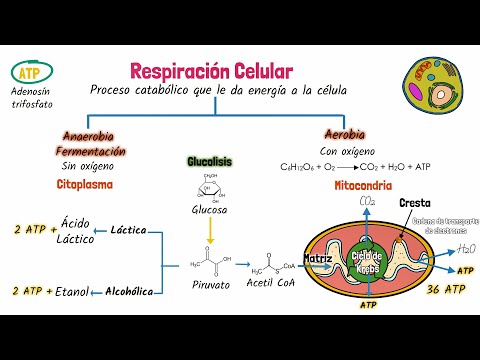
- Cellular respiration is a catabolic process where large molecules are broken down into smaller ones to release energy, primarily through ATP production.
- The process can occur aerobically (with oxygen) or anaerobically (without oxygen), known as fermentation.
Aerobic Respiration: Krebs Cycle and Electron Transport Chain
- Glucose undergoes glycolysis in the cytoplasm to produce pyruvate or pyruvic acid, generating ATP.
- In aerobic respiration, pyruvate enters the mitochondria to form acetyl CoA, initiating the Krebs cycle in the matrix.
- The Krebs cycle breaks down acetyl CoA to produce CO2 and hydrogen atoms that move to the electron transport chain on the mitochondrial cristae.
Energy Production and ATP Synthesis
- The electron transport chain facilitates oxidative phosphorylation, converting ADP to ATP using oxygen as a final electron acceptor, forming water.
- Approximately 36 ATP molecules are generated during aerobic respiration through this complex process in mitochondria.
Anaerobic Respiration: Fermentation Pathways