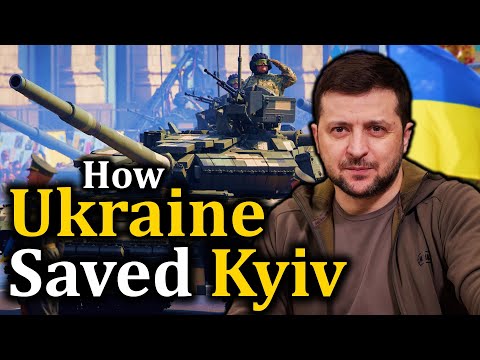
The Battle of Kyiv: A Tale of Russian Missteps and Ukrainian Ingenuity
The Battle of Kyiv
This transcript describes the events leading up to and during the Battle of Kyiv, which took place in 2022 between Russia and Ukraine. It highlights the Ukrainian resistance against Russian invasion and how they were able to prevent Moscow from achieving its goal.
Act One: Russia’s Mobilization
- A fleet of tanks, trucks, armored personnel carriers, and other vehicles depart from Belarus as part of Russia's offensive against Kyiv.
- Pockets of fighting are already active around Kyiv with Ukrainian President Zelensky organizing what seems like the final stand against the Russian invasion.
- At this point, Ukraine is massively outgunned by Russia who is considered one of the greatest military powers in the world.
- Despite being only 150 kilometers away from Kyiv, it takes three days for Russian troops to reach the capital.
Act Two: The Battle Begins
- By March 11th, pockets of fighting continue but the dreaded convoy has dispersed.
- By March 16th, Ukraine begins a true counterattack.
- By March 29th, Russia announces its plan to depart from the area ending their western offensive entirely.
Conclusion
- The combination of Ukrainian ingenuity and Russian missteps prevented Moscow from achieving its goal.
Understanding Military Mobilization
In this section, the speaker discusses the different levels of military mobilization and how they come with costs and benefits. The goal is to find the mobilization level where the extra chance of victory is exactly offset by the additional economic costs and political risks.
Levels of Military Mobilization
- Low effort mobilization involves limited involvement in a conflict.
- Medium effort mobilization involves putting boots on the ground.
- High effort mobilization involves establishing a draft to keep the effort going.
- All-in wartime economy strategy like World War II, where everyone’s labor is connected to the broader war effort.
Costs and Benefits of Military Mobilization
- The more you mobilize, the greater the costs you incur to do so.
- The obvious benefit is that the more you mobilize, the more likely you are to win a conflict.
- In current times, high mobilization would mean a higher chance that more of Ukraine would fall into Russian hands.
- The goal is to find the mobilization level where extra chance of victory is exactly offset by additional economic costs and political risks.
Putin's Calculations for Mobilizing Troops
In this section, we learn about Putin's calculations for choosing a modest military mobilization. He believed that Russian soldiers were ready and their equipment was top-notch. He also believed that many Ukrainians would not resist in case of an invasion.
Factors Influencing Putin's Decision
- Putin calculated that modest military mobilization was his best choice.
- He believed that a sizable portion of Ukrainians would not resist in the first place.
- Selecting a large mobilization would be overkill for Russia, even if the war itself were short.
Constraints on Putin's Decision
- Every unit of mobilization would impose a sharp cost.
- There were real institutional constraints in Moscow that Putin had to navigate through.
- It was central to the whole social contract that kept the Kremlin afloat.
- The implicit bargain was that Putin was free to pursue his own agenda, especially on the international stage, so long as the economy was booming and his foreign affairs were not affecting the average Alexanders.
Ending Conscription and the War in Donbas
In 2019, Moscow declared its intention to end conscription altogether and move to a professional military. This decision impacted the War in Donbas as Russia sent unmarked men into eastern Ukraine to foment a separatist movement instead of engaging in a traditional invasion. Putin faced challenges mobilizing conscripted men to Ukraine due to their service being intended for Russia.
- The War in Donbas looked different due to the decision to end conscription.
- Putin's sensitivity on the political risk meter was higher than what a casual analysis might suggest.
- Russia announced a "special military operation" instead of a war due to political risks.
- The initial invasion had a shortfall of troops given basic rules of thumb.
Operational Secrecy
Putin was committed to starting the war but did not want it publicized, especially to the West. There was disagreement within Western leadership regarding the seriousness of the threat, with some countries believing that Russia's implicit threats were not inherently credible.
- Putin wanted to keep his desire for war private from Western leaders.
- Disagreement existed within Western leadership regarding the seriousness of Russia's threat.
- France and Germany were sympathetic towards Ukraine's position.
- The secrecy plot worked even late into the game despite U.S. intelligence leaking information about Russia's next moves regularly.
Putin's Ambitions
This section discusses how Putin's ambitions led to the invasion of Ukraine and how he kept his plans secret from even senior Russian officials.
Diplomatic Solution
- By the end of a conversation with Macron, Putin was convinced to seek a diplomatic solution.
- However, the next day, Putin recognized the independence of Donetsk and Luhansk.
- Three days later, diplomacy ended and the special military operation began.
Keeping Secrets
- Russia's military planners had to accept tradeoffs in organizing the invasion due to keeping it secret for so long.
- Senior Russian officials may have been kept in the dark about Putin's plans until the last moments.
Biden and Burns' Warning
This section discusses how Biden dispatched CIA Director William Burns to Moscow to warn Russian officials that the United States was prepared to respond if Ukraine was invaded.
Warning Russia
- On November 2, 2021, Biden dispatched CIA Director William Burns to Moscow.
- The plan was to warn Russian officials that the United States was prepared to respond if Ukraine was invaded.
Meeting with Patrushev
- During one of Burns' meetings with Nikolai Patrushev, he warned him about potential consequences should Russia invade Ukraine.
- Patrushev appeared shocked by these warnings which could indicate that he wasn't aware of Putin's plans or he could be acting for the benefit of Burns.
Blinken's Uncertainty
This section discusses how U.S. Secretary of State Antony Blinken was uncertain about Russia's intentions after meeting with Russian Minister of Foreign Affairs Sergey Lavrov.
Touring Europe
- In January, Blinken toured Europe with the war in Ukraine on his mind.
- He met with his Ukrainian counterpart in Kyiv before flying to Geneva to meet with Lavrov.
Pressing for Answers
- During their 90-minute meeting, Blinken pressed Lavrov for answers regarding Russia's intentions.
- However, Lavrov talked in circles and left Blinken uncertain about Putin's goals.
Puppet Governments
This section discusses how the FSB eyed two potential puppet governments should Kyiv fall and how Russian troops were not prepared for implementing these plans.
Potential Puppet Governments
- The FSB eyed two potential puppet governments should Kyiv fall including Viktor Yanukovych who fled to Russia in 2014 and Oleg Tsaryov who led the brief "New Russia" movement.
- Yanukovych's plane flew to Belarus on March 7, apparently in place to go back to Kyiv so he could stake a claim as the legitimate leader of Ukraine.
- A second group formed in southeast Ukraine which included Oleg Tsaryov who sought to create a confederacy of Luhansk, Donetsk, and other Ukrainian separatist regions that failed to arise.
Lack of Preparation
- Russian troops were not prepared for implementing these plans as they were under the impression that they were in Belarus for training exercises.
- Some soldiers were given simple instructions to follow the vehicle in front of them, which led to a lack of preparation and damage.
- Eventually, high-level Russian leadership had to tell the soldiers what was happening but for many, the forewarning was between 24 hours and just one hour—not enough time to undo all of the damage.
Russian Military's Shortcomings
This section discusses the shortcomings of the Russian military during the 2022 crisis.
Outdated Maps and Poor Communication
- Outdated maps of Ukraine from the 1960s were discovered on some soldiers.
- Soldiers used their own cell phones for communication, giving away their locations to the enemy.
Inadequate Provisions and Dress Uniforms
- Medics received an undersupply of provisions.
- Soldiers packed dress uniforms instead of necessary supplies.
Inability to Conduct Shock and Awe Campaign
- Russia could not conduct a shock and awe campaign like the United States did before the Iraq War.
- Putin had only available military resources for this task.
Ticking Time Bomb
This section discusses how Ukraine had strong suspicions that Russia’s invasion force was a ticking time bomb.
Evidence of Corruption and Morale Problems
- Ukrainian intelligence agents found drunk units with rusting tanks in Russia's preparation.
- Putin appointed Anatoly Serdyukov, who had no military background, as Minister of Defense to fix corruption problems in 2007.
- The US intelligence assessment showed that Moscow’s broader plans were not reaching Russian soldiers on the ground.
Self-Destruction of Invasion Force
- Kyiv had strong suspicions that Russia’s invasion force was a ticking time bomb.
- Russian soldiers would begin running out of food and fuel after 72 hours, equipment would start breaking down, and most of the special military operation would begin to flail around.
Ukraine's Gameplan
This section discusses the five tasks that Ukraine needed to complete to survive long enough for Russia's ticking time bomb to go off.
Keeping Zelensky Alive and in the Country
- Ukraine had to keep President Zelensky alive and in the country.
- Refusing any plane, train, or automobile that the West was offering would ensure he stayed in the country.
- Even if Ukraine could militarily win the battle of Kyiv, they still had to worry about assassination attempts on the ground and from the sky.
- The ground part was a major concern as a single person within Zelensky’s own security service turning could take down the president from inside.
Preventing Russia from Establishing a Sky Bridge into Kyiv
- The second task was to prevent Russia from establishing a skybridge into Kyiv.
- Targeting Hostomel Airport, just 38 kilometers away from Kyiv's center, was Russia's central goal.
Rendering Russian Air Force Ineffective
- To survive long enough for Russia’s ticking time bomb to go off required rendering Russian Air Force ineffective.
Repelling Initial Attack on Capital
- Another task was repelling initial attack on capital.
Making Convoy Regret Crossing Belarusian Border
- The last task was making convoy regret ever having crossed Belarusian border.
Protecting Zelensky
This section discusses how Ukraine retooled its protection assignments to protect President Zelensky during invasion.
- CIA Director Burns warned President Zelensky of specific plots that Russia might use against him.
- Only those whose loyalty was unquestionable could get near Zelensky while armed.
- Ukraine had a large bunker system under Kyiv specifically designed to keep the government functioning from below.
- The bunker network effectively guaranteed his safety.
Kyiv's Infrastructure
This section discusses how much of Kyiv’s infrastructure is a byproduct of Cold War planning and how it helped Ukraine during the invasion.
- Much of Kyiv’s infrastructure is a byproduct of Cold War planning.
- Subway tunnels that are normally meant for trains were built deeper underground to double as nuclear fallout shelters.
- Civilians jammed inside them for safety during the initial stages of the invasion.
- The office of the president had an even better option, a large bunker system under Kyiv specifically designed to keep the government functioning from below.
Conclusion
This section concludes that Ukraine completed its first goal, which was keeping President Zelensky alive and in the country.
Stopping Russian Planes and Securing the Airport
Ukraine parked long vehicles perpendicular to the runway, preventing Russia from landing planes until soldiers had arrived, secured the location, and removed obstructions. Russia air dropped soldiers around the airport within a few hours of the invasion. Ukrainian forces were waiting in reserve for a counterattack. The airport exchanged hands multiple times before Ukraine hit the runway with enough bombs and artillery to render it inoperable.
- Russian reinforcements arrived on the ground and overwhelmed Ukrainian defenders.
- Russia repaired the runway but not quickly enough to have an impact on the outcome of the overall offensive.
- Ukraine was two for two with its goals thus far.
Stopping Russian Air Force
Ukraine dispersed its anti-aircraft systems as a preliminary step toward creating a more robust defense network. In the days before the actual invasion, Ukraine further reshuffled many of its systems. As a result, most of Russia’s first wave of strikes missed instead hitting former locations. Ukrainian pilots discovered that they could fly their ostensibly inferior planes low to ambush Russian bombers.
- Majority of Russia’s first wave of strikes missed instead hitting former locations.
- Ukrainian pilots discovered that they could fly their ostensibly inferior planes low to ambush Russian bombers.
- Zelensky found MANPADS from US and Europe which helped trap Russian planes in a place where Ukraine could put them to full use.
Managing Russian Aircraft Advantage
Despite having an inferior Air Force with substantially worse range, Ukrainian planes also got into action by ambushing Russian bombers. Low flying aircraft are vulnerable to man-portable air-defense systems, or MANPADS for short. As a result, what appeared to be a clear aircraft advantage to Russia at least on paper ended up being manageable for Ukraine.
- Ukrainian planes ambushed Russian bombers.
- Zelensky found MANPADS from US and Europe which helped trap Russian planes in a place where Ukraine could put them to full use.
Stopping the Oncoming Russian Soldiers
Ukraine divided the workflow into two, setting up an outer ring and an inner ring of defense around the city. The purpose of the inner ring was to serve as the final stand where Ukraine could take the battle to the streets in case all else failed.
- Ukraine was familiar with what Russian artillery and armored columns could do from short range.
Ukraine's Defense Strategy
This section discusses the strategic advantage that Ukrainian defenders had during the war with Russia.
Split Attack
- Russian attack was split between Kyiv, Donbas and Crimea fronts.
- This meant that initially outnumbered Ukrainian forces did not have to bear the full weight of Russia’s attack.
Shifting Force Ratios
- Ukraine opened up its armories, inviting average Ukrainian citizens to take military-grade arms.
- It made for a more powerful Territorial Defense Force, Ukraine’s official reserve system.
Urban Combat Advantages
- Every building is a potential ambush point or sniper’s nest.
- Russian troops on the ground had to exercise extreme caution or risk never returning home.
Czech Hedgehogs
This section explains what Czech hedgehogs are and how they were used in the war.
What are Czech Hedgehogs?
- They are devices that can stop advancing motorized troops by lodging themselves under the chassis of vehicles and lifting them off of the ground.
- The device has a symmetric design which makes it impossible for attackers to blast their way through.
Counter Strategies
- One counter strategy is to move them yourself using a tow but this is risky if you suspect there are defenders in the area.
- The other option is to simply go around, but this strategy will not always present itself.
Mass Production of Czech Hedgehogs
This section explains how Ukrainian welders mass-produced Czech hedgehogs during the war.
Mass Production
- As soon as the war began, welders across Ukraine quit what they were doing and found whatever scrap metal was lying around to mass-produce them.
- More buildings destroyed meant more raw materials for I-beams suddenly became available.
Urban Combat and Climate Strategy
This section discusses the urban combat that occurred in Kyiv during the Russian invasion, as well as Ukraine's climate strategy to defend against the Russian convoy.
Urban Combat
- Pockets of Russian soldiers penetrated into the city, leading to some urban combat.
- The closest call occurred when Russian invaders approached the Kyiv Zoo. Defending soldiers repelled the attack in time.
- Ukraine had conditionally checked four of five pockets of Russian soldiers. Now it all came down to the convoy.
Climate Strategy
- Before leaving Belarus, Belarussian opposition sabotaged train systems and limited fast movement of Russian supplies.
- Ukraine's strategy was all about climate and geography. The heavily wooded area stretching from Belarus to Kyiv provided an endless supply of locations for ambushes.
- Fighting on eastern plains provides few natural places to set up an ambush and wide open paths for attackers to take.
- From the Ukrainian perspective, tree cover provides an endless supply of locations from which to spring traps.
- Ukraine's basic playbook was a "pinch" strategy where soldiers would immobilize first and last vehicles in a group through direct fire or drones, trapping all remaining vehicles in between.
- With first and last vehicle immobilized, escaping off-road through mud was only option for Russians. If mud was unkind, they would have to abandon their vehicles and run.
- Ukraine exploited this advantage by setting up Czech hedgehogs to block roads and using the Irpin River as a natural break point.
The Height of the Mud Strategy
This section discusses how Ukraine intentionally breached the Irpin River dam, which caused water to flow back toward the river and created a valuable weapon for Ukraine.
Breaching the Dam
- Ukraine intentionally breached the Irpin River dam.
- Water flowed back toward the Irpin, returning the area west to its swampy state.
- Twenty kilometers upstream were affected, and twenty-five square kilometers overall went underwater.
Impact on Russia's Military Operations
- Russia’s existing pontoon bridges became worthless as the river had become too wide to cross.
- Fringe areas became full-blown mudfests, deterring any tank or other vehicle from approaching.
- Having to stay on the road created a different problem for Russia. Military vehicles are far from lightweight objects. And while your average road can tolerate some level of military abuse, tank after truck after tank after truck is a different story.
- Once the road breaks, you are back to traversing dirt.
Consequences for Russian Troops
- Vehicles ran out of fuel. Tires started popping. Poorly maintained engines refused to work. Russian soldiers had no idea where their next meal was coming from.
- By March 11, the convoy had dispersed, no longer in a shape to conduct offensive operations.
Epilogue
This section discusses Russia's announcement to abandon the Kyiv front and redeploy its forces to the south and east, Ukraine's counteroffensive, and how Russia described the entire offensive as a "feint."
Russia's Announcement
- On March 29, Russia announced a general intention to abandon the Kyiv front and redeploy its forces to the south and east.
Ukraine's Counteroffensive
- Although the declaration was met with skepticism in the West, Ukraine indeed retook all of its lost territory in the theater by April 4.
- And five days later, the roles had reversed. Ukraine went on a counteroffensive, and Russia had to play defender.
Russia's Explanation
- Russia described the entire offensive as a “feint” designed to distract Ukraine while true offensives occurred in the south and in the east. However, feints are supposed to be low cost, smoke-and-mirrors operations that distract your enemy and raise your popularity at home. This did not meet those standards.
- Rather, it was a series of logistical blunders that prevented Russia from achieving a quick victory in Ukraine and earning a champagne toast.
The Ukrainian War
This section discusses the progress of the war between Ukraine and Russia, including significant events and outcomes.
Russian Advances
- Kherson City fell on March 2.
- On May 20, Russia captured Mariupol, completing its Crimean land bridge.
- Ukraine's supposition that Russia had overextended its supply lines was partially correct.
Ukrainian Successes
- Ukraine pushed Russia out of Kharkiv's vicinity in September.
- Ukraine forced Russia to retreat out of Kherson City without serious confrontation in November.
Current Status
- As of this recording, Russia maintains firm control over the land bridge to Crimea, and there is no obvious end to the war in sight.
Fonts - Times New Roman vs. Calibri
This section discusses the shift from Times New Roman to Calibri as the preferred font for the U.S. State Department.
Shift to Calibri
- Secretary Blinken issued a memo on February 6 shifting the Department's preferred font to Calibri.
- Although serif fonts are being phased out, Calibri is considered a boring option.
Historical Context
- In 2017, Pakistan pressed corruption charges against former Prime Minister Nawaz Sharif based on a document allegedly drafted in 2006 using Calibri. However, Calibri did not debut until 2007.