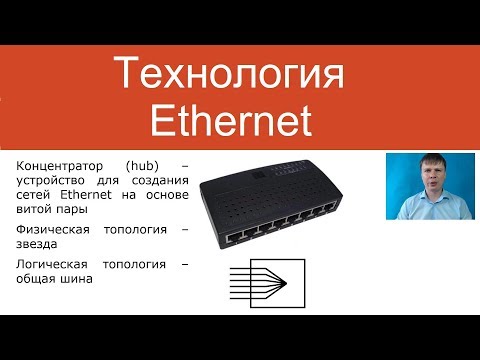
Технология Ethernet | Курс "Компьютерные сети"
Introduction to Ethernet Technology
Overview of Ethernet
- The lecture introduces Ethernet technology as a popular method for creating wired computer networks, often used alongside Wi-Fi.
- Developed by Robert Metcalfe in 1973 while at Xerox, the concept was inspired by the ALOHAnet system from the University of Hawaii, which utilized wireless data transmission.
Evolution of Ethernet Standards
- Initially named "Ethernet" (from "ether" referring to the medium), it transitioned from using radio waves to wired connections.
- By 1982, Ethernet became an industrial standard adopted by major companies like Xerox, DEC, and Intel, leading to its widespread use in local area networks (LANs).
Development of Ethernet Variants
Early Versions and Speeds
- The first version of Ethernet supported speeds up to 10 Mbps using coaxial cables, twisted pairs, and optical fibers under the IEEE 802.3 standard.
- Fast Ethernet increased speed tenfold to 100 Mbps but limited cable types to twisted pair and fiber optics.
Advanced Technologies
- Subsequent versions included Gigabit Ethernet (1 Gbps), 10 Gigabit Ethernet (10 Gbps), and 100 Gigabit Ethernet (100 Gbps).
- Intermediate versions like 2.5G and 5G were developed specifically for local networks where higher speeds were unnecessary due to cost constraints.
Types of Ethernet: Classic vs. Switched
Classic Ethernet
- Classic Ethernet uses a shared medium for data transmission accessible by all connected computers; this model has been in use since its inception until Gigabit standards.
Switched Ethernet
- Switched or commutated Ethernet emerged with Fast Ethernet technology; it allows dedicated connections between devices improving network efficiency.
Physical Topology Changes
Transition from Bus to Star Topology
- The original bus topology utilized coaxial cables connecting all computers directly; issues arose when any segment failed.
- Star topology replaced this with hubs or switches centralizing connections; if one device fails, only that device is affected.
Technical Specifications of Data Transmission
Physical Layer Details
- At the physical level, various cable types are defined for signal transmission: coaxial cables, copper wires, and optical fibers.
Data Frame Formats
Ethernet Frame Structure and Protocols
Overview of Ethernet Frame Format
- The Ethernet frame format is more popular than 802.3, with modern Ethernet equipment supporting both formats. This discussion focuses on the Ethernet II frame format, which is most commonly used in practice.
- The header of the Ethernet frame includes the source and destination computer addresses, as well as a protocol type field that indicates the next-level protocol (e.g., IP version 4 or ARP).
Data Handling and Error Checking
- The trailer (or footer) contains a checksum for error checking. Upon receiving a frame, the recipient calculates its own checksum to verify data integrity; if it doesn't match, the frame is discarded without notifying the sender.
- In contrast to Ethernet II frames, IEEE 802.3 frames use a length field instead of a type field. This change reflects different handling of data packets at various network layers.
Size Limitations of Frames
- The maximum size for an Ethernet frame's data payload is 1500 bytes due to historical constraints from when Ethernet was developed in the 1970s. Although this seems small today, it was considered substantial at that time.
- There are standards like Jumbo Frames that allow larger sizes up to 9000 bytes; however, even these are relatively small by today's standards where file sizes can reach gigabytes.
Collision Detection and Minimum Frame Size
- The minimum size for an Ethernet frame's data payload is set at 46 bytes due to collision detection requirements inherent in Ethernet technology.
Evolution of Ethernet Technology