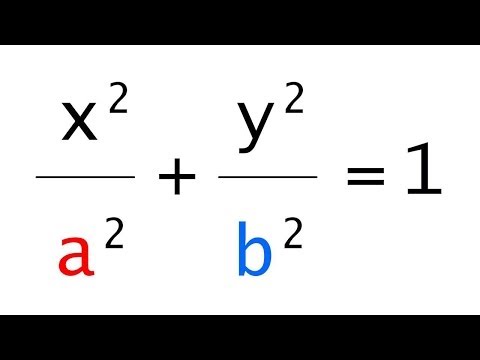
The Best Explanation of the Equation of an Ellipse
Deriving the Equation of a Horizontal Ellipse
In this video, we will learn about deriving the equation of a horizontal ellipse. We will explore the concept of foci, major and minor axes, and use algebraic steps to simplify the equation.
Understanding Ellipses
- An ellipse is created by connecting two points called foci with a string.
- The length of the string remains constant, creating an ellipse when extended around the foci.
- The longest diameter of the ellipse is called the major axis, while the shortest diameter is called the minor axis.
- Let's denote half the length of the major axis as 'a' and half the length of the minor axis as 'b'.
Pythagorean Theorem and Distance Formula
- By applying Pythagorean theorem to a triangle formed by extending the string evenly at the top, we have B^2 + C^2 = A^2.
- We label distances from each focus to an XY coordinate as D1 and D2.
- Using distance formula, we can find D1 and D2 by substituting coordinates into the formula.
Simplifying Equations
- After simplifying equations and rearranging terms, we square both sides to eliminate square roots.
- Expanding parentheses and canceling out like terms helps us further simplify equations.
- Dividing both sides by A^2 * (A^2 - C^2), we eliminate common factors.
Equation of a Horizontal Ellipse
- Finally, after factoring and substituting B^2 = A^2 - C^2 into our equation, we obtain x^2 / A^2 + y^2 / (A^2 - C^2) = 1.
- This represents all points (x,y) that make up a horizontal ellipse.
Thank you for watching this video on deriving the equation of a horizontal ellipse.