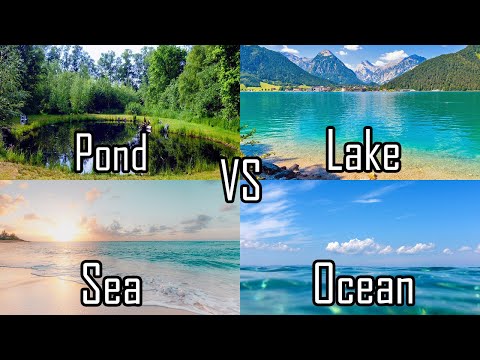
What is the difference between ponds, lakes, rivers, seas, and oceans?
What Defines Different Bodies of Water?
This section discusses the distinctions between ponds, lakes, rivers, seas, and oceans based on their characteristics and surrounding land formations.
Differences Between Ponds and Lakes
- If a body of water is surrounded by land from all sides:
- It's either a pond or a lake.
- A pond is generally shallow, while a lake is deep.
- Size does not always determine classification; depth plays a crucial role.
Contrasting Lakes and Rivers
- Rivers are moving bodies of water that constantly flow into other bodies like seas or oceans.
- Lakes are standing bodies of water that do not move significantly.
Distinctions Between Seas and Oceans
- Seas are smaller and shallower than oceans.
- Seas are connected to land, unlike oceans which are not.
Visualizing the Differences
- The sea connects land with the ocean; at the beach, you swim in the sea where land is visible. In contrast, in the middle of an ocean, no land can be seen due to being unbounded by land.
Summary of Definitions
- A pond: Shallow body surrounded by land.
- A lake: Deep body encircled by land.
- A river: Moving water flowing into another body like a sea or ocean.
- Seas: Partially enclosed bodies linked to land.