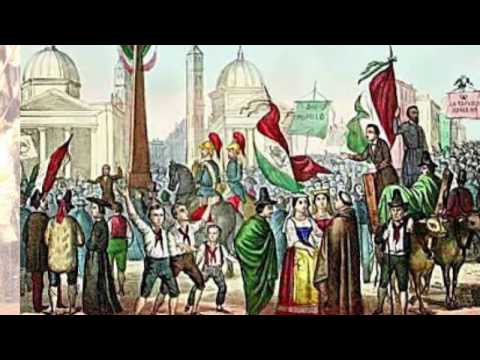
La Unificación Italiana: "Il Risorgimento"
Nationalism and the Unification of Italy
The Context of Italian Nationalism Post-Congress of Vienna
- Nationalism emerged as a force opposing the territorial arrangements established by the Congress of Vienna, significantly impacting both Italy and Germany.
- After the Congress of Vienna, Italy was fragmented into seven states, with the Kingdom of Piedmont-Sardinia being pivotal for future unification efforts.
- The Kingdom of Lombardy-Venetia was under direct Austrian control, while central Italy comprised independent duchies that were ultimately influenced by Austria.
- The Papal States represented territories governed directly by the Pope, highlighting the intertwining of religion and politics in this period.
- By 1815, all Italian territories fell under Austrian influence, necessitating their intervention in regional conflicts.
Projects for Italian Unification
Project for a Great Nation
- A revolutionary movement aimed to dismantle existing states to create a unified liberal and democratic Italian state with universal suffrage.
- Giuseppe Mazzini emerged as a key figure advocating for this vision through multiple revolutionary attempts throughout his life.
- His most significant effort occurred in 1848 when he briefly took control of Rome but was ultimately defeated by Austrian forces in 1849.
Confederation Proposal
- An alternative proposal suggested forming a confederation where individual states would retain some sovereignty while ceding authority to a central body led by the Pope.
- This idea garnered more conservative support compared to Mazzini's radical approach but failed to meet nationalist aspirations similar to those seen in Germany.
The Small Nation Strategy
- Recognizing Austria's military power as an obstacle, proponents argued that any unification plan must involve defeating Austria first.
- A viable strategy required an existing state with sufficient military strength or powerful allies capable of challenging Austrian dominance.
Role of Piedmont-Sardinia in Unification Efforts
- The Kingdom of Piedmont-Sardinia became crucial due to its potential military capabilities and political leadership under Camillo di Cavour.
The Role of France in the Unification of Italy
Request for Assistance from Napoleon III
- The Piedmontese seek help from Napoleon III, the Emperor of the Second French Empire, as he aims to enhance France's prestige by involving it in various conflicts.
- Agreements are made at Plombières where Piedmont secures military support from France against Austria, with the condition that they cede territories like Savoy and Nice to France.
The War Against Austria (1859)
- With French assistance, Piedmont declares war on Austria, leading to significant battles such as Magenta and Solferino, both resulting in victories for the Franco-Piedmontese forces.
- Technological advancements in military weaponry during this period lead to increased casualties due to faster-loading rifles capable of firing multiple rounds per minute.
Consequences of the Battles
- The high number of casualties shocks Napoleon III, who is concerned about sustaining his well-trained army amidst heavy losses.
- In response to rising concerns over human costs, Napoleon III negotiates a peace agreement with Austria independently, leading to territorial gains for Piedmont but leaving them feeling betrayed.
Aftermath and Territorial Changes
- Following the peace agreement, Piedmont feels deceived as they lose significant territories while only gaining Lombardy in return.
- Despite these setbacks, Piedmont expands its territory but falls short of its goal to liberate all of Italy from Austrian control.
Political Shifts Post-War
- Although territorial gains are limited post-war, defeating Austria politically weakens their influence in Italy and encourages central Italian states like Parma and Tuscany to join Piedmont voluntarily.
Garibaldi's Campaign
- In summer 1860, Garibaldi leads a volunteer army known as the "Red Shirts" into Sicily and Naples, successfully liberating southern Italy from Bourbon rule.
Unification Efforts
- A potential conflict arises between two visions for Italy: one led by Piedmont’s King Victor Emmanuel II and another by Garibaldi’s revolutionary ideals. However, Garibaldi ultimately concedes his conquests to Victor Emmanuel II.
Formation of the Kingdom of Italy
Unification of Italy: Key Events and Challenges
The Remaining Territories for Italian Unification
- The unification of Italy is incomplete, with two significant areas remaining: the Papal States and the Lombardo-Venetian Kingdom, which are outside of Italy. The goal is to conquer Venice and Rome.
Alliance with Prussia Against Austria
- To defeat Austria, Piedmont realizes it cannot do so alone. It allies with Prussia during the Seven Weeks' War against Austria, leveraging this conflict to gain Venice.
- Although Italy gains Venice through this alliance, its military role in the war was minimal. The victory over Austria was primarily due to Prussian strength rather than Italian efforts.
Territorial Disputes Post-Venice Acquisition
- After acquiring Venice, two critical territories remain contentious: Trentino-Alto Adige and Trieste (Istria). Despite their Italian-speaking population, Austrians refuse to cede these regions as they have historical ties dating back to the Habsburg era.
- This unresolved issue leads to ongoing tensions between Italy and Austria. These territories are referred to as "irredentist" lands by Italians who continue to claim them despite not having decisively defeated Austria.
The Challenge of Capturing Rome
- With Venice secured, the focus shifts to capturing Rome from the Pope. However, Napoleon III defends Rome vigorously, complicating Italian ambitions due to his support for the Papacy.
- An opportunity arises when Prussia declares war on France in 1870 (Franco-Prussian War), allowing Italy to declare war on France while they are preoccupied.
Conquest of Rome and Its Aftermath
- As French forces retreat from Rome under pressure from Prussia, Italian troops seize control of the city amidst a lack of resistance from the Pope's side.
- Following this conquest in 1870, the Pope views himself as a prisoner within the new Kingdom of Italy. This marks a significant moment in completing Italian unification but leaves lingering issues regarding papal authority.
Political Tensions Post-Unification
- Internally, Italy faces political instability due to what is known as "the Roman Question," where the Pope refuses recognition or acceptance of his loss of territory and power within Italy.