How Electric Motors Work - 3 phase AC induction motors  ac motor

How Electric Motors Work - 3 phase AC induction motors ac motor

How Do Induction Motors Work?

Introduction to Electrical Motors

  • The electrical motor is a crucial invention, utilized in various applications such as water pumping, elevators, cranes, and cooling nuclear power stations.
  • Induction motors convert electrical energy into mechanical energy for driving pumps, fans, compressors, gears, and pulleys.

Components of an Induction Motor

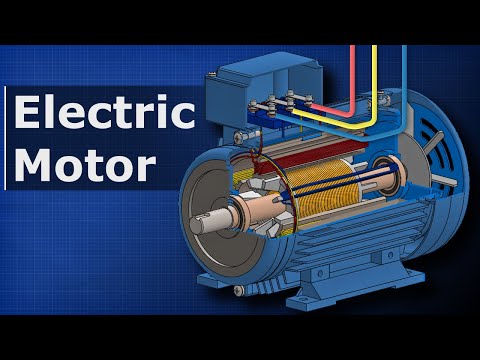
  • The shaft at the front rotates and connects to external devices like pumps and gears.
  • A fan at the back cools the motor by blowing air over it; overheating can lead to insulation melting and short circuits.
  • Inside the housing is the stator, which consists of copper wire coils insulated with special enamel to ensure proper current flow.

Stator and Rotor Functionality

  • This induction motor features three-phase coils in the stator that connect to terminals in an electrical box.
  • When powered, the stator generates a rotating electromagnetic field that interacts with the rotor.
  • The squirrel cage rotor design includes end rings connected by bars; this structure enhances magnetic field concentration.

Electromagnetic Principles

  • Laminated steel sheets are used in the rotor to improve efficiency by reducing eddy currents.
  • An electromagnetic field is generated when electricity flows through wires; reversing current direction also reverses this field.

Interaction Between Magnetic Fields

  • A wire placed within a magnetic field experiences force based on current direction and magnetic polarity.
  • Coiling wires strengthens their electromagnetic fields; alternating current causes these fields to expand and collapse continuously.

Inducing Current Through Coils

  • Two coils can induce current in each other when placed close together within a magnetic field.
  • A closed loop of wire inside a larger magnetic field will generate its own magnetic field that interacts with others, causing rotation.

Overcoming Rotor Alignment Issues

  • The rotor aligns with stator coils but may get stuck due to induced current reversal; additional coil sets help maintain motion.

Understanding Three-Phase Motor Configurations

The Role of Coils and Magnetic Fields

  • When connecting coils to different phases, the electrons change direction at varying times, affecting the magnetic field's polarity and intensity.
  • To create a rotating magnetic field, coils must be positioned 120 degrees apart; this arrangement allows for variations in strength and polarity across the coils.
  • The rotor bars induce current due to their interaction with the stator's magnetic field, causing the rotor to rotate in alignment with the stator's rotating field.
  • Skewed rotor bars help distribute the magnetic field and prevent jamming by ensuring that alignment is never fully achieved between rotor and stator.
  • The electrical terminal box contains six terminals (u1, v1, w1, w2, u2, v2), facilitating connections for three-phase power supply.

Connecting Power Supply: Delta vs. Star Configuration

  • Completing the circuit can be done via two configurations: delta or star (Y).
  • In delta configuration, terminals are connected as follows: u1 to w2, v1 to u2, and w1 to v2; this allows electricity flow as AC power reverses direction across phases.
  • The star configuration connects terminals differently (w2 to u2 and v2), resulting in shared electron flow among phases due to design differences.

Voltage and Current Calculations

  • In delta configuration with a supply voltage of 400 volts, measuring between any two phases yields a line-to-line voltage of 400 volts; each coil has an impedance of 20 ohms leading to a current reading of 20 amps.
  • For delta configuration calculations: Line current is higher at 34.6 amps due to each phase being connected to two coils (20 amps multiplied by √3).

Differences Between Delta and Star Configurations

  • In star configuration with a line-to-line voltage of 400 volts measured similarly yields lower coil voltage at 230 volts because one end connects only to a shared point rather than directly between two phases.
  • This results in lower current readings; if impedance remains at 20 ohms for star connection then calculated current drops significantly compared to delta setup.

Summary Insights on Electrical Configurations

Understanding Star vs. Delta Connection in Electrical Engineering

Key Differences Between Star and Delta Connections

  • The star connection utilizes less voltage and current compared to the delta version, making it more efficient for certain applications.
  • This efficiency is attributed to the neutral point in the star configuration, which helps balance the load.
  • The video concludes with an invitation to explore further educational content on electrical engineering.
Video description

How Electric Motor Works - 3 phase induction motor AC alternating current. 🎁 Sign up for a Free Trial at ➡️ https://greatcourses.thld.co/engineeringmindsetjan Learn from the basics how an electric motor works, where they are used, why they are used, the main parts, the electrical wiring connections, induction motor, alternating current AC, electrical machines, rotating magnetic field, star delta, wye delta. ⚡🛠️ TOOLS YOU NEED 🛠️⚡ ******************************* Get this electronics book ➡️ https://amzn.to/41cCJPk Professional Multimeter -➡️ https://amzn.to/3xu2Vaw Good multimeter -➡️ https://amzn.to/3xrbuTd Professional clamp meter ➡️ https://amzn.to/4140FnK Good Clamp meter ➡️ https://amzn.to/3xqt2is Outlet tester ➡️- https://amzn.to/3kavg2l Energy monitoring plug ➡️ https://amzn.to/3SkfPl7 Battery tester -➡️ https://amzn.to/3S3fHWI Basic electronics ➡️ kit https://amzn.to/3xuLiqS DC Motor explained:👉 https://youtu.be/GQatiB-JHdI Alternators:👉 https://youtu.be/jdSKlg80DjU Star Delta starter:👉 https://youtu.be/h89TTwlNnpY Variable frequency drive:👉 https://youtu.be/yEPe7RDtkgo Power inverter:👉 https://youtu.be/iIqhAX0I7lI Relays:👉 https://youtu.be/n594CkrP6xE 👋 SOCIALISE WITH US 👋 ******************************* 👉FACEBOOK: https://facebook.com/theengineeringmindset/ 👉TWITTER: https://twitter.com/TheEngMindset 👉INSTAGRAM: https://instagram.com/engineeringmindset/ 👉WEBSITE: http://TheEngineeringMindset.com 👀 Links - MUST WATCH!! 👀 ******************************* ⚡ELECTRICAL ENGINEERING⚡ 👉How electricity works: https://youtu.be/mc979OhitAg 👉Three Phase Electricity: https://youtu.be/4oRT7PoXSS0 👉How Inverters work: https://youtu.be/ln9VZIL8rVs 👉How TRANSFORMER works: https://youtu.be/UchitHGF4n8 👉How 3 Phase electricity works: https://youtu.be/4oRT7PoXSS0 👉How Induction motor works: https://youtu.be/N7TZ4gm3aUg 👉What is a KWH: https://youtu.be/SMPhh8gT_1E 👉How induction motor works: https://youtu.be/N7TZ4gm3aUg ❄️ CHILLER ENGINEERING ❄️ 👉Chiller Efficiency improvements: https://youtu.be/8x3MiO5XjhY 👉Chilled water schematics: https://youtu.be/ak51DHAiuWo 👉Chiller crash course: https://youtu.be/K0xAKzdROEg 👉Chiller types: https://youtu.be/gYcNDT1d30k 👉Chillers/AHU/RTU: https://youtu.be/UmWWZdJR1hQ 👉Water cooled chiller Part1: https://youtu.be/0rzQhSXVq60 👉Water cooled chiller Part2: https://youtu.be/3ZpE3vCjNqM 👉Chiller/Cooling tower/AHU: https://youtu.be/1cvFlBLo4u0 👉Chiller flow rate: https://youtu.be/tA1_V6-dThM 👉Chiller fault troubleshooting: https://youtu.be/Zu0LVVNNVSw 👉Chiller COP calculation: https://youtu.be/h5ILlZ8nyHE 👉Chiller cooling capacity calcs: https://youtu.be/BZxXIdxVKeY 👉Chiller compressors: https://youtu.be/7Bah__spkTY 👉Chiller expansion valve: https://youtu.be/dXiV5YzTZQ4 👉Chiller surge: https://youtu.be/DQK_-vxObiw 👉Chiller condenser: https://youtu.be/p5uuPsyqnwU 👉Chiller evaporator: https://youtu.be/W3w7FpX9j9k 👉Chiller compressor centrifugal: https://youtu.be/PT0UIqAGacg 👉Chiller cooling capacity: https://youtu.be/f-N4isgQRGQ 🌡️ HVAC ENGINEERING 🌡️ 👉HVAC Basics: https://youtu.be/klggop60vlM 👉Boilers/AHU/FCU: https://youtu.be/lDeuIQ4VeWk 👉How Heat Pump works: https://youtu.be/G53tTKoakcY 👉Heat pumps advanced: https://youtu.be/G53tTKoakcY 👉Fan Coil Units: https://youtu.be/MqM-U8bftCI 👉VAV Systems: https://youtu.be/HBmOyeWtpHg 👉CAV Systems: https://youtu.be/XgQ3v6lvoZQ 👉VRF Units: https://youtu.be/hzFOCuAho_4 👉Cooling load calculations: https://youtu.be/0gv2tJf7nwo 👉Pulley belt calculations: https://youtu.be/yxCBhD9nguw 👉Pump calculations: https://youtu.be/99vikjRrlgo 👉Fan and motor calculations: https://youtu.be/rl-HQRzL-kg 👉HVAC Cooling coils: https://youtu.be/oSs-4Ptcfhk 👉Cooling towers: https://youtu.be/UzHJWNL2OtM ⚗️ REFRIGERATION SYSTEMS 🌡️ 👉How refrigerants work: https://youtu.be/lMqoKLli0Y4 👉Thermal expansion valves: https://youtu.be/oSLOHCOw3yg 👉Refrigeration design software: https://youtu.be/QqP5aY6liAg 👉Design refrigeration system: https://youtu.be/TPabv9iDENc 👉Reversing valve: https://youtu.be/r8n1_6qmsKQ 👉How A/C units work: https://youtu.be/Uv3GfEQhtPE ⚗️ REFRIGERANTS ⚗️ 👉Refrierant retrofit guide: https://youtu.be/1OqgLcU2buQ 👉Refrigerant types, future: https://youtu.be/J77a0keM2Yk 👉How refrigerants work: https://youtu.be/lMqoKLli0Y4 🌊 HYDRONICS 🌊 👉Primary & Secondary system: https://youtu.be/KU_AypZ-BnU 👉Pumps: https://youtu.be/TxqPAPg4nb4 👉Pump calculations: https://youtu.be/99vikjRrlgo 🔥➡️❄️ HEAT EXCHANGERS 🔥➡️❄️ 👉Plate Heat Exchangers: https://youtu.be/br3gkrXTmdY 👉Micro plate heat exchanger: https://youtu.be/xrsbujk4u6k 💻 DATA CENTERS 💻 👉Data Center cooling: https://youtu.be/xBxyhxmhigc 🔬 PHYSICS 🔬 👉What is Density: https://youtu.be/r0Ej0xB-0C8 🎬 DOCUMENTARY 🎬 👉WW2 Bunker HVAC engineering: https://youtu.be/xEzz-JkPeLQ ac motor #engineering #electrical #tesla synchronous motor amp 3 phase AC induction motors ac motor electrical machines tesla synchronous motor rotating magnetic field amp