Agile Product Ownership in a Nutshell
Agile Software Development from the Product Owner Perspective
This section introduces the concept of Agile Software Development and focuses on the role of the Product Owner.
The Role of the Product Owner
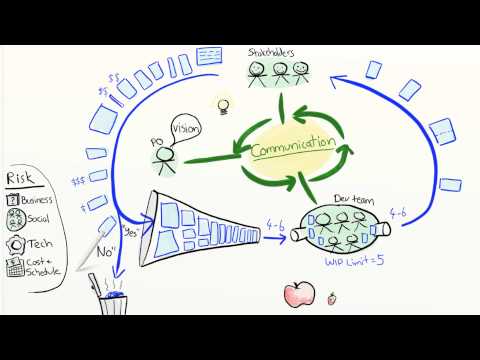
- The Product Owner, such as Pat in this case, has a product vision and understands why the product is being built and what problem it will solve.
- Stakeholders are those who will use or be affected by the system being developed. Their needs and ideas are expressed as user stories.
- A development team is responsible for building the system. They work in an agile manner, releasing early and often. Capacity is measured by counting the number of stories released per week.
Managing Stakeholder Requests
- Stakeholders may have numerous ideas and requests, which can overwhelm the development team if they try to fulfill all of them. Saying "NO" becomes crucial for the Product Owner to avoid overload and maintain productivity.
- Scrum uses a method called "Yesterday's Weather" where past performance is used to determine which features to build next. Kanban limits Work In Progress (WIP) to prevent overload.
- However, managing stakeholder requests can lead to a backlog forming in front of the team, which needs to be managed effectively by prioritizing and making tough decisions about what not to build.
Value vs Size
- The Product Owner collaborates with the team and stakeholders to prioritize user stories based on their value and size. Not all big features are important, while some small features can be critical for users.
Conclusion
Agile software development from the perspective of a Product Owner involves understanding the product vision, managing stakeholder requests, and making tough decisions about what to build. Prioritizing based on value and size is crucial for successful development.
Understanding the Value and Size of Stories
In this section, Pat discusses how to determine the value and size of stories in product development.
How to Determine Value and Size
- The value and size of stories are not known with certainty; it is a guessing game.
- Pat continuously communicates with stakeholders to understand what they value.
- Pat also talks to the team to gauge their perception of what is big or small.
Relative Guesses and Prioritization
- Estimating implementation effort involves relative guesses rather than absolute numbers.
- Prioritizing the backlog is based on understanding that some stories have higher value than others.
- The focus is on conversations and learning rather than getting the actual numbers right.
Continuous Improvement through Feedback Loop
- Trying to get everything right from the beginning is not practical as knowledge is limited at that stage.
- By delivering to real users, the team learns and improves their ability to estimate both value and size.
- Continuous prioritization, estimation, and story breakdown are part of backlog grooming.
Breaking Stories Down into Bite-Sized Pieces
This section focuses on breaking down stories into smaller, manageable pieces for efficient product development.
Importance of Story Breakdown
- Stories should be broken down into bite-sized pieces, preferably just a few days' worth of work per story.
- This approach allows for taking advantage of latest insights about the product and user needs.
Just-in-Time Breakdown
- Breaking down stories in a just-in-time fashion enables leveraging current knowledge for effective story splitting.
Backlog Grooming Workshop
- Backlog grooming involves activities like estimating value and size, splitting stories, writing acceptance criteria, etc.
- Pat conducts a Backlog Grooming workshop every Wednesday from 11 am to 12 pm, where the whole team and stakeholders participate.
Communication and Product Ownership
Effective communication is crucial for successful product ownership.
Emphasis on Communication
- Experienced product owners highlight passion and communication as key factors for success.
- The first principle of the agile manifesto emphasizes individuals and interactions over processes and tools.
Product Owner's Role
- The Product Owner's role is not just about providing stories to the team; it involves ensuring everyone understands the vision.
- Direct contact with stakeholders and frequent deliveries to real users facilitate a short feedback loop for continuous learning.
Trade-offs in Product Development
Pat discusses various trade-offs that need to be made by the Product Owner and the team during product development.
Value Trade-off
- There is a trade-off between different types of value, such as business risk, social risk, technical risk, cost, and schedule risk.
- Early on in a project, reducing uncertainty through knowledge acquisition takes precedence over customer value.
Short-term vs. Long-term Thinking
- Balancing short-term reactive work with long-term proactive work is essential.
- Decisions need to be made regarding urgent bug fixes versus building new features or upgrading platforms for future development.
Building the Right Thing vs. Building It Right vs. Building It Fast
- Finding the right balance between building the perfect product with perfect architecture and meeting market demands can be challenging.
- Prioritizing trade-offs based on project stage and goals is necessary for business agility.
Continuous Focus on Value
This section highlights how focus shifts from reducing uncertainty to delivering customer value throughout product development.
Knowledge Value + Customer Value
- Initially, focus is on reducing uncertainty through knowledge acquisition.
- As uncertainty decreases, the emphasis gradually shifts towards delivering customer value.
Value Curve
- The value curve starts steep and gradually flattens out as the most important features are built.
- At any point, Pat and the team can decide to trim the tail and move on to another project or start a new feature area within the same product.
Continuous Trade-offs
This section discusses ongoing trade-offs in product development.
Balancing Reactive Work and Proactive Work
- Finding a balance between reactive work (firefighting) and proactive work (fire prevention) is crucial.
- Prioritizing between fixing urgent bugs, building new features, or upgrading platforms requires continuous evaluation.
Building the Right Thing vs. Building It Right vs. Building It Fast
- Striking a balance between building the right thing, building it right, and building it fast is challenging but necessary for success.
The transcript provided was already in English.
The Roles in Agile Development
This section discusses the different roles in Agile development and their focus areas.
Product Owner, Development Teams, and Scrum Master/Agile Coaches
- Product Owners focus on building the right thing.
- Development Teams focus on building the thing right.
- Scrum Masters or Agile Coaches focus on shortening the feedback loop for accelerated learning.
Importance of Balancing Perspectives
- All three perspectives (Product Owner, Development Teams, Scrum Master/Agile Coaches) are important.
- Finding a balance between these perspectives is crucial.
Trade-off between New Product Development and Old Product Improvement
- The terms "product backlog" and "project" can be confusing as they imply that product development ends.
- In reality, a product is never truly finished as there is always maintenance and improvements to be done.
- Handing off a product from one team to another is expensive and risky. It's more common for teams to continue maintaining the old product while developing a new one.
Team Backlog vs. Product Backlog
- When developing a new product, the team's backlog becomes a mix of items from different products.
- The Product Owner needs to continuously make trade-offs between these items.
- Stakeholders may inquire about when their requested features will be done or how much will be done by a certain deadline. The Product Owner is responsible for managing expectations realistically.
Forecasting with Velocity and Burn Up Charts
This section explains how velocity and burn up charts can be used for forecasting in Agile development.
Output vs. Outcome
- Velocity measures the output of a team or combined teams over time.
- A story burn up chart shows the cumulative number of stories delivered over time (output).
- The desired outcome is happy stakeholders, not just producing as much output as possible.
Optimistic and Pessimistic Trend Lines
- Burn up charts can have optimistic and pessimistic trend lines.
- The gap between these lines represents the uncertainty in velocity.
- Over time, velocity tends to stabilize, resulting in a tighter cone of uncertainty.
Expectations Management
- Forecasting can be done using trend lines to answer questions about fixed scope/variable time or fixed time/variable scope.
- It's generally better to reduce scope than extend time when managing expectations.
- Regular updates of forecasts based on real data help maintain honest communication with stakeholders.
Technical Debt and Multiple Teams
This section discusses the impact of technical debt on forecasting and how Agile principles apply to larger projects with multiple teams.
Impact of Technical Debt on Forecasting
- Accumulating technical debt, such as neglecting tests or architecture improvements, slows down the team over time.
- This leads to a flattening out of the story burn up curve and makes forecasting almost impossible.
Sustainable Pace and Avoiding Pressure
- Teams are responsible for maintaining a sustainable pace by avoiding shortcuts and continuously improving.
- Product Owners still need to manage capacity, communicate with stakeholders, groom backlogs, and maintain a short feedback loop.
Multiple Teams and Product Owners
- In larger projects with multiple teams, each team may have its own backlog managed by a different Product Owner.
- Velocity can be used for forecasting overall or separate forecasts can be made for each team if it makes more sense.
Agile Product Ownership in a Nutshell
This section discusses the role of Chief Product Owner in large projects to synchronize Product Owners.
The Role of Chief Product Owner
- In large projects, there is often a need for a Chief Product Owner role.
- The Chief Product Owner is responsible for keeping the Product Owners synchronized.
- Their role is to ensure alignment and coordination among multiple Product Owners.
No specific timestamp was provided for this section.
Turn any video into a summary like this
YouTube links, meetings, lectures — with transcripts, search, and chat.