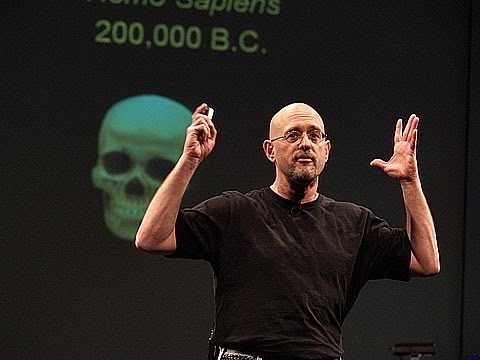
The surprising science of happiness | Dan Gilbert
The Evolution of the Human Brain and Happiness
The Growth of the Human Brain
- Over two million years, the human brain has nearly tripled in mass, evolving from a 1.25-pound brain in ancestors like Homo habilis to an almost three-pound brain today.
- A significant factor in this growth is the development of new structures, particularly the frontal lobe and prefrontal cortex, which play crucial roles in human cognition.
Functionality of the Prefrontal Cortex
- The prefrontal cortex serves as an "experience simulator," allowing humans to mentally simulate experiences before attempting them in real life.
- This ability to visualize outcomes is unique to humans and is comparable to other evolutionary advantages such as opposable thumbs and language.
Understanding Happiness Through Simulation
- An exercise invites contemplation on two contrasting futures: winning a $314 million lottery versus becoming paraplegic, highlighting how people can simulate their emotional responses.
- Research indicates that both lottery winners and paraplegics report similar levels of happiness one year after their respective events, challenging common assumptions about happiness.
The Impact Bias
- The concept of "impact bias" describes how individuals overestimate the emotional impact of significant life events; they believe outcomes will affect their happiness more than they actually do.
- Studies show that major life changes have less long-term effect on happiness than expected, with many traumas losing their impact after three months.
Synthesizing Happiness
- Humans possess a psychological immune system that helps them adapt their perceptions to maintain or regain happiness despite adverse circumstances.
The Secret of Happiness
The Journey to Discovering Happiness
- The speaker introduces the concept of happiness through a story about Harriet Langerman, who found inspiration in a 1949 article about McDonald's, leading to a discussion on how ideas can transform lives.
- Ray Kroc later capitalized on this idea, becoming immensely wealthy and demonstrating that people's appetite for hamburgers was underestimated.
- A reference is made to Pete Best, the original drummer for The Beatles, who reflects on his life post-Band and claims he is happier than if he had stayed with them.
Understanding Synthetic vs. Natural Happiness
- The speaker humorously outlines a "secret" formula for happiness: accruing wealth and power, spending time in prison, making others rich, and avoiding joining The Beatles.
- There’s skepticism regarding synthetic happiness; people often believe it lacks the quality of natural happiness derived from achieving desires.
- Definitions are provided: natural happiness comes from getting what we want while synthetic happiness arises when we don't get our desires fulfilled.
Economic Implications of Happiness Perception
- Society's belief that synthetic happiness is inferior affects consumer behavior; if not getting what we want could make us happy, economic engines would struggle.
- A humorous analogy suggests that a shopping mall full of Zen monks wouldn't be profitable due to their lack of desire for material goods.
Experimental Evidence on Happiness Synthesis
- To support his argument scientifically, the speaker introduces the "free choice paradigm," an experiment designed to demonstrate how people synthesize happiness based on choices made.
- Participants rank objects (Monet prints), choose one as a prize, and later reassess their feelings towards both prints after some time has passed.
Insights from Amnesiac Patients' Choices
- An experiment involving amnesiac patients reveals they cannot remember which print they chose but still express preferences when asked again later.
Synthesis of Happiness and Its Implications
Understanding the Change in Liking Scores
- The change in liking scores illustrates how individuals perceive ownership; they tend to favor items they own, even if unaware of their ownership.
- This phenomenon indicates that people can alter their emotional responses to objects based on perceived ownership, demonstrating a shift in affective hedonic aesthetics.
Psychological Immune System and Happiness
- Everyone possesses a psychological immune system that helps synthesize happiness, but effectiveness varies among individuals and situations.
- Freedom to choose enhances natural happiness by allowing exploration of preferred futures, while it hinders synthetic happiness due to indecision.
The Role of Choice in Happiness Synthesis
- A humorous example from Dilbert highlights how people often fail to appreciate the quality of what they have when given too many choices.
- The psychological immune system functions optimally when individuals feel trapped or unable to change their circumstances, contrasting dating with marriage dynamics.
Experiment on Photography Choices at Harvard
- An experiment involved students taking photographs and later choosing which ones to keep under different conditions regarding choice reversibility.
- Students were divided into two groups: one could change their minds about their choice, while the other could not.
Findings on Satisfaction Levels
- Results showed that those who felt stuck with their choice reported higher satisfaction than those who had the option to reconsider.
- Even after the opportunity for reversal expired, those who initially chose without options continued feeling dissatisfied with their selections.
Preference for Reversible Choices Despite Consequences
- When presented with two course options—one allowing changes and one not—66% of students opted for the reversible course despite knowing it would lead to dissatisfaction.
Exploring the Nature of Good and Bad
The Subjectivity of Experience
- The speaker reflects on the idea that good and bad are subjective, suggesting that "thinking makes it so." This raises questions about whether experiences like gallbladder surgery and a trip to Paris can be equated.
- Citing Adam Smith, the speaker emphasizes that human misery often stems from overrating differences between situations. While some circumstances may be preferable, none should be pursued with excessive passion.
Preferences and Consequences
- The discussion highlights that while preferences exist, they can lead to negative outcomes if pursued too fervently. Overrated ambitions may cause individuals to act against prudence or justice.
- When ambition is bounded, it fosters joy in work; however, unbounded ambition can lead to unethical behavior such as lying or cheating. This underscores the importance of maintaining balance in our desires.
Managing Fears and Longings
Turn any video into a summary like this
YouTube links, meetings, lectures. With transcripts, search, and chat.