Physical properties of aldehydes and ketones | Organic chemistry | Khan Academy
Introduction to Aldehydes and Ketones
In this section, the speaker explains where the names for aldehydes and ketones come from.
Naming of Aldehydes and Ketones
- Aldehydes are made by oxidizing alcohol, which results in a loss of hydrogen atoms.
- The name "aldehyde" comes from combining "alcohol" with "dehydrogenatum," which refers to the loss of hydrogen atoms.
- Ketones can also be made by oxidizing alcohol.
- The name "ketone" comes from an old German word for acetone.
Physical Properties of Aldehydes and Ketones
In this section, the speaker discusses the physical properties of aldehydes and ketones, specifically their boiling points.
Boiling Points
- Boiling point is determined by intermolecular forces between molecules.
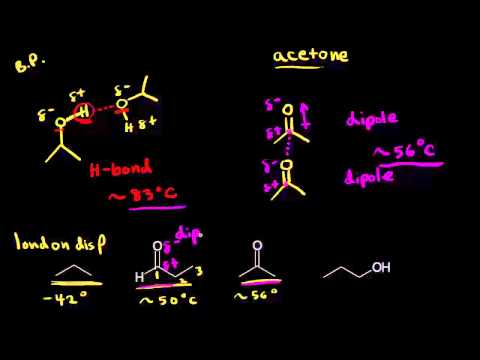
- Isopropanol has a high boiling point due to hydrogen bonding between molecules.
- Acetone has a lower boiling point than isopropanol because it has dipole-dipole interactions instead of hydrogen bonding.
Comparison of Boiling Points and Intermolecular Forces
In this section, the speaker compares the boiling points and intermolecular forces of different molecules.
Alkanes
- Propane is a gas at room temperature due to its low boiling point.
- The only intermolecular force holding alkanes together is London dispersion forces.
Aldehydes and Ketones
- Propanal has a higher boiling point than propane due to dipole-dipole interactions between molecules.
- Acetone also has dipole-dipole interactions between molecules.
- Hydrogen bonding is stronger than dipole-dipole interaction, which explains why alcohols have higher boiling points than aldehydes or ketones.
Alcohols
- One propanol has hydrogen bonding, which results in a higher boiling point compared to acetone and propanal.
- Boiling points reflect the type of intermolecular force present in each molecule.
Solubility in Water
In this section, the speaker discusses solubility in water for different molecules.
Acetone
- Acetone is polarized due to the partial negative charge on oxygen and partial positive charge on carbon.
- Water is also polarized with a partial negative charge on oxygen and partial positive charge on hydrogen.
- Hydrogen bonding occurs between acetone and water, making it soluble in water.
Small Aldehydes and Ketones
- Small aldehydes and ketones are also polarized like acetone, so they can form hydrogen bonds with water.
Turn any video into a summary like this
YouTube links, meetings, lectures. With transcripts, search, and chat.