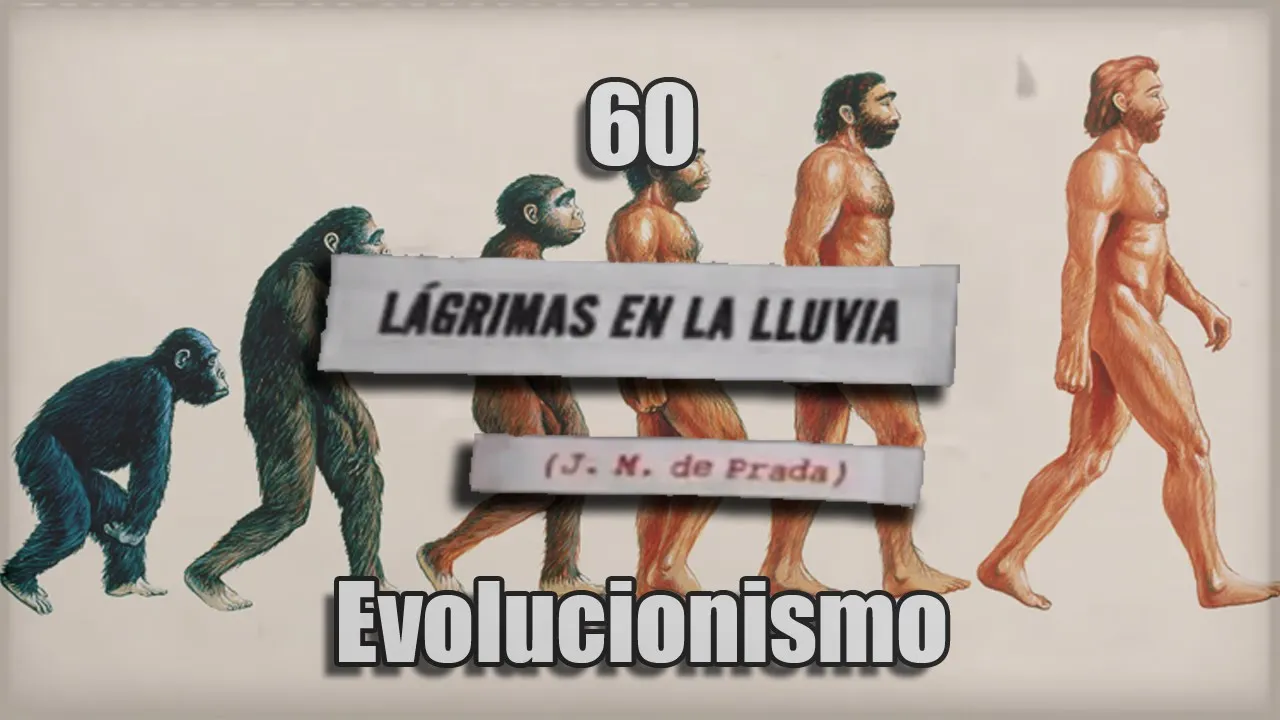
Lágrimas en la lluvia - 60 - Evolucionismo (video con subtítulos)
New Section
The introduction to the program "Lágrimas en la Lluvia" discussing the focus on evolutionary theories, particularly those of Charles Darwin, and their impact on contemporary culture.
Evolutionary Theories by Charles Darwin
- Discusses the influence of Charles Darwin's evolutionary theories over 150 years ago on contemporary culture.
- Explores the concept of evolutionism postulating that all living beings, including humans, originated from a few original forms through gradual transformations over millions of years.
- Mentions the evolutionism's attempt to explain biogenesis - the spontaneous origin of life from inanimate matter.
- Highlights two main propositions: common ancestry of living beings and species transformation through natural selection.
- Contrasts Darwin's expectation of transitional forms with nature's presentation of perfectly formed species.
Exploring Fossil Evidence and Molecular Studies
Delving into fossil evidence and molecular studies as support for evolutionary theories.
Fossil Evidence Analysis
- Notes the absence of intermediate species fossils supporting Darwin's predictions.
- Discusses findings of extinct species fossils showing mosaic creatures with fully developed organs but lacking semi-developed transitional forms.
Molecular Studies Evaluation
- Examines molecular studies' inconclusive results in establishing evolutionary sequences or genetic mutations supporting evolutionism.
- Differentiates between favorable mutations and genetic variability within organisms, emphasizing limitations in creating new genes or increasing genetic information.
Critique on Evolutionary Mechanisms
Critiquing evolutionary mechanisms regarding mutations, genetic complexity, and intelligent intervention.
Mutation Challenges
- Argues that even favorable mutations are insufficient to generate new species without significant organism transmutations.
Genetic Complexity Debate
- Emphasizes the intricate interrelation of structures within organisms, suggesting simultaneous changes across an organism for significant structural or functional alterations.
Intelligent Intervention Argument
New Section
In this section, the speaker discusses the film "Inherit the Wind" directed by Stanley Kramer and highlights key aspects of the production team and cast.
John Ford and Stanley Kramer's Approach
- John Ford and Stanley Kramer preferred working with their trusted teams.
- The film's cinematography was handled by Ernest Laszlo, while the music was composed by Ernesto de.
- Spencer Tracy, a favorite actor of Kramer, played the lead role as lawyer Henry Drummond.
Exploring Characters and Plot
This part delves into the characters' roles in "Inherit the Wind" and sets up the central conflict of defending a teacher accused of teaching evolution.
Character Introductions
- Spencer Tracy portrays lawyer Henry Drummond defending teacher Bertram Cates for teaching evolutionary theories.
- Frederic March plays Matthew Harrison Brady, opposing Cates' teachings supported by Gene Kelly's character, a sensationalist journalist.
Historical Context and Real Events
This segment provides insights into the real-life events that inspired "Inherit the Wind" and touches on historical accuracy versus cinematic portrayal.
Basis in Reality
- The film is based on the 1925 Scopes Trial where teaching evolution was deemed illegal in Tennessee.
- The actual defense attorney in the trial was Clarence Darrow, not depicted accurately in the movie.
Debates on Evolution
This part discusses debates around evolution beyond the movie narrative, highlighting interactions between prominent figures like Clarence Darrow and G.K. Chesterton.
Evolution Debates
- G.K. Chesterton debated Clarence Darrow on evolution publicly in New York.
- The film simplifies characters like Fredric March's lawyer compared to real-life counterparts like Chesterton.
Film's Message and Reflection
Reflecting on "Inherit the Wind," this section explores themes of science versus religion portrayed in cinema and its impact on viewers.
Film Reflection
- The film conveys a message reconciling scientific knowledge with religious faith through Spencer Tracy's character.
Intergenerational Conflict and Evolutionism Discussion
The discussion delves into intergenerational conflict, the Spanish fiscal system from the perspective of the Church's social doctrine, and transitions to a conversation on terrorism. The hosts express gratitude for assistance in program preparation and introduce the topic of evolutionism.
Intergenerational Conflict and Fiscal System
- Discussion on intergenerational conflict and the Spanish fiscal system from the Church's social doctrine.
- Transition to discussing terrorism as suggested by Ángeles Aitor Elorriaga and Joseba Azpeitia.
Introduction to Evolutionism
- Introduction to exploring evolutionism as a scientific theory with materialistic implications.
- Highlighting the influence of evolutionism in contemporary times across various disciplines like biology, theology, physics, and philosophy of science.
Guest Introductions: Nicolás Jouvé, José Antonio Sayés, Manuel Carreira, José Miguel Ganbara
The guests are introduced - Nicolás Jouvé (biologist), José Antonio Sayés (theologian), Manuel Carreira (Jesuit philosopher), and José Miguel Ganbara (philosopher).
Nicolás Jouvé
- Nicolás Jouvé is a biologist specializing in genetics with notable works in biology and genetics.
José Antonio Sayés
- Introduction of José Antonio Sayés as a theologian with significant contributions to theology and philosophy.
Manuel Carreira
- Presentation of Manuel Carreira as a Jesuit philosopher with expertise in physics and astronomy.
José Miguel Ganbara
- Introduction of José Miguel Ganbara as a philosopher focusing on logic and philosophy of science.
Film Analysis: Manicheanism in Movie Plot
Critique on a recently viewed film highlighting technical excellence but critiquing its tendency towards manichean portrayal of characters.
Debate on Evolution Theory
The discussion revolves around the portrayal of characters in a movie, categorizing them as either good or bad based on their physical appearance and behavior. It delves into the central theme of a debate within the film and the arguments presented regarding evolution theory.
Characters Categorized as Good and Bad
- The "good" characters are depicted as young, attractive, honest, and witty in conversations.
- In contrast, the "bad" characters are described as old, unattractive, ridiculous, dishonest, and constantly embarrassing in their actions.
Central Theme of the Movie
- The pivotal element of the film is a debate that unfolds.
- Every debate consists of defending a thesis with an initial topic leading to various arguments.
Thesis Related to Evolution Theory
- The core thesis pertains to whether the accused is guilty or innocent initially.
- Additionally, it touches upon how laws should protect different doctrines within society.
Arguments for Evolution Theory
This segment focuses on the arguments supporting the theory of evolution presented within the movie. It explores scientific knowledge maintenance by laws and emphasizes Darwin's theory as a scientific understanding.
Scientific Support for Evolution Theory
- Science should be upheld by laws according to one argument.
- Darwin's theory is portrayed as a scientific knowledge rather than just an idea.
Refutation of Contrary Views
- The movie ridicules those who interpret biblical texts literally.
- It highlights flaws in literal interpretations through examples like counting days in creation akin to physicists estimating age without solar systems.
Challenges to Evolution Theory
This section addresses challenges posed against evolution theory within the film. It critiques reliance on authority over evidence-based reasoning and freedom of thought association with science.
Critiques Against Evolution Theory
- Challenges arise due to excessive reliance on authority rather than empirical evidence.
- Freedom of thought is ambiguously linked with acceptance of evolution theory while denial equates to rejecting science and free expression.
Lack of Evidence for Evolution Theory
Here, it is discussed how despite arguments presented in favor of evolution theory within the movie, there remains a lack of substantial evidence supporting this concept directly.
Absence of Convincing Evidence
- The film fails to provide concrete evidence backing up evolutionary claims.
New Section
In this section, the speaker discusses their deep dislike for a particular movie due to its portrayal of locals in Hillsboro as well as the perceived intellectual shortcomings of Americans.
Analysis of Movie Portrayal
- The movie is criticized for being crude and presenting an unacceptable depiction of the people in Hillsboro.
- Comparison drawn between how Spaniards accepted being portrayed as fools versus Americans' reactions to similar portrayals.
Spencer Tracy's Role
- Spencer Tracy's casting is highlighted as sly and malicious due to his Catholic background in a predominantly Jewish-controlled Hollywood.
Critique on American Society
- Discussion on the diversity within America, acknowledging the presence of primitive thinking in certain regions.
Evolutionary Debate
This part delves into the debate surrounding evolution, creationism, and the scientific accuracy presented in the film.
Evolutionary Arguments
- Criticism towards the lack of substantial reasoning in the movie regarding evolution versus creationism.
- Distinction made between biological evolution and scientific explanations for life's origins not adequately addressed in the film.
Fundamentalist Views
- Mention of a real-life incident involving fundamentalists pushing for intelligent design over evolution in schools.
- Highlighting fundamentalist Protestant beliefs and their clash with evolutionary theories.
Creationism vs. Evolution Dialogue
The conversation shifts towards examining specific dialogues within the film that challenge creationist beliefs with questions about human origins.
Creationist Arguments
- Spencer Tracy's character ridiculed for lacking evidence supporting evolution but posing thought-provoking questions challenging literal interpretations of Genesis.
- Emphasis on exploring nuanced debates around creationism, evolution, and interpreting religious texts like Genesis allegorically or literally.
Evolutionism and Creationism Debate
In this section, the discussion revolves around the debate between evolutionism and creationism, focusing on the film "Inherit the Wind" by Stanley Kramer.
Evolution vs. Creationism in "Inherit the Wind"
- Nicolas Jouvé expresses his views on the film "Inherit the Wind," highlighting its lack of argumentation in portraying fundamentalist beliefs against evolutionary theories.
- The film depicts a clash between fundamentalist believers in Genesis and emerging evolutionary theories, set in Tennessee during the early 20th century when scientific evidence for evolution was still developing.
- Evolution initially lacked sufficient evidence regarding diversity origins and gene transmission, leading to polarized and stereotyped representations in the film.
Critique of Fundamentalist Views
- Jouvé criticizes the rigid stance of fundamentalists depicted in the film, emphasizing their literal interpretation of Genesis and outdated cosmological beliefs that have been scientifically refuted.
- He questions the portrayal of a pastor's harsh judgment and lack of mercy towards individuals, contrasting it with contemporary Catholic values centered on love, providence, and compassion.
Scientific Discourse Representation
- The film showcases a biased depiction favoring creationists over evolutionists by restricting scientific input during trial proceedings, reflecting societal biases prevalent at that time.
Evolutionism and Creationism Debate
The discussion delves into the portrayal of creationists in the context of evolutionism and creationism debates, highlighting misconceptions and historical perspectives.
Misconceptions Surrounding Creationists
- Creationists are often misrepresented as individuals who believe in a literal six-day creation, contrary to historical interpretations.
- Historical perspectives from figures like St. Augustine suggest that the days of creation should be understood as eras rather than literal days.
Caricaturization of Believers in a Creator
- Critics tend to caricaturize believers in a creator, portraying them as anti-science and holding outdated views.
- Instances where scientists dismiss religious beliefs by asserting evolutionary origins without acknowledging intelligent design are highlighted.
Theory of Evolution Overview
This segment introduces the theory of evolution, emphasizing descent from a common ancestor and gradual transformation over millions of years.
Evolutionary Process Explanation
- Evolution posits that species evolved from a single primitive life form through substantial changes over extended periods.
- Darwin's theory underscores significant transformations between organisms, challenging traditional views on species origins.
Challenges to Evolutionary Theory
The discussion addresses key challenges to evolutionary theory, including gaps in fossil records and genetic advancements.
Fossil Record Gaps
- Lack of intermediate forms in fossil records poses a challenge to evolutionary claims regarding gradual transitions between species.
- Absence of creatures with developing organs or non-functional features contradicts expectations based on evolutionary principles.
Genetic Advancements Impact
- Genetic engineering achievements demonstrate the necessity of intelligent intervention for creating new species, questioning purely natural selection processes.
Critiques on Evolutionist Views
Critiques on classical evolutionist theories are discussed, emphasizing complexity irreducibility and philosophical underpinnings.
Complexity Irreducibility Argument
- Critics argue that evolutionist hypotheses oversimplify complex biological processes without accounting for irreducible complexity.
Philosophical Implications
Desafíos de la Evolución y la Vida Humana
The speaker discusses the challenges surrounding evolution, probability, and the emergence of life, highlighting the limitations in experimental evidence for certain evolutionary claims.
Challenges to Evolutionary Theory
- Large numbers are used to illustrate probabilities in evolution, emphasizing the lack of scientific rebuttals to these calculations.
- The vast difference between atomic particles in the universe and probabilities in evolution is highlighted, questioning how life emerges and evolves without clear explanations.
- Despite a century of scientific experimentation causing genetic mutations, there is no experimental proof of one species evolving into another, challenging claims of new species forming in laboratories.
- Experimental evidence fails to demonstrate genetic changes leading to speciation even after generations of genetic manipulation on bacteria and fruit flies.
Critique on Random Evolution
- The speaker argues against attributing evolution solely to chance, stating that randomness cannot explain the complexity and purpose observed in biological systems.
- Evolution as a fact is acknowledged; however, attributing it solely to chance lacks empirical support as randomness does not account for human qualities like truth-seeking or beauty appreciation.
La Teoría de la Evolución y los Pasos Biológicos
The discussion delves into the concept of evolution as a probability rather than a certainty due to the lack of experimental evidence supporting key transitions in biological development.
Evolution as Probability
- The speaker distinguishes between accepting evolution as a fact but viewing it as a probabilistic process rather than an established certainty due to insufficient experimental validation.
- Acknowledgment of observable changes from single cells to complex organisms supports evolutionary progression but does not clarify how transitions occur between different biological stages.
Biological Transitions
- Historical perspectives categorize beings into four stages based on material existence and sensory capabilities, raising doubts about transitioning between these stages through evolutionary processes.
Diversification and Natural Selection
In this section, the speaker discusses diversification, natural selection, genetic variations, mutations, and the role of environment in shaping life forms.
Diversification and Genetic Variations
- Genetic variations arise without purpose or benefit initially.
- Beneficial genetic variants lead to diversity through natural selection.
Natural Selection and Adaptation
- Darwin's theory emphasizes diversity creation through adaptation to the environment.
- Organisms with advantageous traits leave more offspring, enhancing adaptive capabilities over generations.
Common Origins and Shared Systems
- All life shares common molecular structures like DNA and metabolic cycles.
- Discussion on whether all life evolved from a common origin or if diverse beings were created using shared elements.
Evolutionary Perspectives
This section delves into perspectives on evolution, creationism, divine intervention, and the compatibility of scientific theories with religious beliefs.
Creationism vs. Evolution
- Debate on whether all life forms stem from a common ancestor following the tree of life model.
- Comparison between the concept of gradual evolution versus sudden creation by a higher power.
Darwin's Views and Religious Interpretations
- Reference to John Henry Newman supporting Darwin's theory as evidence of intelligent design.
- Acknowledgment that Darwin himself saw human intelligence as proof of a creator's existence.
Scientific Methodology and Complexity
The discussion shifts towards scientific methodologies, interdisciplinary approaches, complexity in sciences, and historical perceptions of experimental science.
Interdisciplinary Science Approach
- Each scientific discipline focuses on specific aspects of reality using distinct methods.
Understanding Evolutionary Theories
In this section, the speaker delves into the concept of evolution, discussing the methodological approach to understanding and justifying scientific observations.
Methodological Approach to Evolution
- The method involves going beyond observed and justified phenomena in experimental methods.
- It establishes relationships between phenomena, formulates hypotheses, and verifies them through observation or laboratory experiments.
- Darwin introduced natural selection, demonstrating how accidental characteristics within species occur in nature.
- Darwin extended his ideas to challenge biblical views on creation by proposing natural selection for species diversity.
Debating Macroevolution
This part focuses on the debate surrounding macroevolution as opposed to microevolution, exploring the scientific evidence and arguments presented.
Macroevolution Debate
- Materialistic declarations influenced evolutionary theories towards broader speciation concepts.
- Microevolution (within species variations) was supported by genetics and DNA studies in laboratories.
- Macroevolution involves transitions between species and life origins but lacks conclusive evidence.
Challenges to Evolutionary Theories
Here, criticisms against macroevolution are discussed, highlighting gaps in evidence and refutability of evolutionary claims.
Criticisms of Macroevolution
- Microevolution is scientifically proven; however, macroevolution lacks substantial evidence according to some scholars.
- Lack of intermediate species fossils challenges the generalized theory of evolution and life's origin explanations.
New Section
In this section, the speaker discusses the belief in abstract concepts like numbers and sets in mathematics and how physicists believe in the existence of particles like protons and neutrons.
Mathematics and Physics Beliefs
- Mathematics and sciences: Mathematicians believe in the existence of numbers, sets, and even the set of all sets, similar to how physicists believe in particles like protons and neutrons.
- Physicists' beliefs: Physicists are convinced of the existence of particles such as protons and neutrons, akin to mathematicians' belief in abstract mathematical entities.
New Section
This part delves into how certain ideologies have influenced scientific publications unidirectionally towards metaphysical interpretations, potentially impacting societal norms like natural rights.
Ideological Influences on Science
- Metaphysical shift: Scientific publications have been influenced by ideological motives leading to a unidirectional focus towards metaphysical interpretations rather than empirical observations.
- Impact on society: Ideological influences may lead to justifications for practices like eugenics or euthanasia by altering perceptions of natural rights based on metaphysical interpretations.
New Section
The discussion shifts towards an analysis of the Genesis narrative from a literary perspective, highlighting its intended messages beyond literal interpretation.
Literary Analysis of Genesis
- Sacerdotal narrative: The Genesis account is termed sacerdotal as it emphasizes human labor patterns with a weekly day of rest, reflecting cultural values rather than strict historical events.
- Interpretation insights: Scholars like Rock, Westermann, Gross analyze Genesis not as a historical record but as a symbolic text conveying moral lessons through allegorical elements.
New Section
Further exploration into religious texts reveals deeper meanings beyond literal readings, emphasizing symbolic significance and philosophical implications.
Symbolism in Religious Texts
- Allegorical interpretations: San Agustín's interpretation of Eve's creation from Adam's rib symbolizes equality between genders rather than a literal event, showcasing deeper spiritual meanings within religious texts.
Detailed Discussion on Evolution and Intelligent Design
In this section, the speaker delves into the concepts of atheism, intelligent design, evolution, and speciation. The discussion revolves around the existence of God, the idea of intelligent design in nature, challenges to evolutionary theories, and the role of divine intervention in evolution.
Atheism to Belief in Intelligent Design
- The speaker discusses a known atheist who converted to belief in God after finding it impossible to deny God's existence.
- Introduces the concept of intelligent design as an alternative explanation for the order and functionality observed in nature.
Challenges to Evolutionary Theories
- Critiques the inability to create new species in laboratories despite claims of proven mechanisms.
- Questions how intelligent design is proven without clear evidence or methodology provided.
Evolution and Divine Intervention
- Acknowledges belief in evolution but emphasizes that only through God can one explain its ultimate causes.
- Distinguishes between evolution and speciation while highlighting gradual genetic changes over generations.
Fossil Record and Transitional Forms
This part focuses on transitional forms found in the fossil record, emphasizing gradual genetic changes leading to diverse species.
Transitional Forms in Fossil Record
- Discusses gradual genetic changes seen across various evolutionary lineages from ancient strata to modern forms.
- Mentions animals like platypus, axolotl, and mudskipper exhibiting characteristics from multiple species.
Examples of Transitional Forms
- Provides examples like Archaeopteryx as a transition from reptiles to birds with skeletal features of both groups.
- Mentions Tiktaalik as a fish showing lung capacity transitioning from marine to aerial environments.
Genomic Insights into Evolution
This segment explores genomic studies shedding light on gene regulation's role in development and evolutionary transitions.
Genomic Understanding of Evolution
- Highlights challenges in proving macroevolution but discusses genomic insights into trans-specific evolution through gene remodeling.
Desarrollo y Evolución Genética
The speaker discusses the genetic similarities between humans, mice, and vinegar flies, emphasizing the role of specific genes in determining different body parts and their evolutionary significance.
Genetic Similarities and Evolutionary Significance
- Humans, mice, and vinegar flies share identical genes in the same order, where the first gene determines the head, the middle gene controls the thorax, and the last gene influences the abdomen.
- Mutations in these genes can lead to significant changes in body architecture over a few generations, showcasing how genetic alterations impact developmental phases.
- Changes in regulatory genes can explain transitions between species during evolution, highlighting rapid shifts from marine species to those with chordate skeletons as crucial evolutionary leaps.
Reconstruction of Darwinism through Genetics
The discussion delves into experimental evidence supporting the fundamental theorem of natural selection and how genetic diversity drives evolutionary improvements.
Experimental Evidence for Natural Selection
- Laboratory experiments by prominent evolutionists like Francisco Ayala demonstrate how genetic diversity enhances long-term evolutionary potential by generating beneficial traits over time.
- Various evidences align with an evolutionary continuum from a common ancestral species (progenote), underpinning modern biology's foundation on evolutionary principles illuminated by genetics.
Genetic Commonalities Across Species
Exploring shared genomic features across species and their implications on developmental mechanisms and morphological variations.
Shared Genomic Features Impacting Development
- Common DNA sequences, genetic codes, and developmental mechanisms among all species underscore how disruptions in these processes can rapidly alter body structures across different mollusk orders.
Evolutionism and Causality
The discussion delves into the concept of causality within evolutionism, highlighting the role of chance and logical connections in evolutionary processes.
Evolutionary Causality
- The argument explores the relationship between causality and succession, emphasizing that causation is often inferred through hypotheses due to the lack of direct observation.
- Critique is raised regarding the use of patches to address criticisms in evolutionary theory, suggesting that some aspects may be perceived as mere patches rather than robust explanations.
- Evolution attributed to chance is questioned, particularly concerning its ability to explain human existence. The distinction between random occurrences and logical connections is emphasized.
Role of Chance in Evolution
- Chance in evolution is likened to coincidental events without prior explanation, contrasting it with ordered processes. The example of genetic mutations leading to antibiotic resistance illustrates unpredictable outcomes.
- Fred Hoyle's analogy challenges the notion of life arising by chance, highlighting the complexity involved in attributing randomness as a sole explanatory factor.
Divine Perspective on Causality
- The discussion shifts towards divine creation and the absence of chance from a theological standpoint. It contrasts human perception of randomness with a creator's omniscient design principles.
- While acknowledging unpredictable genetic effects and beneficial mutations, emphasis is placed on God's comprehensive knowledge guiding outcomes based on specific conditions and natural laws.
Darwinian Theory: Randomness vs. Natural Selection
Delving into Darwinian theory, the discourse dissects the interplay between randomness and natural selection as driving forces behind evolution.
Darwinian Framework
- Darwin's religious affiliation is mentioned briefly before transitioning into an analysis of natural selection as a pivotal mechanism in evolutionary theory.
- The integration of chance within DNA underpins Darwinian concepts, where survival hinges on reproductive success amidst varied possibilities governed by natural selection.
Evolution and Creation: Exploring the Intersection
In this section, the discussion revolves around the transition from inanimate matter to living matter, focusing on the flexibility required for such a transformation. The conversation delves into the role of DNA molecules in allowing for errors and mutations that drive evolution.
Flexibility in Transition to Living Matter
- DNA's Error Tolerance: DNA's flexibility, including its ability to accommodate errors, is highlighted as crucial for explaining evolutionary processes.
- Evolution through Mutation: Evolution is discussed in terms of acquiring new genetic traits through mutations, leading to changes within species over time.
- Environmental Adaptation: Evolution is portrayed as a continuous process of adapting to environmental changes, with examples like color variations in butterflies due to pollution.
- Natural Selection: The concept of natural selection is emphasized, where beneficial mutations persist while unfavorable ones fade away, driving species adaptation.
The Role of Adaptation in Evolution
This segment explores substantial versus non-substantial changes in organisms due to environmental pressures and the adaptive nature of evolution.
Substantial vs. Non-Substantial Changes
- Examples of Change: Various examples are provided to distinguish between substantial changes (e.g., butterfly color adaptation) and non-substantial alterations (e.g., slight physical modifications).
- Significance of Substantial Change: The importance of substantial changes in evolution is underscored through instances like butterfly color shifts.
Survival Strategies and Evolutionary Dependency
This part delves into survival strategies across different species and how evolutionary dependency impacts offspring viability.
Offspring Dependency
- Offspring Viability: The discussion contrasts primitive animals' self-sufficiency at birth with increasing dependency levels as species evolve.
Human Evolution and Consciousness
Here, human evolution is examined alongside consciousness development and reproductive capabilities compared to other organisms.
Human Reproductive Capacity
- Human Dependency Contrast: Despite limited reproductive capacity compared to other creatures, humans have dominated Earth due to unique characteristics like consciousness.
Reconciling Evolution with Religious Beliefs
This segment navigates attempts at reconciling evolutionary theories with religious beliefs regarding creationism.
Harmonizing Science and Faith
- Coexistence Challenges: Challenges arise when aligning scientific theories like evolution with religious interpretations such as literal Genesis readings.
The Church's Stance on Evolution
The discourse shifts towards the Catholic Church's perspective on evolution and its compatibility with theological doctrines.
Church Doctrine on Evolution
Creationism and Evolution in Christian Theology
In this section, the discussion revolves around the compatibility of creationism and evolution within Christian theology, exploring different perspectives on the topic.
Creationism vs. Evolution
- Creation is directly attributed to God, distinct from evolutionary processes.
- The Jesuit Frenchman Teilhard de Chardin attempts to reconcile Darwinian evolution with Christian revelation by proposing a vision where evolution leads to a unified existence.
- Teilhard de Chardin introduces the concept of a cosmic Christ involved in the evolutionary process towards unity and fulfillment.
- According to Teilhard de Chardin, cosmic evolution is driven by Christ gradually overcoming material multiplicity towards a higher state.
- The Church should adapt to the forces of progress by revisiting and adjusting doctrines that belong to outdated phases of evolution.
Catholicism, Evolution, and Spiritual Beliefs
This section delves into the intersection of Catholic beliefs with evolutionary theory and spiritual concepts like freedom, soul, and intelligence.
Catholicism and Evolution
- Can one be both Catholic and an evolutionist? The guest believes it is possible due to their belief in God's role in explaining origins.
- Exploring the concept of soul as transcending genetics through examples of personal choices beyond genetic determinants.
- Discussing freedom as linked to spirituality and soul's existence beyond genetic explanations.
Intelligence, Soul, and Design in Human Existence
This part focuses on intelligence, soul transcendence over genetics, and design in human life.
Intelligence and Soul
- Nobel laureate's contemplation on twins' unique experiences despite identical genetics points towards something beyond genetics - the soul.
- St. Thomas Aquinas' view on human intellect surpassing animal knowledge through abstraction signifies a transcendence over sensory understanding.
Design Intelligence vs. Randomness Debate
Delving into debates between design intelligence versus randomness in creation theories.
Design Intelligence Debate
- Cardinal's perspective on intelligent design emphasizing gradual divine intervention within natural processes rather than instant creation.
Faith, Evolutionary Theory, and Unanswered Questions
Addressing faith alongside evolutionary theory while acknowledging theological insights for unanswered questions.
Faith and Science Integration
New Section
In this section, the speaker discusses the relationship between science and religion, emphasizing their complementary nature in addressing fundamental questions about existence.
Science and Religion Complementarity
- Science answers how things happen, while theology addresses why - they are complementary.
- No conflict in seeking answers from both science (how) and theology (why).
- Science cannot answer ultimate questions like the origin of the universe, which theology can address.
- Intelligent design is criticized in science for associating evolution with chance rather than natural selection.
- Evolution does not equate to randomness; it involves natural selection shaping diversity.
New Section
This segment delves into the speaker's perspective on evolutionism, intelligent design, and the concept of God as a creator within scientific discourse.
Evolutionism and Intelligent Design
- Critique of intelligent design reducing God to a repairman or plumber in creation.
- Proposing a view where God creates diverse nature elements with consistency but varying outcomes.
- Arguing against being both Catholic and an evolutionist due to theological implications.
- Discussing Pope John Paul II's stance on evolution as more than just a hypothesis.
New Section
The discussion shifts towards reconciling evolutionary theory with religious beliefs, focusing on human origins and doctrinal considerations.
Evolution and Religious Doctrine
- Addressing the creation of the human soul and monogenism for transmitting original sin.
- The Church allows for evolutionism but emphasizes caution due to intertwined philosophy and theology.
The Importance of Philosophy and Evolutionism
In this section, the speaker discusses the significance of Aristotelian philosophy for theology and morality. Additionally, they delve into the potential dangers associated with evolutionism and its implications on natural law and theological concepts.
Aristotelian Philosophy and Theology
- Aristotle's philosophy is deemed essential for theology and morality as constructed historically.
- The speaker highlights that Thomistic philosophy should not be completely dismantled or altered to maintain its foundational principles.
Evolutionism and Its Implications
- Evolutionism poses a significant risk by challenging the concept of species, leading to a loss of intelligibility in nature.
- The idea that species are merely agreed-upon constructs without a basis undermines theological concepts like transubstantiation.
Challenges with Monogenism and Evolution
This segment explores the challenges posed by monogenism in reconciling with Catholic beliefs, particularly regarding original sin. The discussion also touches upon the compatibility between Catholicism and Teilhard de Chardin's theories.
Monogenism and Original Sin
- The speaker reflects on the issue of receiving original sin from ancestors due to monogenism's limitations in explaining this concept.
- Despite debates on monogenism, it transcends beyond biological origins concerning original sin according to Church doctrine.
Compatibility with Teilhard de Chardin
- The transcript mentions Father Carrilla's association with Teilhard's theories, questioning if one can be Catholic while rejecting Teilhard's cosmic Christ concept.
Materiality, Spirituality, and Evolution
This part delves into defining matter from a physicist's perspective, emphasizing how spiritual aspects like free will cannot be explained solely through material evolution.
Definition of Matter
- Matter is defined by its interactions through four forces recognized in physics: gravitational, electromagnetic, strong nuclear, and weak nuclear forces.
- Anything beyond these forces does not fall under matter categorization; hence human spirit attributes like abstract thought remain unexplained materially.
Material Evolution vs. Spiritual Attributes
- Material evolution lacks scientific or logical grounds to explain human capacities such as rationality or freedom.
- The speaker asserts that attributing human capabilities solely to material evolution lacks scientific or logical validity.
Critique on Teilhard de Chardin
Here, criticisms are raised regarding Teilhard de Chardin's work from both scientific and theological perspectives. His approach is scrutinized for lacking depth when examined rigorously.
Criticism on Teilhard de Chardin
- Teilhard is criticized for excelling more as a poet than as a scientist or theologian due to his ideas lacking substantial reasoning.
Desarrollo de la Inteligencia y Libertad
The discussion revolves around the development of intelligence and freedom in the context of observed reality, touching on theological and philosophical perspectives.
Development of Intelligence and Freedom
- The principle of lesser development of intelligence and freedom challenges the notion that all universes move towards Christ.
- Over 2000 years, biology, theology, and philosophy have debated whether humans give meaning to the universe's evolution towards perfection.
- A new perspective is proposed where redemption occurs through Christ's immersion in matter and his struggle against material multiplicity.
- Evolutionary processes leading to Omega point are discussed, challenging traditional views on original sin and Christian beliefs.
Evolutionary Impact on Culture
The influence of evolutionary theories on contemporary culture is explored, particularly regarding materialism and eugenics.
Evolutionary Impact
- Evolutionary theories significantly shape contemporary culture towards materialism.
- Darwinian theory's link to eugenics is highlighted, emphasizing the impact on societal views regarding survival of the fittest.
- Darwin's observations on weak individuals in civilized societies influencing degeneration are discussed in relation to human intervention for survival.
Challenges to Traditional Beliefs
Challenges posed by evolutionary theory to traditional beliefs such as original sin and divine intervention are examined.
Traditional Beliefs vs. Evolution
- Belief in original sin is seen as a significant obstacle to embracing Christianity due to evolutionary perspectives on imperfections.