Qué es una asíntota
Understanding Asymptotes
Introduction to Asymptotes
- The speaker introduces the concept of asymptotes, emphasizing their importance and acknowledging past misunderstandings in teaching this topic.
- An asymptote is defined as a straight line that a function approaches as it tends towards infinity or negative infinity on either the x-axis or y-axis.
Vertical Asymptotes
- Vertical asymptotes are described as vertical lines where the function approaches but never touches.
- The speaker illustrates this with an example of a logarithmic function, highlighting how it behaves near its vertical asymptote.
- A common misconception is clarified: while functions may appear to approach an asymptote closely, they do not necessarily touch it; however, there are exceptions.
Behavior Near Asymptotes
- The discussion includes how functions behave at extreme values (infinity and negative infinity), focusing on their proximity to the asymptote without actual contact.
- The speaker emphasizes that even when zooming in on the graph, there remains a gap between the function and its vertical asymptote.
Horizontal Asymptotes
- Transitioning to horizontal asymptotes, these are introduced as lines that represent behavior of functions at extreme values along the y-axis.
- An example is provided with an exponential function illustrating how it approaches its horizontal asymptote without touching it.
Key Differences Between Vertical and Horizontal Asymptotes
- The distinction between vertical and horizontal asymptotes is made clear: vertical ones relate to x-values while horizontal ones pertain to y-values.
- Observations about approaching horizontal asymptotes from both ends (left and right sides of the graph) reinforce understanding of their nature.
Conclusion on Function Behavior
- It’s noted that some functions can have both types of asymptotes simultaneously, which will be explored further in future videos.
Understanding Asymptotes in Functions
Importance of Asymptotes
- Asymptotes are crucial for discussing the domain and range of functions, making it easier to graph them.
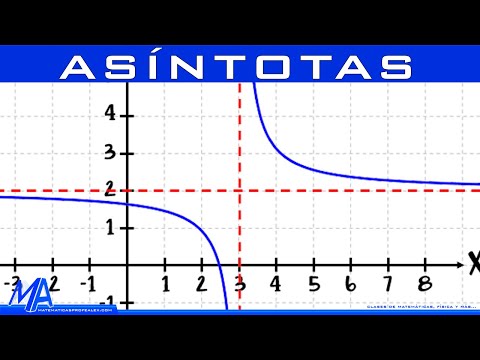
- The function discussed is y = 2x - 1/x + 3 , which has both vertical and horizontal asymptotes.
Identifying Vertical and Horizontal Asymptotes
- The vertical asymptote occurs at x = 3 , while the horizontal asymptote is at y = 2 .
- The function approaches these asymptotes as x tends towards negative or positive infinity but never actually touches them.
Behavior Near Infinity
- As x approaches negative infinity, the function gets closer to its vertical asymptote without touching it.
- Similarly, as x approaches positive infinity, the function continues to approach its horizontal asymptote.
Additional Types of Asymptotes
- Besides vertical and horizontal, there are also oblique (slant) asymptotes that can occur in certain functions.
- An example given is the function y = 5x + 21/x^2 + 10x + 25 , which will be explored further later on.
Graphical Representation and Function Behavior
- The graph shows a behavior where it appears to have an asymptote at y = 0 .
- A vertical asymptote exists at x = -5; as we move leftward on the graph, the function approaches this line without touching it.
Clarification on Touching Asymptotes
- It’s noted that while functions typically do not touch their asymptotes, there are exceptions where they may intersect.
- Observations indicate that as one side approaches an asymptote from either direction (left or right), it gets infinitely close but does not necessarily touch.
Turn any video into a summary like this
YouTube links, meetings, lectures. With transcripts, search, and chat.