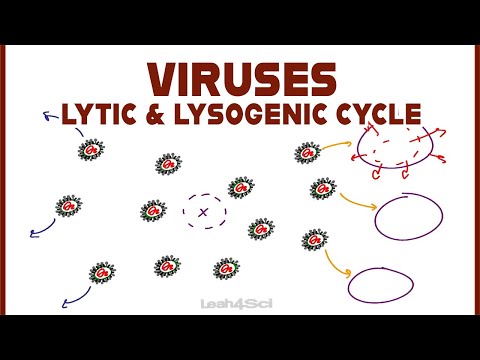
Lytic and Lysogenic Cycles of Virus Replication
Virus Replication Cycle: Lytic and Lysogenic Phases
In this video, Leah discusses the virus replication cycle, including the lytic and lysogenic phases. Viruses require a living host for replication and have two phases of replication cycles.
Lytic Cycle
- The lytic cycle is destructive and deadly.
- The first step in the lytic cycle is attachment of the virus to the cell through receptor-mediated endocytosis.
- Once inside the cell, the viral membrane breaks to expose its genome, which takes over the cell machinery to make copies of itself.
- RNA viruses can act similar to DNA in that we make RNA copies but also use some of the RNA as mRNA for new proteins.
Lysogenic Phase
- The lysogenic phase is dormant where instead of lysing cells, it lysing genes.
- Bacteriophages latch onto receptors on bacteria creating a channel into the cell so that only viral genome enters directly into it.
- Retroviruses are an RNA virus that violates central dogma by copying RNA to form DNA which will be copied again to have more DNA.
General Theme
- Viral replication has five or six stages depending on how they break it up.
- The general theme includes attachment, viral entry, replication, assembly and release.
Timestamps may not be exact due to differences in video versions or edits.
The Lytic Cycle
This section explains the three stages of the lytic cycle: entry, replication, and release.
Assembly
- Once the cell has made hundreds of copies of the viral DNA, RNA, and proteins, simple viruses will start to self-assemble.
- More complex viruses will have their proteins helping assemble them.
- All that is done here is packaging up the DNA or RNA surrounded by a capsid and anything else that specific virus requires.
Release or Egress
- This exit stage is what classifies the Lytic cycle with so many viral copies taking over the cell.
- The cell is completely overwhelmed.
- The viruses start to push out on the cell membrane trying to exit and in doing so with all the viruses trying to escape every which way, ultimately Lyses or bursts.
Human Influenza Virus
- The human influenza virus can undergo the first Lytic phase in just six hours.
- When a person is infected with influenza, one viral particle enters their system and attacks a cell.
- By six hours later, we have a couple of hundred cells infected.
Incubation Period
This section explains what an incubation period is and how it relates to viral infections.
Incubation Period for Influenza
- With something like influenza, this could be one to four days.
- That means two days after catching an influenza viral particle; you still don't know that you're sick but may have enough viruses in your throat where if you cough it up and somebody else picks it up they can get sick before you even know that you're sick.
Incubation Period for Coronavirus
- On the other extreme, we have something like the Coronavirus, which has an incubation period of up to 14 days.
- That means a person can be replicating the coronavirus in their system and spreading it to other people without knowing.
The Lysogenic Cycle
This section explains what the lysogenic cycle is and how it differs from the lytic cycle.
Herpes Simplex Virus
- A common example of this is the herpes simplex virus.
- Many people have the virus without any symptoms.
- They can have it for months or even years.
- The silent phase is called the dormant phase of the herpes virus, but then it can go into the Lytic phase to cause an eruption before going back into the Lysogenic phase.
Dormant Phase
- The Lysogenic cycle is typically not what we think of when we picture a viral infection.
- During this dormant phase, instead of making copies of viral genome and protein and reassembling and bursting cell, viral genome finds a comfy spot within cells' own DNA and just parks itself there.
How Viruses Work
In this section, the speaker explains how viruses work and how they can remain dormant in cells until triggered to become active.
Gene Mutation
- Viruses insert themselves into important genes within a cell's sequence, mutating that gene.
- The silent copies of the mutated gene can remain dormant in the cell for a long time until triggered to become active.
Lysogenic and Lytic Phases
- The trigger that makes the virus go from the Lysogenic to the Lytic cycle can be anything extreme that makes the virus feel uncomfortable.
- During the Lytic phase, viral DNA starts coding for viral proteins and making copies of the viral genome. Suddenly all of these cells with harmless DNA start to burst, spreading viral particles everywhere.
Junk DNA
- Sometimes viruses get embedded into the DNA of a cell and then lose their viral ability over generations of cell replication.
- Over time, viruses can mutate or forget how to be a virus and just live as junk DNA inside a cell.
Corona Virus Specifics
In this section, the speaker provides information about coronavirus specifically.
Website Link
- Information about coronavirus can be found on leah4sci.com/virus.
Turn any video into a summary like this
YouTube links, meetings, lectures. With transcripts, search, and chat.