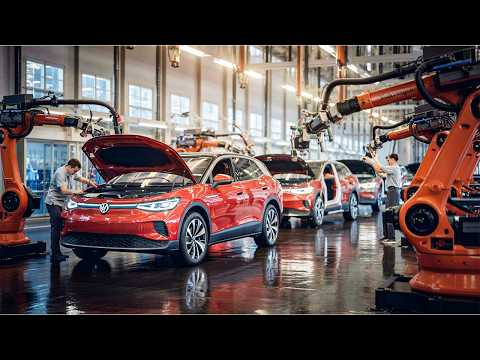
كيف يتم تصنيع سيارات فولكس فاجن داخل المصنع – Volkswagen Factory
A Journey Through the Volkswagen Factory
Introduction to the Volkswagen Factory
- The video introduces a unique factory environment where technology and metalwork converge, showcasing the production of modern Volkswagen cars.
- It highlights the historical context of Volkswagen, tracing back to when cars were considered luxury items in 1930s Germany amidst economic turmoil.
The Birth of "The People's Car"
- The concept of a simple, affordable car for the masses emerged during a time of political and economic strife, leading to the establishment of Volkswagen in 1937.
- Ferdinand Porsche was tasked with creating an accessible vehicle, resulting in a prototype that required a dedicated factory for mass production.
Impact of World War II
- Construction began on the Volkswagen factory near Fallersleben in 1938; however, WWII shifted its purpose from civilian vehicles to military transport.
- Post-war destruction left the factory in ruins, but it also paved the way for innovation as British officer Ivan Hirst saw potential amid devastation.
Revival and Growth Post-War
- Hirst repaired machinery and initiated production again with Beetle cars for occupying forces despite limited resources.
- By 1949, German control returned with Heinrich Nordhoff at the helm, transforming it into a modern car manufacturer while making Beetles popular worldwide.
Evolution of Vehicle Design
- The Beetle became an iconic symbol by blending reliability with simplicity; however, changing consumer demands necessitated new designs.
- In 1974, VW introduced the Golf—a practical design shift featuring front engines and water cooling—catering to contemporary needs.
Expansion and Global Presence
- As VW grew through various models like Passat and Polo, it expanded globally beyond Germany into markets like Mexico and China.
- By early 2000s, VW became one of the largest automotive manufacturers worldwide due to its extensive market presence rather than just engine performance.
Manufacturing Process Insights
- The manufacturing process begins with large rolls of metal being shaped precisely using advanced technology including sensors and algorithms.
- Robotic arms perform spot welding rapidly and accurately during assembly lines enhancing efficiency compared to human labor.
Final Assembly Steps
- After painting comes critical assembly where chassis meets bodywork; this is termed "the magical moment" by VW employees.
- Each vehicle undergoes rigorous testing before completion ensuring all systems function correctly before leaving the factory floor.
Future Innovations
- Modern Volkswagens are equipped with software allowing remote updates for performance improvements alongside traditional mechanical functions.
- Electric models represent VW's commitment to sustainability aiming for carbon neutrality by 2050 through innovative practices across their supply chain.
Conclusion: Legacy and Responsibility
- VW emphasizes environmental responsibility through recycling initiatives while maintaining high standards across their operations globally.
- They ensure ethical practices among suppliers reflecting their commitment not only to quality but also social responsibility.
Turn any video into a summary like this
YouTube links, meetings, lectures. With transcripts, search, and chat.