Ecologia - Aula 09 - Fatores do clima e o clima como fator ecológico
Understanding Climate and Its Elements
Introduction to Climate
- The lesson focuses on climate, its factors, ecological implications, and the types of climates in Brazil.
- Climate is defined as a dynamic set of elements that interact continuously over time and space.
Distinction Between Weather and Climate
- Weather refers to the physical state of the atmosphere at a specific moment, while climate represents the long-term patterns of weather.
- Comparing weather to a film segment illustrates that weather captures a single moment, whereas climate encompasses all moments over time.
Key Elements Influencing Climate
- Important elements include temperature, humidity, precipitation, solar radiation, cloud cover, atmospheric pressure, and wind patterns.
- Factors influencing these elements can be astronomical (seasonality), dynamic (air masses), or geographical (ocean currents and altitude).
Air Masses and Their Impact
- Different air masses affect climate; for example, equatorial Atlantic air mass influences temperatures across regions.
- Geographical features like mountains can alter temperature perceptions due to elevation changes.
Measuring Weather Conditions
- Understanding current weather requires knowledge of temperature, precipitation levels, and wind conditions.
- Instruments such as thermometers measure temperature variations; pluviometers gauge rainfall amounts; anemometers assess wind speed.
Types of Climates Based on Temperature and Precipitation
Classification by Temperature
- Types of climates are categorized based on average temperatures: polar (<10°C), cold (~10°C), temperate (~20°C), and hot (>18°C).
Classification by Precipitation
- Precipitation levels further classify climates into arid (<250mm/year), semi-arid, humid, and very humid (>2500mm/year).
Global Climate Distribution
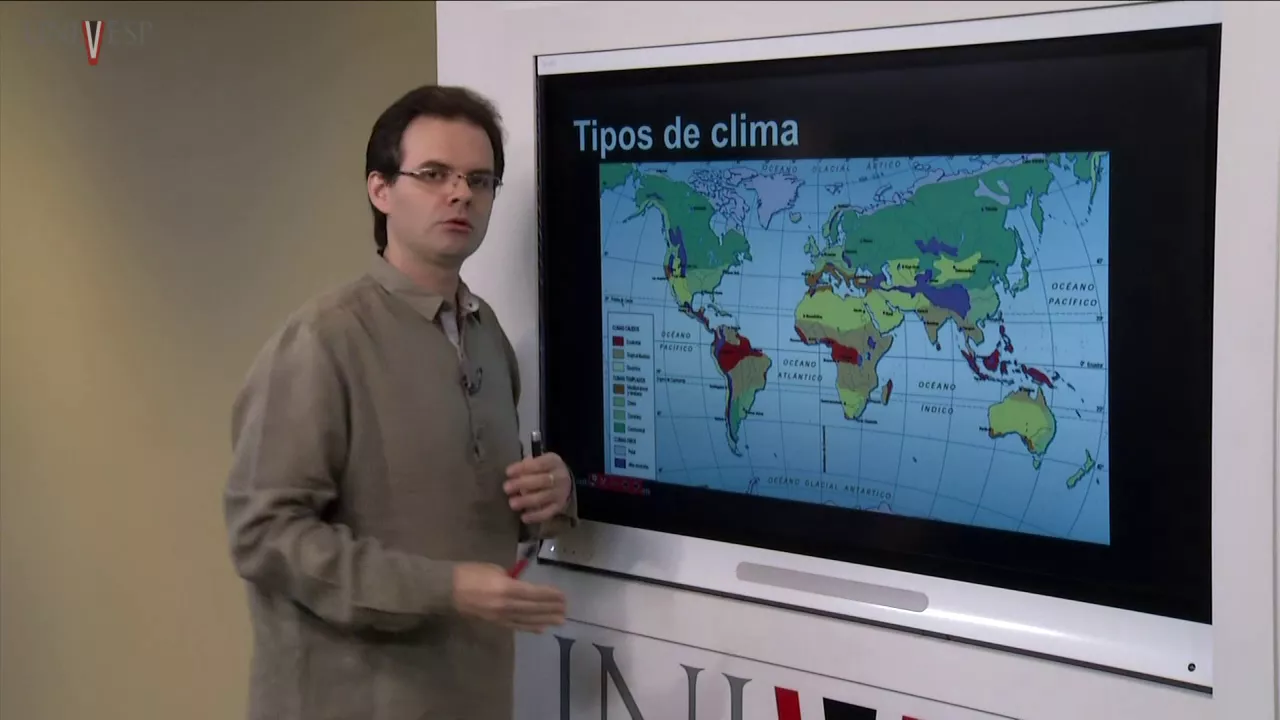
- A global scale animation shows various climatic zones: equatorial tropical humid areas receive high solar radiation leading to abundant rainfall.
Regional Examples
Climate Types and Vegetation Distribution
Overview of Climate Zones
- The discussion begins with an overview of climate types in the Northern and Southern Hemispheres, including Mediterranean, oceanic, continental, cold climates, and their geographical influences.
- It highlights the significance of polar climates and altitude variations in determining local weather patterns.
Solar Radiation Effects
- The animation illustrates how solar radiation impacts climate; it tends to be colder and drier towards the poles while being warmer and more humid near the equator.
- A greater distance for solar radiation to travel in polar regions results in less heat absorption compared to equatorial areas where sunlight is more direct.
Vegetation Distribution Influences
- Climate significantly affects vegetation distribution; temperate and subpolar regions have specific ocean currents and topographical features that support certain plant types.
- Tropical humid climates (between latitudes 30°N and 30°S) foster diverse tropical forests due to ample water availability and suitable temperatures.
Desert Climates
- Deserts are characterized by dry air masses leading to low precipitation levels, extreme temperature fluctuations between day and night, which limits vegetation diversity.
- In contrast, tropical rainforests experience distinct wet seasons followed by dry periods influenced by monsoons.
Altitudinal Gradients in Vegetation
- There is a clear relationship between altitude/latitude gradients affecting vegetation types; higher altitudes typically host specialized species adapted to harsher conditions.
- Examples from Brazil illustrate how altitude influences biodiversity; lower elevations have denser forests while higher elevations may feature herbaceous plants adapted to wind and cold.
Temperature vs. Precipitation Dynamics
- The relationship between temperature and precipitation is crucial for understanding ecosystem dynamics; tropical rainforests thrive under high temperature/precipitation conditions while polar regions face extreme dryness.
Understanding Terrestrial Biomes and Climate in Brazil
Overview of Terrestrial Biomes
- The availability of water is crucial for plant development; only highly adapted species thrive in extreme temperature and precipitation conditions.
- Various biomes are identified, including tropical rainforests in the equatorial zone and savannas like Brazil's cerrado, as well as temperate deserts and forests.
Climate Classifications in Brazil
- Brazil features diverse climate classifications, with equatorial climates concentrated in the north, semi-arid regions in the northeast, and tropical climates predominantly found in central Brazil.
- The Atlantic tropical climate influences coastal areas while altitude variations create microclimates within the country.
Influences on Brazilian Climate
- Brazilian climate is influenced by different air masses: equatorial (in summer), tropical continental (central region), and polar atlantic (southern region).
- Seasonal changes are marked by varying impacts from these air masses, particularly during winter when polar air becomes more prominent.
Understanding Climagrams
- Climagrams illustrate local precipitation and temperature variations over a year. They consist of two axes: one for precipitation (left) and one for temperature (right).
- For equatorial climates, there is minimal temperature variation with consistent rainfall throughout the year.
Specific Climate Examples
- The semi-arid northeastern region experiences low precipitation but has slight temperature variation; this leads to unique adaptations among local flora.
- In contrast, the subtropical south shows significant winter temperature drops due to polar influences, resulting in distinct seasonal patterns.
Seasonal Variations Across Regions
- Tropical climates exhibit pronounced seasonal changes with notable differences between summer (influenced by equatorial mass) and winter (polar mass effects).
- Coastal areas experience higher water availability mid-year while showing less temperature fluctuation compared to inland regions.
Conclusion on Climate Distribution
- Understanding how precipitation and temperature interact across various regions helps clarify Brazil's complex climatic landscape.
Climate Domains and Ecosystems in Brazil
Overview of Climatic Domains
- The discussion begins with a comparison of Brazil's climatic domains, highlighting the distribution of vegetational climates across the country.
- In the northern Amazon region, the equatorial climate predominantly supports the Amazon rainforest, aligning with its climatic conditions.
- The central region features a tropical climate, while southern areas exhibit colder climates characterized by grasslands (pradarias).
- The Atlantic Forest domain is primarily found along the coastal regions where the Atlantic tropical climate prevails.
Influence of Climate on Ecosystems
- Atmospheric, geophysical, and geographical factors play crucial roles in determining climate and subsequently influence ecosystem types distributed globally.
- The characteristics of climate are pivotal in shaping physical conditions that determine various ecosystems' existence and dynamics.
Understanding Brazilian Ecosystems
- The relationship between climatic domains and vegetation distribution aids in comprehending Brazil's diverse ecosystems.