How Does a Waterjet Work? Waterjet 101
Welcome and Overview
In this section, the speaker introduces the topic of a Question and Answer session about the Flow Mach 500 water jet machine.
Introduction to Water Jet Cutting
- The water jet machine operates by boosting tap water through a pump, mixing it with abrasive material, and then cutting various materials with CNC control.
Installation Process of the Machine
- The machine arrived on a semi-truck in multiple boxed components, including tank halves, gantry supports, garnet hopper, and an intensifier pump.
- Installation involved bolting together components using gaskets and rubber pieces to prevent damage from the high-pressure water jet.
Water Usage and Intensifier Pump
This section delves into the water usage of the machine and explains the functioning of the intensifier pump.
Water Consumption and Pump Operation
- The machine uses around five gallons per minute from a building's water line but has a capacity for up to 15 gallons per minute.
- The intensifier pump operates at 94,000 psi with a hydraulic system that pressurizes water for cutting purposes efficiently.
Maintenance of Intensifier Pump
- Rebuilding the intensifier pump takes about an hour and a half after approximately four to five hundred hours of operation.
- The speaker attended a class to learn how to rebuild the pump independently for cost-effective maintenance in-house.
Hydraulics System and Garnet Usage
This part focuses on the hydraulics system within the machine as well as the importance of garnet in water jet cutting.
Hydraulics System Functionality
- A coolant system keeps the hydraulic pump cool while ensuring that clear, clean water is always supplied to the intensifier pump for optimal performance.
- Water travels through hard lines into flexible tubing (whip stand) following specific paths within the machine for effective cutting operations.
Role of Garnet in Cutting Process
- Garnet serves as an abrasive mineral essential for erosion during cutting processes when combined with high-speed water jets.
- Increasing garnet usage can enhance cutting speed significantly by accelerating erosion on materials being cut by the machine.
Detailed Overview of Waterjet Machine Operation
In this section, the speaker provides a detailed explanation of how a waterjet machine operates, focusing on the handling and usage of garnet in the process.
Garnet Handling and Usage
- Garnet bags are typically 55 pounds each and priced between four to seven dollars per bag, depending on quantity.
- The garnet is poured into a hopper to feed the waterjet machine.
- The hopper can hold up to 800 pounds of garnet and has a sensor that alerts when levels are low.
- A diaphragm inside the hopper controls garnet flow based on air pressure from an air compressor.
Garnet Flow in the Machine
- Garnet flows through a hose into the machine via vacuum and air pressure, controlled by a metering disk.
- The metering disk regulates garnet flow to match material thickness for optimal cutting performance.
Garnet Reusability and Disposal
- While some machines can recycle garnet by separating impurities, it's mostly not reusable due to contamination during cutting.
- Methods for removing used garnet include manual shoveling or using specialized equipment like augers or vacuum systems.
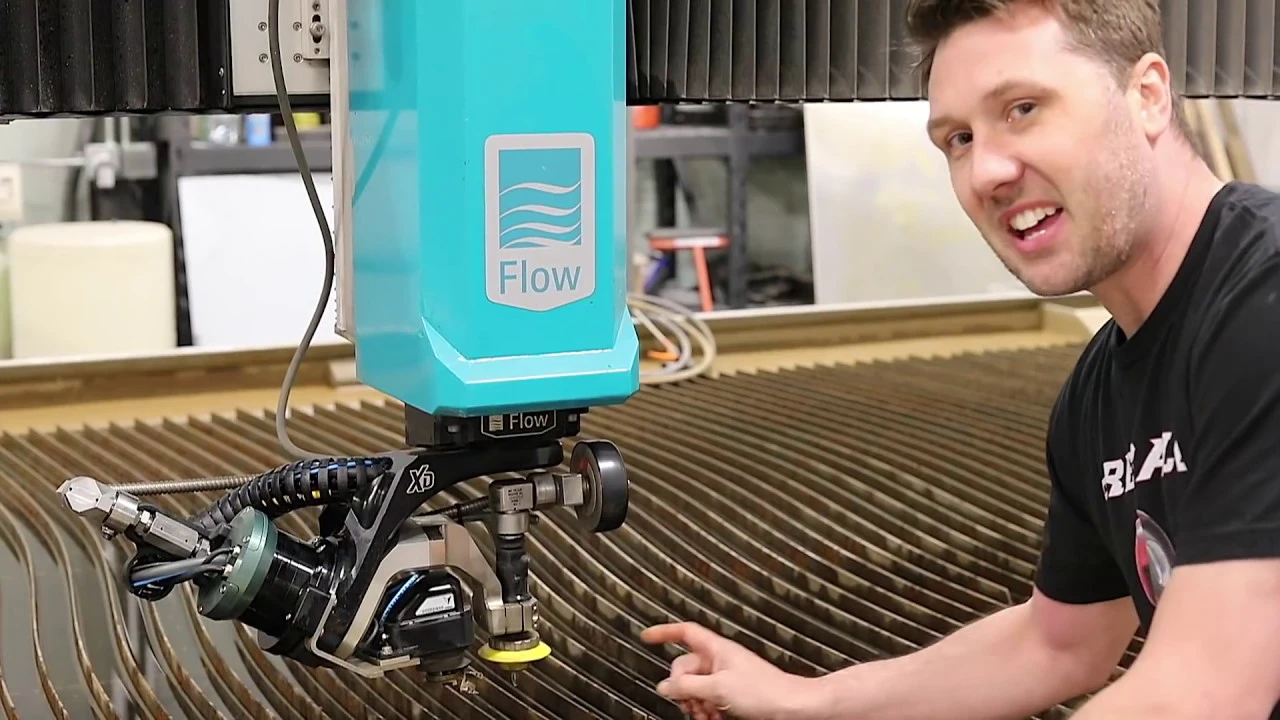
Functionality of XD 5 Axis Head in Waterjet Cutting
This part delves into the features and benefits of the XD 5 Axis Head attachment used in waterjet cutting processes.
XD 5 Axis Head Features
- The XD 5 Axis Head allows for cutting at various angles up to 60 degrees, enhancing flexibility in cutting operations.
- An additional accessory called "compass" aids in nozzle positioning to prevent collisions with workpieces during cutting.
Taper Compensation and Nozzle Design
- The five-axis head compensates for taper caused by water jetting, ensuring precise cuts without angular deviations.
- A blast shield attached to the nozzle helps contain spray during high-pressure cutting operations for safety and efficiency.
Water Jet Cutting Process Overview
In this section, the speaker explains the water jet cutting process and its components.
Components of Water Jet Cutting
- The orifice in the head creates pressure similar to holding a thumb over a hose end. There is a space between the diamond orifice and the mixing tube, causing a vacuum that can suck garnet into the chamber.
- An air actuator controls water flow to the nozzle through an air-controlled plunger. Higher water pressure aids in cutting by assisting with garnet consumable but doesn't necessarily mean faster cutting times.
Benefits of Water Pressure and Garnet Usage
- Water pressure helps with cutting by aiding garnet, which acts as an abrasive for cutting rather than direct cutting action. Adjusting water pressure allows for cutting various materials, from food to metal, with different thicknesses efficiently.
- Evolution of water jet machines has seen increasing pressures (e.g., 94k psi) for better efficiency and reduced garnet consumption during cutting processes. The machine's versatility allows for adjusting surface finishes based on speed variations.
Versatility and Material Handling
This part delves into the versatility of water jet machines in handling various materials and surfaces.
Versatility in Cutting
- Water jet machines can cut through diverse materials like metal, food products (e.g., chicken nuggets), and thick steel up to an inch and a half thick plate efficiently. Adjusting machine speed enables control over surface finish quality during cuts.
- The machine's capability extends beyond solid pieces; it can cut stacked sheet metals effortlessly without being limited by material thickness, showcasing adaptability in material processing tasks.
Material Handling Tools
Setting Up the Water Jet Machine
In this section, the speaker explains the process of setting up a water jet machine, including powering it on and navigating the control panel to select programs for cutting different materials.
Powering On and Control Panel Setup
- The first step in the morning is to turn on the main power to the pump and then activate power on the control panel.
Software Programs Selection
- Two main software programs are used: Flow Path for design and drawing, and Flow Cut for controlling machine movements.
Setting Parameters for Cutting
- After drawing a shape, parameters such as material type (e.g., mild steel), thickness, and cut speed percentage are selected.
Initiating Machine Run
- Running the machine involves ensuring all axes are functional before starting cutting operations.
Testing Garnet Flow and Initial Cutting
This part covers testing garnet flow by listening to its sound barrier breakage when mixed with water. It also demonstrates making an initial cut using different cut qualities.
Testing Garnet Flow
- To ensure proper garnet flow, an audible test is conducted by turning on water first followed by abrasive.
Finding Home Position
- The process involves positioning the workpiece, lowering the cutting head close to the surface, zeroing it, and setting it as home position.
Making Initial Cuts
- After setup, cuts are made at various cut qualities (20%, 40%, 60%, 80%, 100%) to observe differences in finish.
Cutting Different Materials with Varying Cut Qualities
This segment showcases cutting a rectangle at different cut qualities (20% vs. 100%) to compare finishes across materials like mild steel.
Demonstrating Cut Qualities
- Cuts at varying percentages show differences in finish quality from smooth (20%) to rougher textures (60%).
Cutting an Elliptical Shape with Precision
The speaker demonstrates cutting a 45-degree chamfer on both the outside and inside of a quarter-inch plate using a machine, highlighting the precision and complexity involved in replicating such shapes manually.
Cutting Process Insights
- The 45-degree chamfer on the elliptical shape of the quarter-inch plate showcases the intricate detailing that would be challenging to replicate without specialized machinery.
Innovative Cutting Techniques for Enhanced Precision
Exploring innovative cutting techniques to ensure precision and avoid trapping parts during the cutting process.
Upside-Down Cutting Technique
- Cutting the part upside down prevents trapping during the process, showcasing a strategic approach to maintaining precision.
Versatility and Efficiency of Water Jet Cutting
Discussing the efficiency and versatility of water jet cutting technology compared to other methods like laser or plasma cutting.
Machine Versatility
- Demonstrates how water jet cutting offers high precision without trapping parts, emphasizing its efficiency over traditional methods like laser or plasma cutting.
Utilizing Water Jet for Production and Prototyping
Highlighting the diverse applications of water jet technology for production runs and prototyping purposes.
Diverse Applications