Rocas sedimentarias - 1ESO
Rock Cycle and Sedimentary Rocks Characteristics
Introduction to the Rock Cycle
- The video concludes a series on the rock cycle, focusing on sedimentary rocks and their characteristics.
- All surface rocks interact with the atmosphere, biosphere, and hydrosphere, leading to destabilization of minerals through weathering.
Weathering Processes
Physical Weathering
- Physical weathering causes fragmentation of rocks, increasing surface area; in cold climates, water freezes in cracks, expanding and widening them.
- In hot climates, temperature fluctuations cause minerals to expand and contract, leading to breakage over time.
Chemical Weathering
- Chemical weathering occurs in humid climates where water induces dissolution or hydration processes in minerals.
- An example includes limestone reacting with dissolved carbon dioxide in water.
Biological Weathering
- Biological weathering results from plant roots acting as wedges or chemical reactions from bacteria or lichens that increase acidity.
Erosion Process
Mechanisms of Erosion
- Following weathering at high altitudes, erosion mobilizes fragments for transport by ice, water, or wind.
- Water's speed increases after heavy rains on slopes; it can carry larger fragments compared to wind which mainly moves smaller particles.
Role of Vegetation
- Vegetation reduces erosion by stabilizing soil and slowing down currents that could otherwise displace sediments.
Transportation and Deposition of Sediments
Factors Influencing Transport
- Gravity plays a crucial role in transporting eroded materials downhill; ice has greater transport capacity than water which is more effective than wind.
Sediment Deposition
- When currents slow down (e.g., after rain), sediments settle into layers known as deposits. These are often found at lower altitudes like river deltas or beaches.
Formation of Sedimentary Rocks
Compaction and Cementation
- Over time, sediments accumulate in sedimentary basins under pressure from upper layers. This compacts them while mineral-rich water acts as a cement between particles.
Analogy for Understanding
- A comparison is made between loose gravel (like almonds without honey) versus compacted sedimentary rock (like nougat where honey binds almonds).
Classification of Clastic Rocks
Types Based on Fragment Size
Types of Rocks and Their Formation
Conglomerates and Breccias
- Rocks formed from fragments larger than 2 cm are called conglomerates, which can be either rounded clasts (puddingstone) due to long transport or angular clasts (breccia) from shorter transport.
Chemical Sedimentary Rocks
- Chemical sedimentary rocks originate from the precipitation of dissolved salts in water, often triggered by changes in temperature or other conditions, leading to formations like limestone.
Organic Sedimentary Rocks
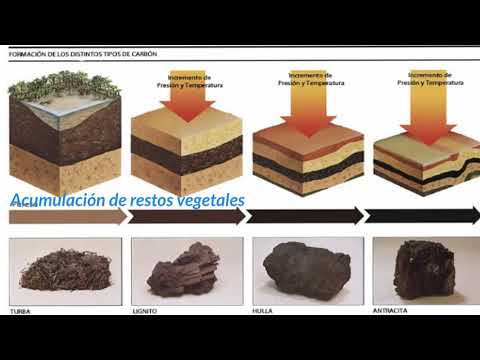
- Organic sedimentary rocks form from the accumulation of shell fragments or decomposed organic matter in anoxic environments, such as marshes or deltas, eventually transforming into coal or petroleum.
Stratification in Sedimentary Basins
- Over extensive periods, sediments accumulate in layers known as strata. The oldest sediments lie at the bottom while newer ones are deposited on top, preserving a chronological record of geological history.
Fossilization Process
- Fossils are created when living organisms' remains become buried by sediments and transform into rock through lithification processes, preserving their shape within the sedimentary rock.
Deformation of Sedimentary Rocks
Tectonic Forces and Folding
- Initially horizontal strata can become folded due to tectonic forces. This folding results in structures like anticlines (upward folds with older materials at the core) and synclines (downward folds with younger materials).
Components of Folds
- Key parts of a fold include:
- Hinge: Line connecting points of maximum curvature.
- Flanks: Lateral sides of the fold.
- Nucleus: Innermost area of the fold.
- Bedding Angle: Angle between flanks and horizontal ground.
Faulting Mechanisms
Types of Faults
- A fault occurs when there is a fracture followed by displacement. Different types include:
- Reverse Fault: Occurs under compressive forces where one block rises over another.
- Normal Fault: Happens under extensional forces where one block sinks relative to another.
- Transform Fault: Results from lateral movement along parallel planes.
Characteristics of Faulting
- Important aspects include:
- Fault Plane: Surface where rupture occurs.
- Displaced Blocks: Sections that have moved along the fault plane.
- Fault Jump: Vertical measurement of displacement between blocks.
Ciclo de las Rocas ¿Cómo se transforman las rocas?
Procesos de transformación de las rocas
- El ciclo de las rocas describe cómo las rocas en la superficie son sometidas a procesos externos que generan sedimentos, los cuales se acumulan y forman rocas sedimentarias en cuencas sedimentarias.
- A medida que los sedimentos se acumulan, los estratos más antiguos pueden hundirse profundamente. Este hundimiento, junto con procesos tectónicos, incrementa la presión y temperatura sobre las rocas.
- Las altas temperaturas pueden fundir algunas rocas, generando magma. Además, las rocas cercanas a la cámara magmática sufren metamorfismo debido al intenso calor.
- El enfriamiento del magma puede ocurrir dentro de la tierra o tras una erupción volcánica, resultando en la formación de roca ígnea.