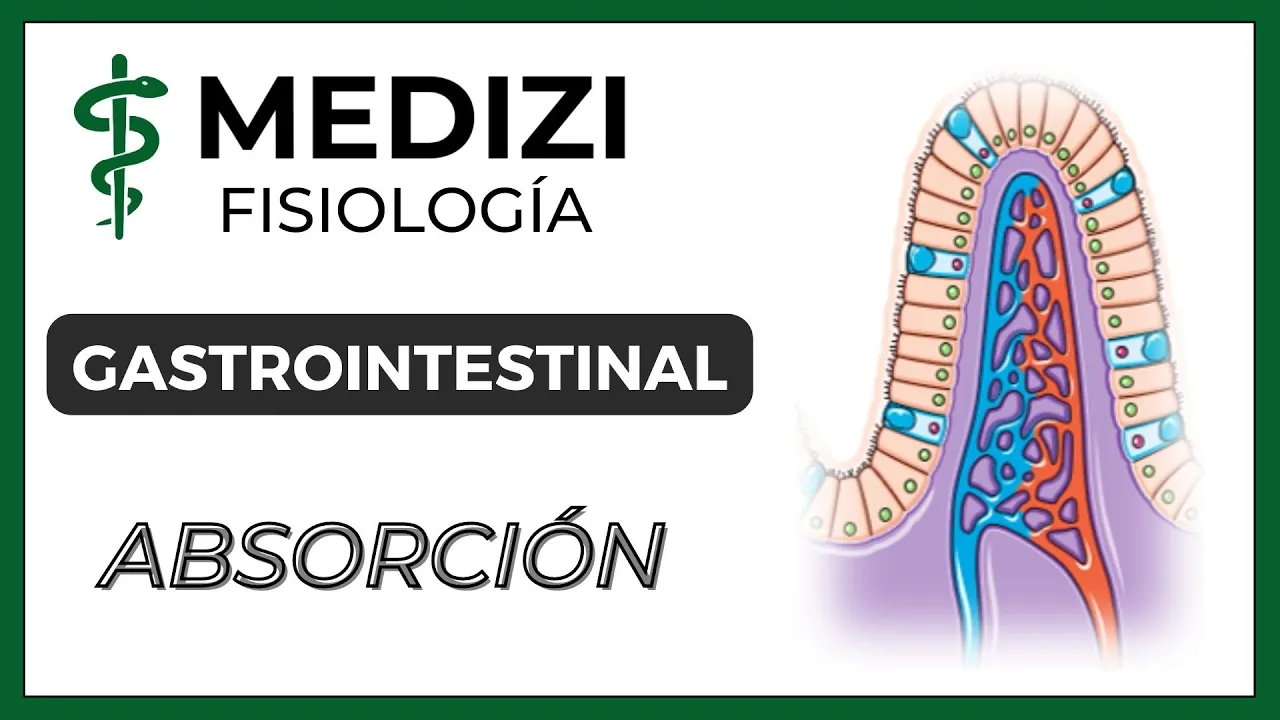
Clase 54 Fisiología Gastrointestinal - Absorción en el tubo digestivo (IG:@doctor.paiva)
Absorption in the Digestive Tract
In this section, the speaker delves into the topic of absorption in the digestive tract, focusing on generalities and specifics related to water absorption, ion absorption, nutrient absorption, and secretion of fluids.
Absorption Overview
- The digestive system absorbs around 8 to 9 liters of liquid daily, with most of it being absorbed in the small intestine. Only about 100 ml reaches the large intestine due to high absorption rates.
- The stomach has low absorptive capacity due to tight epithelial junctions. It primarily absorbs liposoluble substances like alcohol.
- Understanding absorption requires knowledge of intestinal epithelium structure. Villi and microvilli increase surface area for nutrient contact with mucosa.
- Villi are prominent in the duodenum and ileum, extending up to 8 mm into the lumen. They contain villi with crypts that enhance absorption by increasing surface area.
Microscopic Structures for Absorption
- Villi contain microvilli that protrude about 1 mm into the lumen, amplifying absorptive area by tenfold.
- Microvilli have brush border composed of microvilli extensions that further increase absorptive surface by twentyfold.
- These structures collectively amplify small intestine's absorptive surface to nearly 250 square meters, crucial for efficient nutrient uptake.
Osmosis and Nutrient Absorption
This part explores osmosis as a key mechanism for water absorption in the intestines and details nutrient absorption capacities of both small and large intestines.
Nutrient Absorption Capacities
- The small intestine can absorb hundreds of grams of carbohydrates, fats, amino acids, minerals, and several liters of water daily.
- Its maximum capacity allows for even higher intake levels: kilos of carbohydrates, significant fat amounts, substantial protein quantities, and over 20 liters of water per day.
Osmosis Mechanism
- Osmosis involves solvent movement through a semipermeable membrane from lower solute concentration to higher concentration regions.
Osmosis and Absorption in the Intestine
In this section, the speaker discusses osmosis and absorption processes in the intestine, focusing on solute concentrations and water movement to equalize osmolarity.
Understanding Osmosis
- Osmosis is defined as the movement of solvent from an area of lower solute concentration to an area of higher solute concentration.
Examples and Types of Solutions
- Different types of solutions are explored: hypotonic, isotonic, and hypertonic, based on varying solute concentrations affecting water movement through osmosis.
Role of Water Absorption
- Water absorption occurs through osmosis, driven by differences in solute concentrations between compartments like blood and intestines.
Sodium Absorption Mechanisms
This section delves into the mechanisms behind sodium absorption in the intestine, detailing transporters and gradients involved.
Sodium Transport Processes
- The sodium-potassium ATPase pump facilitates active transport of sodium ions out of cells, maintaining cellular gradients crucial for absorption processes.
Specific Transport Proteins
- Various proteins such as sodium-glucose cotransporter aid in absorbing sodium along with other substances like glucose through secondary active transport mechanisms.
Chloride Absorption and Hormonal Regulation
The discussion shifts to chloride absorption mechanisms influenced by electrical gradients and hormonal regulation involving aldosterone.
Chloride Absorption Pathways
- Chloride absorption occurs passively due to electrical gradients created by sodium movements. Additionally, chloride exchange mechanisms further regulate its absorption in different intestinal segments.
Aldosterone Function
- Aldosterone release during dehydration enhances sodium, chloride, and water reabsorption via stimulating specific pumps like the sodium-potassium ATPase pump at the basolateral membrane.
Absorption and Transport Processes in the Digestive System
In this section, the absorption and transport processes of various nutrients in the digestive system are discussed, focusing on key elements such as potassium, sodium, bicarbonate, calcium, iron, carbohydrates, proteins, and fats.
Absorption of Potassium
- Potassium absorption occurs in the jejunum and ileum through passive transport across cell membranes.
Sodium-Potassium Pump Function
- The sodium-potassium pump plays a crucial role in reabsorbing sodium and secreting potassium. This function is particularly vital in the kidneys.
Bicarbonate Absorption Mechanism
- Bicarbonate absorption involves a unique process where hydrogen ions combine with bicarbonate from secretions to form carbonic acid. This acid dissociates into water and CO2.
Active Bicarbonate Ion Transport
- Active transport of bicarbonate ions involves their conversion to carbonic acid and CO2 through reactions that act as buffers within the body.
Calcium and Iron Absorption
- Vitamin D and parathyroid hormone (PTH) play essential roles in actively absorbing calcium. Iron is also absorbed actively by binding to apotransferrin.
Nutrient Absorption Processes Continued
Continuing from the previous discussion on nutrient absorption mechanisms, this section delves into the active absorption of potassium, magnesium, phosphate, carbohydrates, proteins, and fats.
Active Nutrient Absorption
- Potassium, magnesium, phosphate are absorbed actively; monovalent ions like sodium are absorbed more easily than divalent ions like calcium due to differing bodily requirements.
Carbohydrate Absorption
- Carbohydrates are primarily absorbed as glucose (80%) with smaller amounts as galactose and fructose. Glucose is predominantly absorbed along with sodium.
Protein Absorption
- Proteins are mostly absorbed as dipeptides or tripeptides via co-transport with sodium. A minority is transported independently of sodium through specific carriers.
Fat Absorption Process
This segment focuses on fat absorption mechanisms involving micelles formation for lipid uptake and chylomicron synthesis for fat transportation.
Fat Uptake Mechanism
- Fats are absorbed through micelles formed by bile salts. Chylomicrons composed mainly of triglycerides facilitate fat transport after binding to apoprotein B.
Lymphatic Fat Transport
- Chylomicrons enter lymphatics for eventual release into venous circulation via thoracic duct; short-chain fatty acids may directly enter blood circulation due to high solubility.
Digestive System Functions and Composition
In this section, the speaker discusses the functions and composition of the digestive system, focusing on the intestino abrozo's capacity for absorption and the role of bacteria in digestion.
Intestino Abrozo Absorption Capacity
- The intestino abrozo can absorb 5 to 8 liters of liquids and electrolytes per day.
- Bacteria in the colon, particularly vacilos, aid in digesting cellulose.
- Bacterial activity in the colon helps form essential vitamins like K, B12, B1, and B2.
Composition of Feces
This part delves into the composition of feces, highlighting its water content, solid matter components, and bacterial presence.
Fecal Composition
- Feces are composed of 75% water and 25% solid matter.
- Solid matter includes dead bacteria (30%), undigested products (30%), dry digestive juice components (pigments), fats (10-20%), inorganic matter (10-20%), and proteins (2-3%).
Characteristics of Fecal Matter
The discussion centers on factors influencing fecal characteristics such as color, odor, and composition.
Fecal Matter Characteristics
- The brown color of feces is due to stercobilin and urobilin derived from bilirubin metabolism.
- Unpleasant odor results from bacterial action producing indole, skatole, mercaptans, and hydrogen sulfide.
Secretion and Absorption in Digestive Tract
This segment explores secretion and absorption processes within the digestive tract concerning daily intake volumes.
Secretion & Absorption Processes
- Daily intake: 1500 ml ingested; saliva secretes 1000 ml; gastric secretion releases 1500 ml; pancreatic secretion contributes 1000 ml; bile secretion adds another volume.
- Total secretions with digestion amount to 8000 ml entering the small intestine for absorption.
Reabsorption Process in Intestine
Focus shifts to reabsorption mechanisms within the intestine involving water retention through sodium chloride reabsorption.
Reabsorption Mechanisms
- In the small intestine: absorbs 6500 ml out of initial 8000 ml intake.
- Sodium chloride reabsorption facilitates water reabsorption primarily by osmosis.