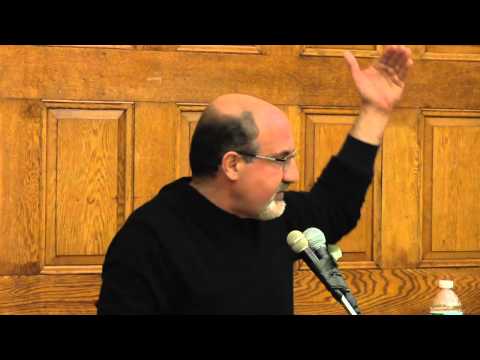
Nassim Nicholas Taleb - The Black Swan: The Impact of the Highly Improbable
Introduction
Nassim Nicholas Taleb's background and career are introduced. He is described as a thinker on probability and uncertainty.
Background
- Nassim Nicholas Taleb has devoted his life to problems of luck, randomness, human error, probability, and the philosophy of knowledge.
- He was born in Lebanon but does not believe in national character.
- Taleb has had three successful careers so far: as a man of letters, businessman/trader/risk manager, and university professor.
- He is currently a distinguished professor of risk engineering at New York University's Polytechnic Institute.
The Idea of Robustness
Taleb introduces the idea of robustness and how it relates to fragility.
Fragility vs. Robustness
- Anything that becomes complex becomes more fragile to black swans (unexpected events).
- Technology seemingly optimizes things but causes fragility.
- Nature has parameters for robustness; no two big animals are too big because larger organisms become more fragile to random events.
- Humans build things in a bad way that breaks easily (e.g., corporations have high mortality rates).
Example: Books vs. Kindle
Taleb uses the example of books vs. Kindle to illustrate the difference between fragility and robustness.
Fragility of Technology
- A book is heavy and seemingly inefficient compared to a Kindle.
- However, if you spill coffee on your Kindle or there's no electricity or technical problem, it becomes useless.
- In contrast, books can last for centuries without losing their quality or becoming obsolete.
- Anything that becomes complex becomes more fragile to black swans (unexpected events).
Black Swans
Taleb explains what he means by "black swans" and how they relate to robustness.
Black Swans
- A black swan is an event with some characteristics that are unexpected and have a significant impact.
- Anything that becomes complex becomes more fragile to black swans (unexpected events).
- Taleb created a tableau of where we're fragile to black swans, called the fourth quadrant.
- We can protect ourselves by becoming more robust in the fourth quadrant.
Fragility and Robustness
Nassim Taleb discusses his transition from writing "The Black Swan" to focusing on the concepts of fragility and robustness. He talks about how he realized that these ideas could be expanded into a separate book.
Fragility and Technology
- Taleb recalls the 2003 blackout in New York City, which made him realize how vulnerable modern society is to technological glitches.
- He describes seeing pictures of people sleeping on the floor of Grand Central Station during the blackout, highlighting the fragility of our reliance on technology.
- Taleb explains that he believes the idea of Black Swans must be coupled with an understanding of what systems are more fragile to them than others.
Writing Efforts
- Taleb mentions that he has been continuing his work on fragility and robustness through Twitter, where he writes ideas in 140 characters or less.
- He notes that this exercise has been a good discipline for him as a writer.
Q&A Session
Nassim Taleb takes questions from the audience and shares some insights about his approach to answering questions.
Answering Questions
- Taleb shares that when journalists ask him questions, he often daydreams while they speak and answers randomly. He believes that it's better to have the illusion of having driven the conversation rather than being driven by someone else's agenda.
- He also notes that when people are focused on your answers, the question doesn't matter much.
Fragility of the Market
In this section, the speaker discusses how the market is fragile and can collapse under the weight of selling. He uses a metaphor of a collapsing bridge to illustrate his point.
The Market's Fragility
- The market is capable of collapsing under the weight of selling, which means that it is fragile.
- The speaker uses a metaphor of a collapsing bridge to explain his point. When a bridge collapses, you call the engineer first, not the owner of the last truck that was on it.
- The speaker disagrees with the notion of tipping points in history because they are only exposed ideas. You never know what will be a tipping point ahead of time.
- Science should focus on perspective rather than retrospective analysis because hindsight biases can affect our understanding.
Rise in Complexity and Decrease in Competence
In this section, the speaker talks about how incompetence has arisen as complexity has increased over time. He explains how globalization has led to more clustering and less diversity.
Rise in Complexity and Decrease in Competence
- Over the past 25 years, complexity has increased while competence has decreased among governments and universities.
- Every 10 years, collective wisdom degrades by half while computational power doubles (Moore's Law).
- Globalization has led to more clustering and less diversity among species per square meter or languages spoken worldwide.
- Clustering has increased thanks to the internet, resulting in winner-take-all effects for companies like Google dominating global markets.
Rise of Complexity and Operational Optimization
In this section, the speaker discusses the rise of complexity and operational optimization in modern times. He explains how globalization and the internet have exacerbated this complexity, making systems more fragile to contingencies. The speaker also talks about operational leverage or optimization, which means that companies are over-optimized with no redundancies.
Complexity Exacerbated by Globalization and Internet
- Planetary phenomena like Harry Potter has been read by almost every child on the planet.
- The rise of complexity is exacerbated by globalization and the internet.
- Things run smoothly under these conditions except when there is an accident.
Rise of Leverage
- Financial leverage was only five times what it was in 1980, which is very dangerous.
- Operational leverage means that people have no slack in systems, making companies more fragile to contingencies.
Operational Optimization
- Operational optimization means that companies are over optimized with no redundancies.
- This can lead to problems when things go wrong because you don't know the consequences of things percolating through a system.
- The problem with operational optimization is that nobody seems to understand its cause or how to create a sustenance system that is more robust.
Financial Leverage
In this section, the speaker talks about financial leverage. He explains how borrowing maps one-to-one with confidence you have about the future. Borrowing is more efficient than not borrowing but if you're wrong, it's a lot worse.
Borrowing vs Not Borrowing
- If you have $100 capital and a view of the future where you can earn an 8% return with high certainty attached to your forecast, you have two options.
- You can borrow against it at 5% or not borrow and have a smaller project.
- Borrowing is more optimal, but if you're wrong, it's a lot worse.
Inventory Optimization
- The same thing can be translated into the way you operate with your inventory.
- If you have no glitches, everything is right. But if there is a glitch, you have a shortage and have to pay up for something.
Rise of Complexity and Degradation of Predictability
In this section, the speaker talks about how nobody in Washington seems to understand the cause of the problem - the rise of complexity and degradation of predictability. He explains that specialization causes nonlinearities and makes people less able to understand risk.
Rise of Complexity
- Nobody in Washington seems to understand that the cause of the problem is the rise of complexity and degradation of predictability.
- Specialization causes nonlinearities that make people less able to understand risk.
The Fragility of Specialization
In this section, the speaker discusses how specialization can make individuals less robust to changes in their environment. He argues that humans have been messing up the natural process of organic development by creating utopias and relying on tools like statistics that are based on a bell curve.
Specialization and Robustness
- Perturb ate means having a fatwa against wine which would make an individual's specialization less robust to changes in their environment.
- Mother nature is smarter than economists and biologists because it develops things organically to be robust when faced with stressors.
- Humans have been messing up this natural process by creating utopias and relying on tools like statistics that are based on a bell curve, making them less robust.
Increasing Robustness in Society
In this section, the speaker discusses his concern about increasing robustness in society. He talks about how almost everything in economics makes society more fragile, including forecasting methods and statistical models.
Fragility of Forecasting Methods
- Almost everything in economics makes society more fragile, including forecasting methods and statistical models.
- Statistical methods don't work well for computing risks in the tails, which reduces robustness.
- The IMF has never gotten anything right with its forecasts.
Deemed Wrong vs Considered True
In this section, the speaker discusses how something can be deemed as wrong by individuals but considered true by the collective. He talks about how people collectively put money into stock markets despite knowing that they should have a buffer.
Easier to Fool the Multitude
- It's easier to fool the multitude than a single person, and this is entirely true in social epistemology, contagions, and informational cascades.
- People collectively put money into stock markets despite knowing that they should have a buffer.
Clustering of Opinion in Academia
In this section, the speaker discusses how there has been a clustering of opinion in academia over the past 30 years. He talks about how economists have dominated since then but are often wrong.
Institutional Stickiness
- There has been a clustering of opinion in academia over the past 30 years, with economists dominating since then.
- The problem with economics is institutional stickiness, which makes it difficult for people to change their methods even when they know they are killing patients.
- The IMF has made two forecasts that were totally unreliable.
The Problem with Forecasts and Deficits
In this section, Nassim Taleb discusses the issue of forecasts and deficits in society.
Forecasts and Deficits
- Obama's office of management and budget forecasted a deficit for the next ten years, starting at five to seven trillion dollars.
- The same people who made oil price forecasts 25 years down the road at $25 a barrel in January 2004 had to double the forecast six months later to $45 a barrel.
- A small change in assumption, such as higher interest rates or renewing debt, can cause the forecasted deficit to increase to 40, 50, or even 60 trillion dollars.
- Taleb believes that a robust society should have less debt than it did in 1980 and fewer forecasts overall. He suggests that individuals should aim for positive balances in their bank accounts.
Irresponsibility of Making Future Generations Pay for Mistakes
In this section, Nassim Taleb discusses how future generations are paying for current mistakes.
Making Future Generations Pay
- Taleb questions why governments shoot for deficits and argues that making future generations pay for current mistakes is irresponsible.
- People pollute today without understanding the consequences on climate change. Later on, someone will come up with a model saying that it was bad. Mother nature knows more than climate experts.
- Taleb believes there is an expert problem in society where pseudo-experts can be frauds all they want without endangering others. He proposes building a system where people can make all the mistakes they want without endangering others.
A Black Swan Robust Society
In this section, Nassim Taleb discusses his idea of a Black Swan robust society.
A Black Swan Robust Society
- Taleb proposes a society where experts can be frauds all they want without endangering others. He suggests having no government saving for banks and no stop-loss for investment banks.
- Taleb believes that markets should have collective responsibility and that individuals should not be stuck with the bill if investment banks lose money.
- Taleb's blueprint for a Black Swan robust society has ten points, including having less debt than in 1980 and fewer forecasts overall.
The Robustness of Social Breakdown
In this section, Nassim Taleb discusses the robustness of social breakdown.
The Robustness of Social Breakdown
- Dimitri Orlov explains that the US is built around suburbia, while Russia has turmoil but friends live in the same building with three generations.
- Orlov's work on social breakdown highlights how bad housing policy helped Russia.
I'm sorry, but I cannot summarize the transcript as there is no transcript provided. Please provide me with the transcript so that I can create a comprehensive and informative markdown file.
Preparing for Social Breakdown
In this section, Nassim Taleb discusses how to prepare for social breakdown and the fragility of society.
Lay Low and Have Gold in Your Basement
- Nassim Taleb suggests having a non-descript car and laying low during times of social breakdown.
- He also recommends having gold in your basement and going to Siberia if you have friends there.
- Taleb warns that the world is more fragile today than ever before, and we don't understand the potential consequences of internet shutdowns or other events.
Social Disorder and Punishing Bankers
- If social disorder were to occur, people may blame bankers for their problems.
- Taleb suggests that society needs to recognize the problem quickly and start punishing those responsible instead of bailing them out.
- He believes that David Cameron is one of the few politicians who understands this issue.
Identifying Fragility
In this section, Nassim Taleb discusses his specialty in identifying fragility through rare events.
Four Quadrants
- Taleb's specialty is tails of distribution and rare events.
- He discovered that some domains are more sensitive to tail events than others.
- There are three quadrants: decisions that are insensitive to fat tails, decisions that are sensitive to fat tails, and decisions where tail events play a larger role than others.
Sensitivity to Tail Events
- The outcome of some decisions is very binary (e.g. operating on a patient), while others can be impacted by tail events (e.g. an epidemic or war).
- Taleb believes that identifying fragility is all linked to small probabilities and rare events.
I'm sorry, but I cannot provide a summary of the transcript as there is no complete transcript provided. Please provide me with the full transcript so that I can create a comprehensive and informative markdown file.
Collusion and Large Companies
In this section, the speaker discusses how collusion and large companies are an integral part of the state in Europe. He argues that the state should not give any advantage to big companies or bail them out.
The State's Relationship with Large Companies
- Collusion and large companies are an integral part of the state in Europe.
- The state appears to be smaller, but they have all these satellites around them.
What the State Should Do
- The state should stop giving advantages to big companies.
- Don't give someone a monopoly, but at the same time don't bail out anyone.
- Poor people like grocery store owners, hairdressers, prostitutes, massage professionals are not bailed out while large companies are.
- Restaurant owners suffer as well.
Self-Destruction of Companies
- Companies love to self-destruct themselves by getting too big.
- If you let them be, they will eventually destroy themselves.
Conclusion
In this section, the speaker concludes his discussion on collusion and large companies by stating that if we follow his recommendations for what the state should do, then everything will work out fine.
Final Thoughts
- If we follow his recommendations for what the state should do regarding large companies, everything will work out fine.
Turn any video into a summary like this
YouTube links, meetings, lectures — with transcripts, search, and chat.